Linear, Quadratic, and Exponential Models
Functions are a type of mathematical relationship between inputs and outputs. In this guide, you will learn more about the types of functions.

Linear, Quadratic, and Exponential Models: what to notice and how to work it
What to notice first
Common student mistake
Key formulas and cues
A reliable path
- Find the startLook for the value when x or time is 0.
- Find the multiplierUse the base or percent change to identify b.
- Check the shapeGrowth rises away from the asymptote; decay moves toward it.
Worked examples
Growth model
- Start at 100.
- Multiply by 2 three times.
- Compute 100 times 8.
Decay model
- Half of 80 is 40.
- Half of 40 is 20.
- This is multiplying by 1/2 twice.
Try one before moving on
Linear, Quadratic, and Exponential Models: pop-up practice
A step-by-step guide to linear, quadratic, and exponential models
Functions are a type of mathematical relationship between inputs and outputs. The linear, quadratic, and exponential functions are the \(3\) main types of functions.
Linear function:
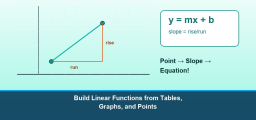
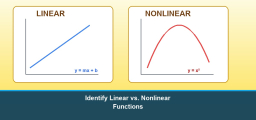
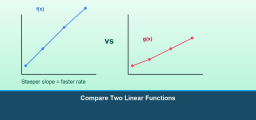
A linear function is a type of function whose highest exponent is \(1\). The standard form of this function is \(y=mx + b\). The graph of the linear function shows a straight line in the coordinate plane.
Quadratic function:
A quadratic function is a polynomial function with one or more variables, where the highest power of the variable is two. Since the highest degree in a quadratic function is of the second degree, it is also called the polynomial of degree \(2\).
The quadratic function, when graphed, makes parabolas. The standard form of a quadratic function is \(f(x) = ax^2+bx + c\), where \(a, b,\) and \(c\) are real numbers with \(a≠0\).
Exponential function:
An exponential function is a function of the form \(f(x)= a^x\), where \(x\) is a variable and \(a\) is a constant, which is called the base of the function and must be greater than \(0\). Exponential function graphs have curves. This curve can be vertical at first and then grow horizontally, or it can be horizontal at first and then become more vertical.


Related to This Article
More math articles
- How to Find Distance and Midpoint of Complex Numbers?
- Smarter Balanced Grade 6 Math Free Worksheets: 72 Printable Standards-Aligned PDFs with Answer Keys
- Smarter Balanced Algebra 1 Free Worksheets: 64 Printable Standards-Aligned Algebra 1 PDFs with Answer Keys
- What Skills Do I Need for the TASC Math Test?
- 7th Grade OST Math Worksheets: FREE & Printable
- Best Blue Light Glasses for Teachers and Students
- Virginia SOL Grade 8 Math Free Worksheets: Printable SOL-Aligned Practice, No Signup Needed
- What Does ALEKS Stand for?
- The Ultimate 6th Grade NDSA Math Course (+FREE Worksheets)
- California CAASPP Grade 7 Math Worksheets: 95 Free Printable PDFs Covering Every Skill







What people say about "Linear, Quadratic, and Exponential Models - Effortless Math"?
No one replied yet.