How to Write Linear Equations From Y-Intercept and A Slope
TL;DR: Think of a linear equation as a clean little description of a straight line. Once you know two things — the slope (call it m) and the y-intercept (call it b) — you can write the whole line in slope-intercept form, y equals mx plus b, in a single move. The slope tells you how steep the line is and which way it tilts; the y-intercept tells you exactly where it crosses the y-axis. Get those two numbers and the equation almost writes itself.
Key takeaways:
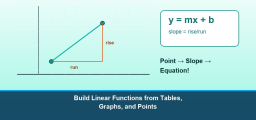
- Slope-intercept form: \( y = mx + b \), where \( m \) is the slope and \( b \) is the y-intercept.
- A positive slope rises left-to-right; a negative slope falls; \( m=0 \) is horizontal; an undefined slope is vertical.
- The y-intercept is the y-value where the line crosses the y-axis (when \( x = 0 \)).
- Given two points, compute slope first with \( m = \dfrac{y_2 - y_1}{x_2 - x_1} \), then solve for \( b \).
- Check your equation by plugging in a known point — both sides should agree.

A slope refers to the steepness of a line, defining its inclination or decline. In a linear equation, it’s denoted by ‘\(m\)’. The slope is calculated by finding the vertical change (rise) ratio to the horizontal change (run) between any two distinct points on the line. In simple terms, slope measures the change in ‘\(y\)’ for a unit change in ‘\(x\)’.
The y-intercept, denoted by ‘\(c\)’, is where the line crosses the \(y\)-axis. Essentially, it’s the \(y\)-coordinate of the point where the line intercepts the \(y\)-axis. In linear equations, the \(y\)-intercept is the value of ‘\(y\)’ when ‘\(x\)’ is zero.
A Step-by-step Guide to Writing Linear Equations From Y-Intercept and A Slope
Step 1: Understanding the Given Values
Firstly, you must comprehend the values given to you. If the slope, ‘\(m\)’, and the \(y\)-intercept, ‘\(c\)’, are given, they directly fit into the standard form of a linear equation.
Step 2: Insert Values into the Equation
The second step is simply to insert these values into the equation. If ‘\(m\)’ equals \(3\) and ‘\(c\)’ equals \(2\), your equation will be \(y = 3x + 2\).
Step 3: Simplify the Equation, if Required
Occasionally, your equation may require simplification. If your slope or \(y\)-intercept is a fraction or includes square roots, simplifying the equation helps improve its readability.
Common Mistakes and Misconceptions
Many learners fall into common pitfalls when dealing with linear equations. Some assume that the y-intercept must always be a positive value, while others confuse the roles of the slope and the y-intercept. Understanding these roles and maintaining careful attention to detail can prevent such misconceptions.
Real-life Applications of Linear Equations: From Economics to Physics
Linear equations are more than mathematical constructs; they have a wide array of applications in real life. Economists use them to predict trends and make decisions, while physicists use them in the study of motion and force. Even in computer science, linear equations help in the design of algorithms and data structures.
Frequently Asked Questions
What is the slope-intercept form of a linear equation?
It’s \( y = mx + b \), where \( m \) is the slope (how steep the line is) and \( b \) is the y-intercept (where the line crosses the y-axis). Once you know \( m \) and \( b \), the equation is done — just drop them in.
How do I find the slope from two points?
Use \( m = \dfrac{y_2 – y_1}{x_2 – x_1} \). For example, between \((1, 2)\) and \((4, 11)\): \( m = \dfrac{11 – 2}{4 – 1} = \dfrac{9}{3} = 3 \). Watch the order — be consistent about which point you call “first.”
How do I find the y-intercept once I know the slope?
Plug the slope and one known point into \( y = mx + b \) and solve for \( b \). If \( m = 3 \) and the line passes through \((1, 2)\): \( 2 = 3(1) + b \), so \( b = -1 \). The full equation is \( y = 3x – 1 \).
What does it mean when the slope is zero?
A slope of zero means the line is horizontal — it doesn’t go up or down. The equation collapses to \( y = b \), a constant. For example, \( y = 4 \) is a horizontal line crossing the y-axis at 4 and staying flat forever.
What about a vertical line — can it be written in slope-intercept form?
No. Vertical lines have an undefined slope because the run is zero, and you can’t divide by zero. A vertical line is written as \( x = a \) (a fixed x-value). For example, \( x = 5 \) is a vertical line through every point with x-coordinate 5.
Walk through a full example — slope 2, y-intercept −3.
Just plug in: \( y = 2x + (-3) \), or cleaned up, \( y = 2x – 3 \). Check: at \( x = 0 \), \( y = -3 \) (matches the y-intercept). At \( x = 1 \), \( y = -1 \), and from there each step right of 1 raises \( y \) by 2 (the slope). The line crosses the x-axis when \( y = 0 \), i.e. \( x = 1.5 \).
How do I tell if two lines are parallel from their equations?
Two non-vertical lines are parallel exactly when their slopes are equal. So \( y = 3x + 1 \) and \( y = 3x – 7 \) are parallel — same slope, different y-intercepts. If the slopes differ, the lines cross at one point.
How do I tell if two lines are perpendicular?
Two non-vertical lines are perpendicular when their slopes multiply to \( -1 \) — i.e. each slope is the negative reciprocal of the other. The line perpendicular to \( y = 2x + 5 \) has slope \( -\dfrac{1}{2} \). One example would be \( y = -\dfrac{1}{2}x + 3 \).
What’s the difference between slope-intercept form and point-slope form?
Slope-intercept form, \( y = mx + b \), is best when you already know the slope and the y-intercept. Point-slope form, \( y – y_1 = m(x – x_1) \), is best when you know the slope and any single point on the line. Both describe the same line; one is easier depending on what you start with.
How do I sketch a line from its slope-intercept equation?
Plot the y-intercept first (the point \((0, b)\)), then use the slope as “rise over run” to find a second point: from the intercept, go up by the numerator and right by the denominator. Draw a straight line through both points and you’re done.
Related Lessons You May Like
- How to find slope
- How to graph linear equations
- How to solve systems of equations
- How to write linear equations
- How to find the equation of a line
If you want a friendly workbook that takes you all the way through slope, y-intercepts, and graphing lines, Pre-Algebra for Beginners covers the topic step by step with worked examples. For a deeper dive into writing and solving linear equations, Algebra I for Beginners builds the same skills with more challenging practice and clear explanations.

Related to This Article
More math articles
- Top 10 Math Books for Grade 5: Cultivating Critical Thinking in Young Mathematicians
- 3D Shapes for 5th Grade: Faces, Edges, and Vertices
- The Best Grade 3 Math Book for Rhode Island Students
- Algebra Puzzle – Challenge 36
- The Mathematics Chances and Odds of CS2 Skins and Cases
- Top 5 PERT Math Study Guides
- FREE 6th Grade NYSE Math Practice Test
- The Best Grade 3 ELA Practice Tests for Nebraska Students
- Fourth Grade Writing: Opinion, Informative, and Narrative Expectations Explained
- A Deep Dive Into the World Derivative of Polar Coordinates











What people say about "How to Write Linear Equations From Y-Intercept and A Slope - Effortless Math"?
No one replied yet.