FREE 7th Grade New York State Testing Program Math Practice Test

TL;DR: Curious where your seventh grader stands for the New York State Math Test? Try this free practice test with 20 real-style questions. The Grade 7 NYSE math test runs across two test days and mixes multiple-choice with short and extended-response items. Calculators are allowed in grade 7. Treat the set as a dress rehearsal, talk through any misses together, and you will know which topics still need more time.
Key takeaways:
- This practice set has 20 questions modeled on the real NYSE (New York State) Grade 7 math test.
- Real Grade 7 NYSE math: about 40-46 questions across two test days.
- Day 1: multiple choice. Day 2: short-response and extended-response problems.
- Calculators ARE allowed at grade 7 (scientific calculator, no graphing).
- 4 performance levels: Level 1 (well below), 2 (below), 3 (proficient), 4 (above).
For this practice test, we’ve selected 20 real questions from past exams for your students’ New York State Testing Program Practice test. Your student will have the chance to try out the most common 7th Grade New York State Testing Program Math questions. For every question, there is an in-depth explanation of how to solve the question and how to avoid mistakes next time.
Use our free 7th Grade New York State Testing Program Math practice tests and study resources (updated for 2026) to help your students ace the 7th Grade NYSE Math test! Make sure to follow some of the related links at the bottom of this post to get a better idea of what kind of mathematics questions students need to practice.
The Absolute Best Book to Ace the 7th Grade New York State Testing Program Math Test
Common Core Math Exercise Book for Grade 7 Student Workbook and Two Realistic Common Core Math Tests
For official information about the test, visit the New York State Education Department website.
10 Sample 7th Grade NYSE Math Practice Questions
1- What is the slope of a line that is perpendicular to the line \(4x-2y=12\)?
A. \(-\frac{1}{2}\)
B. \(-2\)
C. \(\frac{1}{2}\)
D. \(2\)
2- Simplify \(5(x-2y)+(2-x)^2\) when \(x=3\) and \(y=-2\).
A. \(12\)
B. \(24\)
C. \(36\)
D. \(40\)
3- The average of 50 numbers is 88. If a 94 is replaced by a 69, what is the new average?
A. \(85\)
B. \(86.5\)
C. \(87.5\)
D. \(88\)
4- The width of a rectangular box is one-third of its length, and the height of the box is one-third of its width. If the length of the box is \(27\) cm, what is the volume of the box?
A. \(81\) cm\(^3\)
B. \(162\) cm\(^3\)
C. \(243\) cm\(^3\)
D. \(729\) cm\(^3\)
5- In five successive hours, a car travels 40 km, 45 km, 50 km, 35 km, and 55 km. For the next five hours, it travels at an average speed of 50 km per hour. Find the total distance the car traveled in 10 hours.
A. 425 km
B. 450 km
C. 475 km
D. 500 km
6- The ratio of boys to girls in a school is 2:3. If there are 600 students in a school, how many boys are in the school?____________
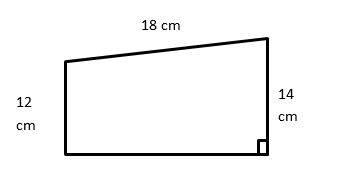
7- The perimeter of the trapezoid below is 54 cm. What is its area? _________
8- In 1999, the average worker’s income increased by \($2,000\) per year starting from a \($24,000\) annual salary. Which equation represents income greater than average? (\(I =\) income, \(x = \)Number of years after 1999)
A. \(I > 2000 x + 24000\)
B. \(I > -2000 x + 24000\)
C. \(I < -2000 x + 24000\)
D. \(I < 2000 x – 24000\)
9- Which of the following graphs represents the compound inequality?
A. Graph 1

B. Graph 2

C. Graph 3

D. Graph 4

10- A football team had $20,000 to spend on supplies. The team spent \($14,000\) on new balls. New sports shoes cost \($120\) each. Which of the following inequalities represent how many new shoes the team can purchase.
A. \( 120x+14,000 ≤20,000 \)
B. \(120x+14,000 ≥20,000\)
C. \(14,000x+12,0 ≤20,000 \)
D. \( 14,000x+12,0 ≥20,000 \)
11- Two dice are thrown simultaneously, what is the probability of getting a sum of 6 or 9?
A. \(\frac{1}{3}\)
B. \(\frac{1}{4}\)
☐C. \(\frac{1}{6}\)
D. \(\frac{11}{36}\)
12- A swimming pool holds 2,000 cubic feet of water. The swimming pool is 25 feet long and 10 feet wide. How deep is the swimming pool? __________
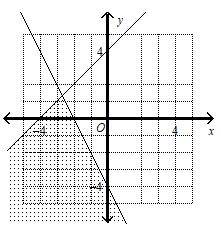
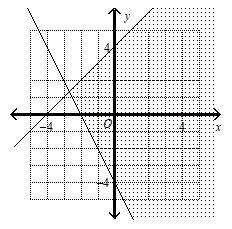
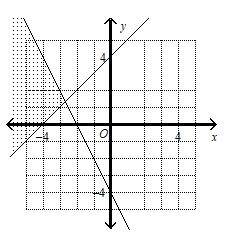
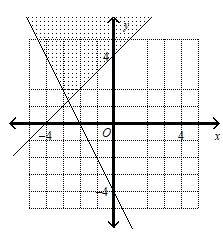
13- Which graph corresponds to the following inequalities?
\(y≤ x + 4\)
\(2x + y ≤ – 4\)
A.
B.
C.
D.
14- A bank is offering \(4.5\%\) simple interest on a savings account. If you deposit $8,000, how much interest will you earn in five years?
A. $360
B. $720
C. $1800
D. $3600
15- A card is drawn at random from a standard 52, card deck, what is the probability that the card is of Hearts? (The deck includes 13 of each suit clubs, diamonds, hearts, and spades)
A. \(\frac{1}{3}\)
B. \(\frac{1}{4}\)
C. \(\frac{1}{6}\)
D. \(\frac{1}{52}\)
16- How long does a 420, miles trip take moving at 50 miles per hour (mph)?
A. 4 hours
B. 6 hours and 24 minutes
C. 8 hours and 24 minutes
D. 8 hours and 30 minutes
17- 11 yards 6 feet and 4 inches equal to how many inches?
A. 388
B. 468
C. 472
D. 476
18- A shirt costing $200 is discounted \(15\%\). After a month, the shirt is discounted another \(15\%\). Which of the following expressions can be used to find the selling price of the shirt?
A. \((200) (0.70)\)
B. \((200) – 200 (0.30)\)
C. \((200) (0.15) – (200) (0.15)\)
D. \((200) (0.85) (0.85)\)
19- Which of the following points lies on the line \(2x + 4y = 10\)
A. \((2, 1)\)
B. \((–1, 3)\)
C. \((–2, 2)\)
D. \((2, 2)\)
20- \(5 + 8 × (–2) – [4 + 22 ×5] ÷ 6 = \)?
A. \(-30\)
B. \(-20\)
C. \(-10\)
D. 0
Best 7th Grade New York State Testing Program Math Workbook Resource for 2026
Answers:
1- A
The equation of a line in slope intercept form is: \(y = mx + b\)
Solve for \(y\).
\(4x-2y=12 ⇒ -2y=12-4x ⇒ y=(12-4x)÷(-2) ⇒ y=2x-6\)
The slope of this line is 2.
The product of the slopes of two perpendicular lines is\( -1\).
Therefore, the slope of a line that is perpendicular to this line is:
\(m_1 × m_2 = -1 ⇒ 2 × (m_2) = -1 ⇒ (m_2) = -\frac{1}{2}\)
2- C
Simplify: \(5(x-2y)+(2-x)^2 = (5x-10y)+(4-4x+x^2) = x -10y +4 +x^2\)
When \(x=3\) and \(y=-2\),therefore:
\(x -10y +4 +x^2 =3+20+4+9 =36\)
3- C
\(average (mean) = \frac{sum \space of \space terms }{number \space of \space terms}⇒ 88 = \frac{sum \space of \space terms}{50}⇒ sum = 88 × 50 = 4400\)
The difference of 94 and 69 is 25. Therefore, 25 should be subtracted from the sum.
\(4400 – 25 = 4375\)
\(mean =\frac{sum \space of \space terms}{number \space of \space terms}⇒ mean = \frac{4375 }{50}= 87.5\)
4- D
If the length of the box is 27, then the width of the box is one-third of it, 9, and the height of the box is 3 (one-third of the width). The volume of the box is:
\(V=lwh = (27) (9) (3) = 729\)
5- C
Add the first 5 numbers. \(40 + 45 + 50 + 35 + 55 = 225\)
To find the distance traveled in the next 5 hours, multiply the average by number of hours.
\(Distance = Average × Rate = 50 × 5 = 250\)
Add both numbers.
\(250 + 225 = 475\)
6- 240
The ratio of boys to girls is 2:3. Therefore, there are 2 boys out of 5 students. First, divide the total number of students by 5, then multiply the result by 2.
\(600 ÷ 5 = 120 ⇒ 120 × 2 = 240\)
7- 130
The perimeter of the trapezoid is 54 cm.
Therefore, the missing side (high) is \(= 54 – 18 – 12 – 14 = 10\)
Area of a trapezoid:
\( A = \frac{1}{2}h (b_1 + b_2) = \frac{1}{2}(10) (12 + 14) = 130\)
8- A
Let \(x\) be the number of years. Therefore, $2,000 per year equals 2000\(x\).
starting from $24,000 annual salary means you should add that amount to 2000\(x\).
Income more than that is:
\(I > 2000x + 24000\)
9- D
Solve for \(x\).
\(-2≤2x-4<8 \)⇒ (add 4 all sides)\( -2+4≤2x-4+4<8+4 \)
\(⇒ 2≤2x<12 \)
⇒ (divide all sides by 2)\( 1≤x<6\)
\(x\) is between 1 and 6.
10- A
Let \(x\) be the number of new shoes the team can purchase. Therefore, the team can purchase 120 \(x\).
The team had $20,000 and spent $14000. Now the team can spend on new shoes $6000 at most.
Now, write the inequality:
\(120x+14.000 ≤20.000\)
11- B
For Sum 6: (1 & 5) and (5 & 1), (2 & 4) and (4 & 2), (3 & 3), so we have 5 options.
For sum 9: (3 & 6) and (6 & 3), (4 & 5) and (5 & 4), we have 4 options.
To get a sum of 6 or 9 for two dice: \(5+4=9\)
Since we have \(6 × 6 = 36\) total options, the probability of getting a sum of 6 and 9 is 9 out of 36 or \(\frac{1}{4}\).
12- 8
Use formula of rectangle prism volume.
\(V = (length) (width) (height) ⇒ 2000 = (25) (10) (height)\)
\( ⇒ height = 2000 ÷ 250 = 8\)
13- A
For each option, choose a point in the solution part and check it on both inequalities.
A. Point \((–4, –4)\) is in the solution section. Let’s check the point in both inequalities.
\(-4 ≤ – 4 + 4, \space It \space works\)
\(2 (–4) + (–4) ≤ –4 ⇒ – 12 ≤ – 4\) it works (this point works in both)
B. Let’s choose this point \((0, 0)\)
\(0 ≤ 0 + 4, \space It \space works\)
\(2 (0) + (0) ≤ –4, \space \space That’s \space not \space true!\)
C. Let’s choose this point \((–5, 0)\)
\(0 ≤ -5 + 4, \space That’s \space not \space true!\)
D. Let’s choose this point \((0, 5)\)
\(5 ≤ 0 + 4, \space That’s \space not \space true!\)
14- C
Use simple interest formula:
I=prt
(I = interest, p = principal, r = rate, t = time)
\(I=(8000)(0.045)(5)=1800\)
15- B
The probability of choosing a Hearts is \(\frac{13}{52}=\frac{1}{4}\)
16- C
Use distance formula:
\(Distance = Rate × time ⇒ 420 = 50 × T\)
divide both sides by 50.
\(\frac{420}{50} = T ⇒ T = 8.4 \space hours\)
Change hours to minutes for the decimal part.
\(0.4 \space hours = 0.4 × 60 = 24 \space minutes\)
17- C
\(11 × 36 + 6 × 12 + 4 = 472\)
18- D
To find the discount, multiply the number by (\(100\% – \)Rate of discount).
Therefore, for the first discount we get:
\((200) (100\% – 15\%) = (200) (0.85) = 170\)
For the next \(15%\) discount: \((200) (0.85) (0.85)\)
19- B
Input \((-1, 3)\) in the \(2x + 4y = 10\) formula instead of \(x\) and y. So we have:
\( 2(-1) + 4(3) = 10\)
\(-2 + 12 = 10\)
20- A
Use PEMDAS (order of operation):
\(5 + 8 × (–2) – [4 + 22 ×5] ÷ 6 = 5 + 8 × (–2) – [4 + 110] ÷ 6 = 5 + 8 × (–2) – [114] ÷ 6 = 5 + (–16) – 19 = 5 + (–16) – 19 = –11 – 19 = –30\)
Looking for the best resource to help you succeed on the 7th Grade NYSE Math test?
The Best Books to Ace the 7th Grade New York State Testing Program Math Test
Recommended EffortlessMath Books
For more structured prep alongside this practice test, the Common Core Mathematics Workbook for Grade 7 covers every Grade 7 NYSE topic with step-by-step worked examples. For practice with the kind of multi-step word problems that show up on Day 2, see the Mastering Grade 7 Math Word Problems.
Frequently Asked Questions
How many questions are on the 7th Grade NYSE math test?
The real New York State Grade 7 math test has about 40-46 questions split across two test days. Day 1 is mostly multiple choice with around 24-30 items. Day 2 has short-response and extended-response problems where your child must show work for full credit. Total testing time is about 130-140 minutes across the two days.
Is a calculator allowed on the 7th Grade NYSE?
Yes. New York allows a scientific calculator (no graphing capability) on the Grade 7 NYSE math test. The school usually provides one, but many districts let students bring their own approved model. Your child should still be comfortable with fraction-decimal-percent conversions by hand.
What’s a passing score on the 7th Grade NYSE math?
The NYSE reports 4 performance levels: Level 1 (well below proficient), Level 2 (below proficient), Level 3 (proficient), and Level 4 (above proficient). Level 3 is the on-grade-level target. Scale scores for Level 3 vary slightly each year but sit near 318 out of a roughly 150-405 range.
When is the NYSE given?
The Grade 7 NYSE math is given in late April or early May each year. New York sets a fixed two-day testing window, and your child’s school administers both days during that window. Schools publish exact dates a few weeks in advance.
How is the NYSE Grade 7 math scored?
Day 1 multiple choice is auto-scored. Day 2 short-response and extended-response items get hand-scored by trained NY State teachers using published rubrics. Scores combine into a single scale score (roughly 150-405) and one of 4 performance levels. Reports come home over the summer.
Can my child retake the NYSE?
The Grade 7 NYSE math is given once per year with no in-year retake. If your child scores at Level 1 or Level 2, the school may schedule extra math support during the next year, and your child will take a fresh NYSE in grade 8.
What math topics are on the 7th Grade NYSE?
New York’s Next Generation Math Standards for Grade 7 cover: ratios and proportional relationships (unit rates, scale drawings), the number system (operations with all rational numbers including negatives), expressions and equations (one- and two-step linear, inequalities), geometry (angles, area, surface area, volume of prisms, circles), and statistics and probability (sampling, comparing populations, probability).
How long should we study for the 7th Grade NYSE?
Most seventh-graders do well with 6-8 weeks of practice at 20-30 minutes per day. Start with a diagnostic, drill the weak topics first, then build to full timed practice in the last 2 weeks. Practice the short-response and extended-response format – kids often forget to show their work for full credit.
Where can I find more 7th Grade NYSE practice?
EffortlessMath has free lessons for every Common Core Grade 7 math topic the NYSE tests, plus the Common Core Mathematics Workbook for Grade 7 and the Grade 7 word problems book. The related lessons below cover the highest-frequency NYSE topics.
Is the NYSE aligned with Common Core?
Yes – New York’s Next Generation Math Standards are derived from Common Core with state-specific adjustments (about 90% overlap at grade 7). Common Core Grade 7 math materials work very well as NYSE prep with minor wording differences.
Related EffortlessMath Lessons
If a topic on this page feels rusty, these short lessons go deeper:
- Proportional ratios
- How to add and subtract integers
- How to solve one-step equations
- Percent of change (resource currently unavailable)
- How to find the volume of a prism

Related to This Article
More math articles
- How to Use a Venn Diagram to Classify Rational Numbers?
- A Guide to the Different Types of Continuity in Functions
- An In-depth Exploration of How to Find the Codomain
- How to Find Inverses of 2×2 Matrices?
- What’s The Best Laptop for Online Teaching?
- CLEP U.S. History I 055: Election of 1824 and the Changing Party System
- 5th Grade SC Ready Math Worksheets: FREE & Printable
- 5 Tips on How to Score Higher on SAT Math
- Chapter 28: Interest Groups
- Free Grade 7 English Worksheets for Washington, D.C. Students



What people say about "Free 7th Grade New York State Math Practice"?
No one replied yet.