8th Grade IAR Math FREE Sample Practice Questions

Does your 8th-grade student need FREE math sample practice questions to assess their math skills for the Illinois Assessment of Readiness (IAR) test? The FREE IAR Math Sample Practice Questions prepared in this article are what you need now!
We assure you that using the 8th-grade IAR Math Sample Practice Questions will lead to your 8th-grade student being fully prepared and proficient in the IAR Math test topics.
Check out our 8th-Grade IAR Math Sample Practice Questions to identify your strengths and weaknesses for the IAR test!
Start preparing your student for the 2026 IAR Math test with our free sample practice questions. Also, make sure to follow some of the related links at the bottom of this post to get a better idea of what kind of mathematics questions students need to practice.
The Absolute Best Book to Ace 8th Grade IAR Math Test
10 Sample 8th Grade IAR Math Practice Questions
1- Five years ago, Amy was three times as old as Mike was. If Mike is \(10\) years old now, how old is Amy?
A. \(4\)
B. \(8\)
C. \(12\)
D. \(20\)
2- What is the length of \(AB\) in the following figure if \(AE=4\), \(CD=6\), and \(AC=12\)?
\( \img {https://appmanager.effortlessmath.com/public/images/questions/test2121212121212.JPG
} \)
A. \(3.8\)
B. \(4.8\)
C. \(7.2\)
D. \(24\)
3- If a gas tank can hold \(25\) gallons, how many gallons does it contain when it is \(\frac{2}{5}\) full?
A. \(50\)
B. \(125\)
C. \(62.5\)
D. \(10\)
4- In the \(xy\)-plane, the points \((4,3)\) and \((3,2)\) are on line \(A\). Which of the following equations of lines is parallel to line \(A\)?
A. \(y=3x \)
B. \(y=\frac{x}{2}\)
C. \(y=2x\)
D. \(y=x\)
5- If \(x\) is directly proportional to the square of \(y\), and \(y=2\) when \(x=12\), then when \(x=75, y=\) ?
A. \(\frac{1}{5}\)
B. \(1\)
C. \(5\)
D. \(12\)
6- Jack earns \($616\) for his first \(44\) hours of work in a week and is then paid \(1.5\) times his regular hourly rate for any additional hours. This week, Jack needs \($826\) to pay his rent, bills, and other expenses. How many hours must he work to make enough money this week?
A. \(40\)
B. \(48\)
C. \(53\)
D. \(54\)
7-
\( \img {https://appmanager.effortlessmath.com/public/images/questions/test252525252525252525252525.JPG
} \)
If \(a\) is the mean (average) of the number of cities in each pollution type category, \(b\) is the mode, and \(c\) is the median of the number of cities in each pollution type category, then which of the following must be true?
A. \(a<b<c\)
B. \(b<a<c\)
C. \(a=c\)
D. \(b<c=a\)
8-
\( \img {https://appmanager.effortlessmath.com/public/images/questions/test252525252525252525252525.JPG
} \)
What percent of cities are in the type of pollution \(A, C\), and \(E\) respectively?
A. \(60\%, 40\%, 90\%\)
B. \(30\%, 40\%, 90\%\)
C. \(30\%, 40\%, 60\%\)
D. \(40\%, 60\%, 90\%\)
9-
\( \img {https://appmanager.effortlessmath.com/public/images/questions/test252525252525252525252525.JPG
} \)
How many cities should be added to the type of pollution \(B\) until the ratio of cities in the type of pollution \(B\) to cities in the type of pollution \(E\) will be \(0.625\)?
A. \(2\)
B. \(3\)
C. \(4\)
D. \(5\)
10- In the following right triangle, if the sides \(AB\) and \(AC\) become twice longer, what will be the ratio of the perimeter of the triangle to its area?
\( \img {https://appmanager.effortlessmath.com/public/images/questions/test3030303030303030.JPG
} \)
A. \(\frac{1}{2}\)
B. \(2\)
C. \(\frac{1}{3}\)
D. \(3\)
Best 8th Grade IAR Math Practice Resource
Answers:
1- D
Five years ago, Amy was three times as old as Mike. Mike is \(10\) years now. Therefore, \(5\) years ago Mike was \(5\) years.
Five years ago, Amy was:
\(A=3×5=15 \)
Now Amy is \(20\) years old:
\(15 + 5 = 20\)
2- B
Two triangles \(∆BAE\) and \(∆BCD\) are similar. Then:
\(\frac{AE}{CD}=\frac{AB}{BC}=\frac{4}{6}=\frac{x}{12-x}\)
\(→48-4x=6x→10x=48→x=4.8\) For education statistics and research, visit the National Center for Education Statistics.
3- D
\(\frac{2}{5}×25=\frac{50}{5}=10\) For education statistics and research, visit the National Center for Education Statistics.
4- D
The slop of line \(A\) is:
\(m = \frac{y_2-y_1}{x_2-x_1}=\frac{3-2}{4-3}=1\)
Parallel lines have the same slope and only choice D \((y=x)\) has a slope of \(1\). For education statistics and research, visit the National Center for Education Statistics.
5- C
\(x\) is directly proportional to the square of \(y\). Then:
\(x=cy^2\)
\(12=c(2)^2→12=4c→c=\frac{12}{4}=3\)
The relationship between \(x\) and \(y\) is:
\(x=3y^2\)
\(x=75\)
\(75=3y^2→y^2=\frac{75}{3}=25→y=5\) For education statistics and research, visit the National Center for Education Statistics.
6- D
the amount of money that Jack earns for one hour: \(\frac{$616}{44}=$14\)
The number of additional hours that he works to make enough money is: \(\frac{$826-$616}{1.5×$14}=10\)
The number of total hours is: \(44+10=54\) For education statistics and research, visit the National Center for Education Statistics.
7- C
Let’s find the mean (average), mode, and median of the number of cities for each type of pollution.
Number of cities for each type of pollution: \(6, 3, 4, 9, 8\)
Mean \(= \frac{sum \space of \space terms}{number \space of \space terms}=\frac{6+3+4+9+8}{5}=6\)
The Median is the number in the middle. To find the median, first list numbers in order from smallest to largest.
\(3, 4, 6, 8, 9\)
The median of the data is \(6\).
Mode is the number that appears most often in a set of numbers. Therefore, there is no mode in the set of numbers.
Median \(=\) Mean, then, \(a=c\) For education statistics and research, visit the National Center for Education Statistics.
8- A
Percent of cities in the type of pollution A:
\(\frac{6}{10} × 100=60\%\)
Percent of cities in the type of pollution C:
\(\frac{4}{10} × 100 = 40\%\)
Percent of cities in the type of pollution E:
\(\frac{9}{10}× 100 = 90\%\)
9- A
Let the number of cities should be added to the type of pollution \(B\) be \(x\). Then:
\(\frac{x + 3}{8}=0.625→x+3=8×0.625→x+3=5→x=2\)
10- A
\(AB=12\) and \(AC=5\)
\(BC=\sqrt{(12^2+5^2 )} = \sqrt{(144+25)} = \sqrt{169}=13\)
Perimeter \(=5+12+13=30\)
Area \(=\frac{5×12}{2}=5×6=30\)
In this case, the ratio of the perimeter of the triangle to its area is:
\(\frac{30}{30}= 1\)
If the sides \(AB\) and \(AC\) become twice longer, then:
\(AB=24\) and \(AC=10\)
\(BC=\sqrt{(24^2+10^2 )} = \sqrt{(576+100)} = \sqrt{676} = 26\)
Perimeter \(=26+24+10=60\)
Area \(=\frac{10×24}{2}=10×12=120\)
In this case, the ratio of the perimeter of the triangle to its area is:
\(\frac{60}{120}=\frac{1}{2}\)
Looking for the best resource to help you succeed on the IAR Grade 8 Math test?
The Best Books to Ace 8th Grade IAR Math Test
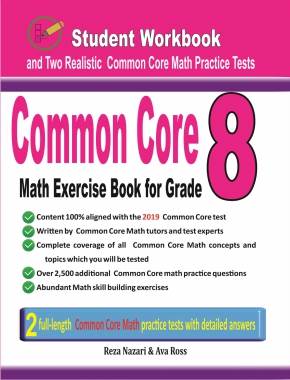
Common Core Math Exercise Book for Grade 8 Student Workbook and Two Realistic Common Core Math Tests

Related to This Article
More math articles
- 10 Most Common 7th Grade FSA Math Questions
- The Practical Benefits Of Knowing Math – The 10 Best Industries For Math Geeks
- Comprehensive Tests for Convergence and Divergence of Infinite Series
- How to Write the Standard Form of Linear Equations?
- Powerful Decimals: How to Uncover the Missing Number in Division by Powers of 10
- Employing the Limit Comparison Test to Analyze Series Convergence
- Top 10 SSAT Lower Level Math Practice Questions
- How to Learn Properties of Logarithms
- 4th Grade MCAS Math Practice Test Questions
- STEM Education is the Key to Success


What people say about "8th Grade IAR Math FREE Sample Practice Questions - Effortless Math: We Help Students Learn to LOVE Mathematics"?
No one replied yet.