Number Properties Puzzle – Challenge 9
Do you enjoy exercising your brain? If so, then this puzzle is just for you. Let’s see if you can solve this Math puzzle!
Challenge:
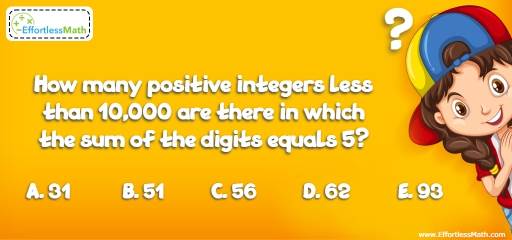
How many positive integers less than 10,000 are there in which the sum of the digits equals 5?
A- 31
B- 51
C- 56
D- 62
E- 93
The Absolute Best Book to Challenge Your Smart Student!

The correct answer is C.
We are looking for a number that the sum of its digits equals 5.
Pairs possible: \(0,0,0,5; 1,4,0,0; 0,0,2,3; 1,3,1,0; 1,2,1,1; 0,1,2,2\)
Number of options for each pair:
\(0,0,0,5 = \frac{4!}{3!} = \frac{4 ×3 ×2 ×1}{3 ×2 ×1} = 4 (5, 50, 500, 5,000)\)
\(1,4,0,0 = \frac{4!}{2!} = \frac{4 ×3 ×2 ×1}{2 ×1} = 12 (14, 41, 104, 140, 410, 401, 1004, 1040, 1400, 4001, 4010, 4100)\)
\(0,0,2,3 = \frac{4!}{2!} = \frac{4 ×3 ×2 ×1}{2 ×1} = 12 (23, 32, 230, 320, …)\)
\(1,3,1,0 = \frac{4!}{2!} =\frac{4 ×3 ×2 ×1}{2 ×1)} = 12 (113, 131, 311, 1013, …)\)
\(1,2,1,1 = \frac{4!}{3!} = \frac{4 ×3 ×2 ×1}{3 ×2 ×1} = 4 (1112, 1121, 1211, 2111)\)
\(0,1,2,2 = \frac{4!}{2! }=\frac{4 ×3 ×2 ×1}{2 ×1} = 12 (122, 212, 221, 1022, …)\)
Total: \(12 + 12 + 12 + 12 + 4 + 4 = 56\)
The Absolute Best Books to Ace Algebra

Related to This Article
More math articles
- The Best Grade 3 ELA Practice Tests for Rhode Island Students
- 10 Most Common ATI TEAS 7 Math Questions
- Why Teaching Math At Home Is Beneficial For Your Kids?
- Demography, Population Size, Composition, and Distribution
- 49 Free AK STAR Grade 5 Math Worksheets for Alaska Students (Aligned, One Skill Per Page)
- Using a Fraction to Write down a Ratio
- The Best Grade 5 ELA Practice Tests for Tennessee Students
- CLEP U.S. History I 003: Spanish Conquest and Colonial Systems
- Matrix Calculator (2×2 Add, Multiply, Determinant & Inverse)
- Fighting words






What people say about "Number Properties Puzzle – Challenge 9 - Effortless Math"?
No one replied yet.