


How to Help Your Child Prepare for the Texas Grade 7 STAAR Math Test

Put four red slips and two blue slips in a cup. Before you draw, ask your seventh grader which color they expect to see more often. Then draw a blue slip. If they say their prediction was wrong, you have something worth talking about: a prediction can make sense even if one trial goes the other way. Start there, with a question your child can explore and explain.
What to expect on the Grade 7 STAAR math test
The Texas Education Agency calendar sets April 19–30, 2027 for Grades 3–8 mathematics. The school chooses the testing date. Spring 2027 is the final Grade 7 STAAR administration before the Student Success Tool begins in 2027–28.
The test is usually taken online. Students may select an answer, enter a number, or interact with an item. STAAR measures selected skills in the Texas Essential Knowledge and Skills, or TEKS. Use the results with classwork and teacher feedback when choosing what to work on next.
The state scheduling guidance gives an expected completion time of three to four hours, with more time generally available up to seven working hours in the regular school day. The standard Grade 7 test is taken without a calculator. Confirm approved accommodations, tools, and break procedures with the school.
Quick Texas Grade 7 STAAR Math Check
Try these ten questions with scratch paper. Encourage your child to jot down one question they’d like to talk through later. They will see a score and worked explanations after submitting all ten. Use the results to choose a first topic to review.
Question 1 of 10
Quiz results
Each correct answer earns 10 points. An 80/100, for example, means eight out of ten correct. Ask your child to explain one solution. If they missed any questions, choose one to work through together. Check the official STAAR report for the state performance level.
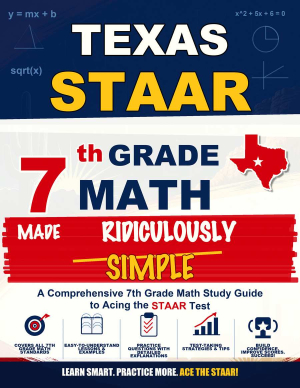
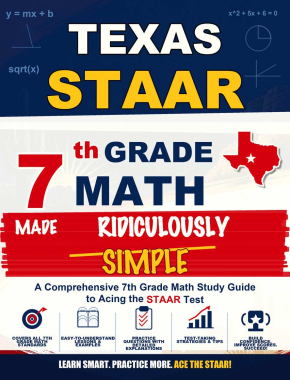
Help your child feel ready for STAAR math. Texas STAAR Grade 7 Math Made Ridiculously Simple walks through Grade 7 skills one step at a time. Open to a skill your child found tricky. Work through one example together and ask them to show you the first step on a new problem.
Answers and explanations
1. A bag contains 3 white and 5 black counters. What is the probability of drawing a white counter at random?
Your answer:
Correct answer: B.
There are eight equally likely counters and three are white. The probability is .
2. A fair coin and a fair four-sided die numbered 1–4 are used. What is the probability of heads and an even number?
Your answer:
Correct answer: D.
Two of the four numbers are even, so the chance of an even number is . Multiply it by the independent chance of heads, , to get .
3. What is − + ?
Your answer:
Correct answer: A. −
Rewrite as . Moving two fourths to the right from − lands at −.
4. A hoodie that normally costs $45 is on sale for 20% off. What is the sale price before tax?
Your answer:
Correct answer: C. $36
Twenty percent of $45 is $9. Subtract the discount to get $36.
5. A runner covers 6 miles in 50 minutes at a constant pace. At that pace, how far does the runner go in 25 minutes?
Your answer:
Correct answer: B. 3 miles
Twenty-five minutes is half of 50 minutes. At a constant pace, the distance is also halved, from 6 miles to 3 miles.
6. Which equation represents three identical notebook prices plus a $4 shipping fee for a total of $22, where n is one notebook’s price?
Your answer:
Correct answer: D. 3n + 4 = 22
Three notebooks cost 3n. The order has one $4 shipping fee, so 3n + 4 = 22.
7. A 9-centimeter line on a scale drawing represents 36 meters. What does a 5-centimeter line represent at the same scale?
Your answer:
Correct answer: A. 20 meters
Each centimeter represents 36 ÷ 9 = 4 meters. Five centimeters represent 20 meters.
8. What is the circumference of a circular lid with a diameter of 14 centimeters?
Your answer:
Correct answer: C. 14π centimeters
Circumference is π times the diameter. The exact answer is 14π centimeters.
9. Two groups recorded reading times. The first group recorded 10, 12, and 14 minutes. The second recorded 15, 17, and 19 minutes. How much greater is the median for the second group?
Your answer:
Correct answer: B. 5 minutes
The two middle values are 12 and 17 minutes. Their difference is 5 minutes.
10. Sam puts $200 in an account earning 3% simple interest per year. With no deposits or withdrawals, how much interest is earned in two years?
Your answer:
Correct answer: D. $12
Three percent of $200 is $6. Simple interest adds $6 each year, so two years earn $12.
For a broader review, compare two samples, solve a scale drawing problem, and discuss how interest can change the price of a purchase.
If this quiz does not load, you can still try a Grade 7 probability quiz in the Online Center.
Grade 7 math topics to review
The assessed Grade 7 math TEKS group skills into four reporting categories. Start with a topic your child can explain using an example.
Probability and numerical representations
Make a list of the outcomes for a coin and a small spinner. Ask how many outcomes satisfy both parts of the question. Compare predictions with actual tallies, and talk about how a result can vary from trial to trial. Review how whole numbers, integers, and rational numbers fit together.
Computations and algebraic relationships
Use a number line to check the sign of a rational sum. In a sale problem, ask your child to point to the original price, the discount, and what they will pay. Relate a constant rate to a table, graph or equation. Have them explain what each term in an equation stands for.
Geometry and measurement
Compare a scale drawing with the actual object and label which units belong to each. For circle problems, sketch the radius and diameter before choosing a formula. Practice areas of composite figures and use a net to make sense of surface area.
Data analysis and personal financial literacy
Compare the center and spread of two data sets. Ask whether a sample is likely to reflect the whole group. Use a simple budget to talk about fixed and variable expenses. For interest problems, discuss whether the interest is based only on the original amount or also on previous interest.
| First flip | Second flip |
|---|---|
| Heads | Heads |
| Heads | Tails |
| Tails | Heads |
| Tails | Tails |
Exactly one head appears in two of the four equally likely outcomes.
At this scale, 3 × 5 meters gives 15 meters.
Try it together: Test a prediction
Put four red slips and two blue slips of the same size in a cup. Mix them, draw one, record the color, and put it back before drawing again. Do this 12 times. Ask what would change if you stopped putting a slip back.
Show the answer
The chance of red on each draw is , or , because the cup has the same six slips each time. A prediction of eight red draws out of 12 is reasonable. Your tally may differ. Without replacement, the mix can change after each draw.
If a short game fits your routine, try an Effortless Math game for a skill your child wants to revisit. Then use the Texas Grade 7 Math Online Center for a lesson, a topic quiz, or a worksheet where available.
Choose a study timeline that fits
Use your child’s classwork and the teacher’s advice to choose where to start. These plans fit around regular schoolwork. If your child is tired, stop after one problem they can explain.
Six months of steady practice
If your school’s test date is six months away, use the study guide and workbook early, then work through selected sets from the five-, six-, and seven-test books. Try an Online Center set near the beginning to choose priorities. Save fresh questions for the last check. Families starting in late November for April 2027 can use a shorter plan below.
Six weeks of focused review
Try two or three 15-minute sessions each week. Pick two priorities using classwork and Online Center questions. Use the study guide for one troublesome step and the workbook for fresh examples. In the last two weeks, choose mixed questions from the five-test book and leave enough time to review one solution carefully.
30 days to prepare
Use Made Ridiculously Simple and the seven-test book if you have them. In week one, choose a few mixed questions. Work on one or two skills in weeks two and three. In the final week, choose an unused set from the seven-test book. If every answer is right, ask your child to explain a choice they made and end there.
One week for a calm review
Try two ten-minute sessions early in the week. Use the guide for a familiar example and the Online Center or seven-test book for a few questions. Check the school’s test-day plans. Keep the last evening free.
Before, during, and after testing
In the weeks before
Ask the teacher what tool or support your child is accustomed to using. Practice reading a word problem all the way through and writing one line about what it asks. Invite your child to name the point where a problem stops making sense.
On test day
If your child is anxious, try saying, “Start with the part you understand.” A breath and a moment to look at the diagram can help. Confirm with your school how students ask for a break or report a computer problem.
After each session and when results arrive
Start by asking what your child noticed about the questions. When the report is available, discuss one useful follow-up with the teacher. A small step could be checking which amount a percent problem starts with.
Books and practice resources
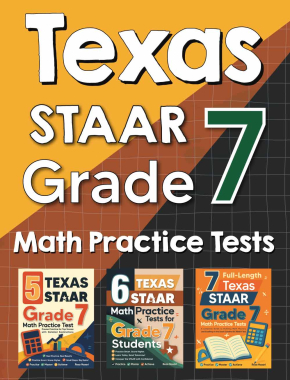
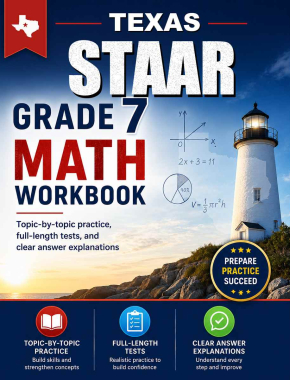
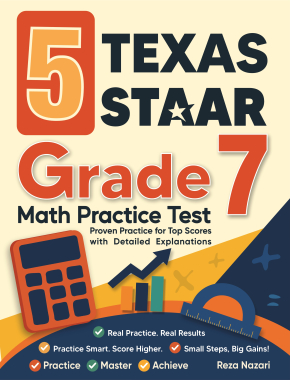
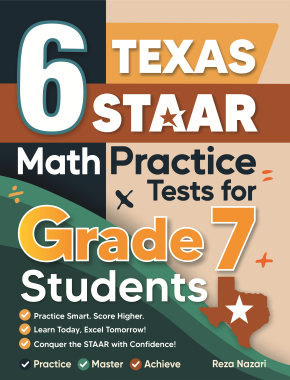
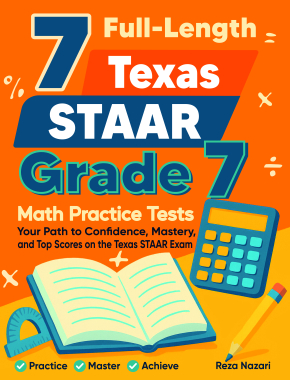
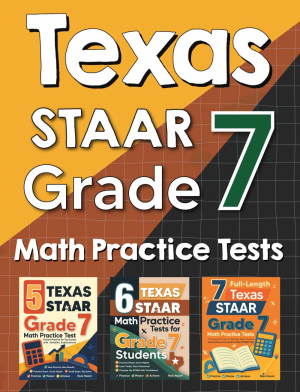
The Texas STAAR Grade 7 practice-test bundle offers the five-, six-, and seven-test books. The study guide and workbook are separate. Use the guide to walk through an unfamiliar concept and the workbook to try it again. Mixed sets are useful once your child is ready to switch between skills.
Work through a lesson
 Original price was: $29.99.$19.99Current price is: $19.99.
Ask your child to explain why one step is needed.
Practice the same skill
Try a short workbook set while the example is fresh.
Start mixing topics
Original price was: $27.99.$17.99Current price is: $17.99.Use the five-test book to practice shifting between skills.
Check an earlier skill
Original price was: $28.99.$18.99Current price is: $18.99.Choose a few questions and talk through a missed answer.
Try a fresh checkpoint
Original price was: $29.99.$19.99Current price is: $19.99.Revisit the guide or workbook after a mixed set.
Texas sources and Effortless Math practice
Try the free probability quiz in the Texas Grade 7 Math Online Center. Follow it with a lesson, worksheet, or skill quiz for one topic you want to revisit.
See TEA mathematics resources and the calculator policy. Ask the school about its date and any approved testing supports.
Common questions
Can my seventh grader use a calculator?
Standard Grade 7 STAAR math does not allow a calculator. The school can confirm if an accommodation applies.
What does 80 out of 100 mean here?
Your child got eight of the ten practice questions right. Use the official STAAR report for the state performance level.
How can I help without doing the question for them?
Ask them to tell you what the numbers represent. Then give them time to try their own first step.
Leave a comment
Leave a comment for another parent. What helped your child get comfortable explaining a chance, scale, or percent problem? Share the activity or prompt you used.

Related to This Article
More math articles
- Can You Use a Calculator on the TEAS? ATI’s Rules Explained
- Inference, Purpose, Assumptions, and Arguments
- How to Use Input/output Tables to Add and Subtract Integers?
- How to Qualify for the IMO: Step-by-Step Guide for 2027
- Grade 3 Math: Graphs
- Subtracting Multi-Digit Numbers for 4th Grade
- Top 10 Tips You MUST Know to Retake the ISEE Math
- Pregnancy Test Calculator (When to Test)
- 3rd Grade Common Core Math Worksheets: FREE & Printable
- Wisconsin Forward Grade 7 Math Worksheets: 95 Free Printable PDFs Covering Every Skill



What people say about "How to Help Your Child Prepare for the Texas Grade 7 STAAR Math Test - Effortless Math"?
No one replied yet.