How to Ace the GRE Quantitative Section (2026 Guide)

The GRE Quantitative Reasoning section is not really a math test. It is a careful-thinking test that happens to use math. Most of the content is content you saw by 10th grade. What is hard is the pacing, the trap answers, and the unusual quantitative-comparison question type. Train those three things and a strong score is well within reach.
This guide gives you the format, the topics, the strategy, and an 8-week plan that has worked for thousands of grad-school applicants.
What the GRE Quant Section Looks Like (Shorter 2026 Format)
ETS shortened the GRE in 2023, and the new format is now the standard.
- Two Quant sections, back-to-back-ish.
- Section 1: 12 questions in 21 minutes (about 1:45/question)
- Section 2: 15 questions in 26 minutes (about 1:45/question)
- Total: 27 questions in 47 minutes.
- Section-level adaptive. Your performance on Section 1 determines whether Section 2 is easier or harder.
Question types:
- Quantitative Comparison, compare two quantities and pick A (greater), B (greater), C (equal), or D (cannot be determined).
- Multiple Choice (single answer).
- Multiple Choice (multiple answers).
- Numeric Entry, type the answer.
Content domains:
- Arithmetic, integers, fractions, decimals, percents, ratios, exponents.
- Algebra, linear, quadratic, simultaneous equations, inequalities, functions.
- Geometry, angles, polygons, circles, area, volume, coordinate geometry.
- Data Analysis, statistics, probability, counting methods, reading data displays.
How GRE Quant Is Scored
Quant is scored from 130 to 170 in 1-point increments. National averages:

- Mean Quant score: ~155
- Top 25%: 161+
- Top 10%: 165+
- Top 1%: 169 to 170
Target scores depend on your program:
- Most master’s programs: 155 to 160
- Top business school MBA programs: 160+ (with strong Verbal too)
- STEM PhD programs: 165+
- Top quant PhD programs (econ, stats, finance): 168 to 170
The 3 Things That Separate High Scorers
1. Quantitative Comparison fluency
Quant Comp is unique to the GRE. Half the section is this format. Key technique: simplify both quantities to the same form before comparing. If you cannot simplify, test extreme values, large positive, large negative, zero, fractions between 0 and 1, negative fractions.
The four-answer logic:
– (A) Quantity A is greater.
– (B) Quantity B is greater.
– (C) Quantities are equal.
– (D) Cannot be determined.
If you can find two values that produce different answers, the answer is (D).
2. The on-screen calculator
The GRE provides a basic on-screen four-function calculator with a square-root key. It is slow to use. High scorers do most computation by hand and reach for the calculator only when needed.
What the calculator helps with: big multiplication, division with awkward decimals, square roots.
What it does not help with: solving equations, fractions, ratios. These go faster by hand.
3. Question-skipping discipline
The GRE lets you flag a question, skip it, and return within the section. Use this aggressively. A 4-minute question costs you the next three easy ones. Pacing rule: if you are over 2 minutes on a single question, flag it and move on.
Recommended Practice Resources
Topic Hit List
High-yield topics (memorize cold)
- Percent of, percent change, simple/compound interest.
- Ratios and proportions, including 3-way ratios.
- Linear equations and inequalities.
- Quadratic factoring and the formula \(x = \dfrac{-b \pm \sqrt{b^2 – 4ac}}{2a}\).
- Exponent rules and roots.
- Triangle properties (especially 30-60-90 and 45-45-90).
- Circle area, circumference, sectors, arcs.
- Mean, median, mode, range, standard deviation (conceptual).
- Probability basics, including “at least one” complement trick.
- Permutations and combinations.
Common trap topics
- Standard deviation comparisons. Quant Comp loves SD with no actual computation needed.
- Overlap problems with two-circle Venn diagrams.
- “Could be” vs “must be” in number-property questions.
- Coordinate geometry without a graph, students forget to sketch.
An 8-Week GRE Quant Study Plan
Weeks 1 to 2, Diagnostic and arithmetic
- Take a free official ETS PowerPrep practice test.
- Drill fractions, percents, ratios, exponents.
- Learn Quant Comp question type with 30 to 50 practice problems.
Weeks 3 to 4, Algebra
- Linear equations, inequalities, systems.
- Quadratics: factoring, the formula, vertex form.
- Functions and translations.
Weeks 5 to 6, Geometry and coordinate geometry
- Triangles, quadrilaterals, polygons.
- Circles, arcs, sectors.
- Lines, slope, distance, midpoint, equations of circles.
Week 7, Data analysis and probability
- Statistics: mean, median, mode, range, weighted average, standard deviation.
- Probability and conditional probability.
- Combinations and permutations.
- Reading data displays.
Week 8, Simulation
- Two full-length GRE practice tests, scored.
- Heavy focus on error log topics.
- Final 3 days: light review only.
The single most useful study artifact: a mistake notebook. Every wrong answer goes in with topic, mistake type, and correct approach. Reread it weekly.
Test-Day Strategy

- Eat real food beforehand. The GRE is 2 hours of intense thinking.
- Skip and return aggressively. Use the on-screen flag.
- Use your scratch paper. ETS provides booklets. Write everything down.
- Watch your section timer. Aim to finish at 4 to 5 minutes remaining for a final pass.
- Plug in numbers for variable-heavy Quant Comp and “could be” problems.
- Bring two forms of ID. ETS is strict.
Common Mistakes
- Treating Quant Comp like multiple choice. It rewards reasoning, not computation.
- Over-using the calculator. Slows you to a stop.
- Skipping Section 1 prep. Section 1 determines whether Section 2 is the “high score” or “low score” form.
- Memorizing trig formulas. The GRE Quant section does not test trig.
- Ignoring data interpretation. Two or three questions per section are based on a single chart. Easy points if you slow down enough to read.
Free Resources
Effortless Math offers a complete free GRE Quant system:
- GRE Math Worksheets, topic-organized printable practice.
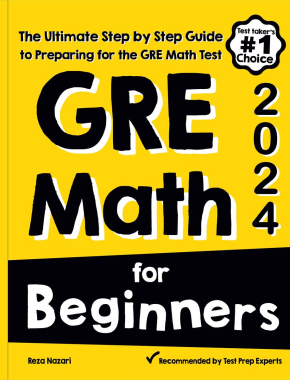
- GRE Math eBooks, full prep books with practice tests.
- Math Topics Library, every GRE-relevant topic, explained.
Frequently Asked Questions
How long should I study for the GRE Quant?
Most students benefit from 6 to 12 weeks at 6 to 10 hours per week. Faster timelines are possible if your math is fresh.
Is the GRE Quant harder than the SAT or ACT math?
Slightly. The arithmetic and algebra are at a similar level, but the question types (especially Quant Comp) and trap-answer design are more advanced.
Do I need to know calculus or linear algebra for the GRE?
No. The GRE Quant section tops out at Algebra II / basic statistics. No calculus, no matrices.
Can I bring my own calculator to the GRE?
No. The on-screen calculator is the only one allowed.
How important is GRE Quant compared to Verbal?
Depends on your program. STEM and quantitative programs care most about Quant. Humanities programs weigh both, often with Verbal slightly higher.
Can I take the GRE more than once?
Yes, up to 5 times in a 12-month period, with a minimum 21-day wait between attempts.
You Can Hit Your Target Score
The math has not changed since you saw it last. What changes is the strategy. Train Quant Comp, build your mistake notebook, drill the calculator discipline. Eight focused weeks from today, you will know exactly how to think your way through this test.
Keep Practicing With the Right Resources

Related to This Article
More math articles
- Rotation, Torque, and Balance
- Battle of the Decimals: Using Grids for Easy Comparisons
- How to Prepare for the ALEKS Math Test?
- SAT Math Level 2 Calculator Tips to Boost Your Score
- How to Prepare for the DAT Quantitative Reasoning Math Test?
- Top Calculators for the ACT Math Test 2026: Quick Review
- CLEP U.S. History I 041: Whiskey Rebellion and Federal Authority
- How to Navigate Inequalities: The Impact of Addition and Subtraction on Fractional Values
- Is the CBEST Math Difficult?
- Free Grade 8 English Worksheets for Massachusetts Students



What people say about "How to Ace the GRE Quantitative Section (2026 Guide)"?
No one replied yet.