How to Help Your Child Prepare for the California Grade 4 CAASPP Math Test
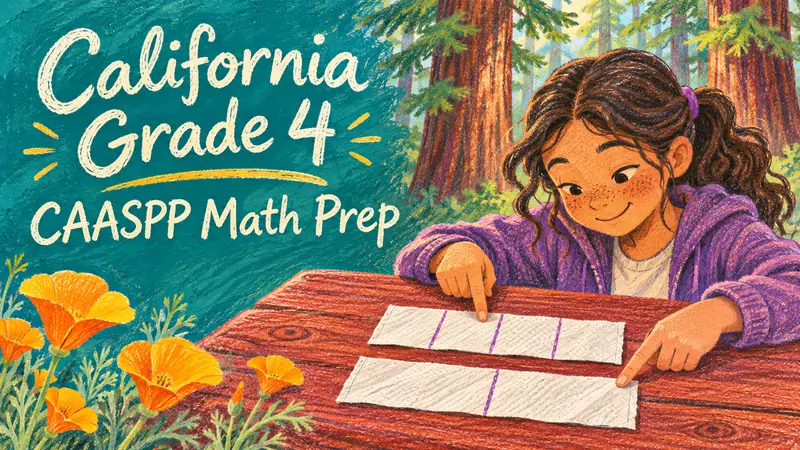
If your fourth grader can do long division on paper but freezes when a question asks what to do with the remainder, start there. Ask, “What does the leftover number mean in this story?” That question can tell you more about what to practice next than an extra page of division.
What happens on test day?
California’s Smarter Balanced Grade 4 math assessment is part of CAASPP, the California Assessment of Student Performance and Progress. Students work through a computer-adaptive segment and a separate performance task. The adaptive segment adjusts the questions as the student responds. The performance task asks students to work through related questions and show how they reason. Students may choose answers, enter a response, or use an on-screen tool.
California uses these results to see how well schools are helping students learn grade-level math. Your child’s score report is one piece of information you can discuss with their teacher alongside regular classwork.
The Grade 4 math test is untimed. The state’s planning estimate is about 45 minutes for the adaptive segment and about 60 minutes for the performance task, plus time for setup and breaks. Your school can tell you which days your child will test and how it handles breaks and supports. Grade 4 has no standard on-screen calculator on the state math test. The school can explain any approved accessibility supports and show your child how to use the tools they’ll have. CAASPP test administration manual · California accessibility and calculator guidance
Quick California Grade 4 CAASPP Math Check
Use scratch paper. Choose one answer at a time. Each correct answer is worth 10 points. The score and worked answers open after question 10.
Question 1 of 10
Quiz results
This score reflects the number of these ten questions your child answered correctly. An 80/100 means eight correct answers. Ask about one missed or uncertain answer, then try a fresh example together.
Ready to work on a tricky skill? Open the Made Ridiculously Simple study guide to a worked example. Read it together, then let your child try the same idea with new numbers.
Answers and explanations
1. A class has 157 seedlings. Each tray holds 8. What is the fewest number of trays needed for all the seedlings?
Your answer:
Correct answer: C. 20
20. Nineteen trays hold 152 seedlings because 19 × 8 = 152. The remaining five seedlings need one more tray.
2. Which number rounds to 360,000 to the nearest ten thousand?
Your answer:
Correct answer: B. 355,802
355,802. The halfway point between 350,000 and 360,000 is 355,000. The number 355,802 is above that point and below 360,000.
3. A library received 24 boxes with 36 books in each. How many books did it receive?
Your answer:
Correct answer: D. 864
864. Break 24 into 20 and 4. Then 36 × 20 = 720 and 36 × 4 = 144. The sum is 864.
4. Which fraction is equivalent to ?
Your answer:
Correct answer: A.
. Split each fourth into three equal parts. Three fourths then covers nine of the twelve equal parts.
5. One ribbon is yard long and another is yard long. How long are the two ribbons together?
Your answer:
Correct answer: C. yard
yard. Both lengths use eighths. Add three eighths and four eighths to get seven eighths.
6. What is 4 × ?
Your answer:
Correct answer: B.
. Four groups of two fifths give eight fifths, or 1 .
7. Which statement is true?
Your answer:
Correct answer: C. 0.4 > 0.35
0.4 > 0.35. Four tenths equals forty hundredths, which is greater than thirty-five hundredths.
8. A path is 2 kilometers and 350 meters long. How many meters long is the path?
Your answer:
Correct answer: C. 2,350 meters
2,350 meters. Each kilometer is 1,000 meters. Add 2,000 meters and 350 meters.
9. An angle is split into a 38° angle and a 27° angle without a gap or overlap. How large is the original angle?
Your answer:
Correct answer: D. 65°
65°. The original angle is the sum of its parts, 38° + 27°.
10. Which shape always has exactly one line of symmetry?
Your answer:
Correct answer: B. An isosceles triangle with exactly two equal sides
The line from the vertex where the equal sides meet to the midpoint of the third side divides the triangle into matching halves. A square has four lines, a nonsquare rectangle has two, and an equilateral triangle has three.
This quiz samples selected skills. Review factors and multiples, patterns, fraction subtraction, line plots, and shape classification too.
Grade 4 math topics to review
Operations and Algebraic Thinking
Try questions that ask how many times as many, then work through whole-number problems that need two or more steps. Help your child find factor pairs and multiples, tell prime from composite numbers through 100, and make a number or shape pattern from a rule. If one class collects 8 cans and another collects 3 times as many, the second collects 24, so together they collect 32. Ask your child to point to the part of the problem that calls for multiplication and the part that calls for addition. Return to the seedlings in the quiz: it takes 20 trays to hold them all, but only 19 trays will be full.
Number and Operations in Base Ten
Read, write, compare, and round whole numbers through 1,000,000. Practice whole-number addition and subtraction using the standard algorithm. Multiply a number of up to four digits by a one-digit number or multiply two two-digit numbers. For division, use dividends of up to four digits and one-digit divisors, and ask what the remainder means. In 4,400, the thousands digit represents ten times the value of the hundreds digit. For a worked area model, split 24 and 36 into tens and ones. The four products 20 × 30, 20 × 6, 4 × 30, and 4 × 6 give 600 + 120 + 120 + 24 = 864.
Number and Operations—Fractions
When you compare fractions, start with wholes of the same size. Show how to compare fractions with different numerators and denominators by using a common denominator or a benchmark such as one half. Add or subtract fractions and mixed numbers with the same denominator. Multiply a fraction by a whole number. Connect tenths and hundredths with fractions and decimals. Two tenths equals twenty hundredths, so + = . To compare decimals, use two matching 100-square grids. Shade 40 squares on one and 35 on the other, starting at the same corner. Ask which shows more and why 0.40 is the same amount as 0.4.
Measurement and Data
Solve problems about length, elapsed time, liquid volume, mass, and money. Practice converting larger units to smaller units within the same system. Use rectangle area and perimeter, and make and read line plots marked in halves, fourths, and eighths. Use a protractor to draw and measure angles in whole degrees, and add or subtract angle measures to find a missing angle. If a line plot has three marks over inch, that represents three objects of that length. Their total length is inch. Ask, “How many objects are there? How long is each one?”
Geometry
Draw and identify points, lines, rays, segments, parallel and perpendicular lines, and angles. Classify two-dimensional shapes by their lines and angles, recognize right triangles, and look for line symmetry. Try a paper rectangle with sides of unequal lengths. Fold until the two short edges meet and line up. Unfold and try a diagonal fold. Ask which fold made the two halves line up and which left corners sticking out.
| × | 30 | 6 |
|---|---|---|
| 20 | 600 | 120 |
| 4 | 120 | 24 |
Draw a rectangle for 24 × 36. Split the side labeled 24 after 20 and the side labeled 36 after 30. Add the four smaller areas to get 864.
| Number | Tenths | Hundredths |
|---|---|---|
| 0.40 | 4 | 0 |
| 0.35 | 3 | 5 |
Compare tenths first. Four tenths is greater than three tenths, so 0.40 is greater than 0.35.
Try it together: Compare fractions with paper strips
Cut three paper strips of the same length. Fold one in half twice to make four equal parts. Fold the other two in half three times to make eight equal parts each. Unfold the strips and shade three fourths on the first. Ask how many eighths would cover the same length on the second strip. On the third strip, shade five eighths. Line up the left ends and ask which shaded length is longer, three fourths or five eighths. Why did the strips need to start at the same length?
Show the answer
Each fourth spans two eighths, so = . The third strip shows only , so its shaded part is shorter.
When your child wants a different kind of practice, try Fraction Pizza and ask them to describe the size of a slice. The Effortless Math games for kids page has more choices. The Grade 4 Online Center has an independent practice test, skill quizzes, lessons, and printable worksheets. The practice test uses its own timer and score labels. Use its results to decide which skills to review. Start with one topic your child missed and try it again a few days later.
Choose a study timeline that fits
Start with the materials you already have and the skills your child’s teacher recommends. For a short online session, work through one lesson and let your child try a few questions. Finish by talking through one answer.
Six months
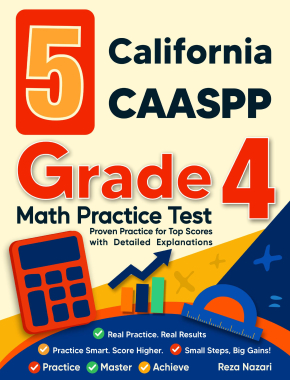
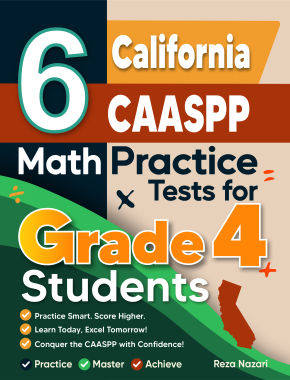
Try three sessions of 15–20 minutes each week. Start with Made Ridiculously Simple and the Grade 4 Math Workbook. During months 1 and 2, choose one skill for each session as you work through place value, whole-number operations, and fractions. In months 3 and 4, add measurement and geometry. Use selected sets from the five-test book and six-test book and reserve a different day to correct them. In months 5 and 6, use the seven-test book for mixed checkpoints, return to the guide for missed skills, and leave the final day light. Try a short online practice section early to get used to the screen.
Six weeks
Use the study guide and workbook three times a week for about 20 minutes. In week 1, compare the quiz with recent classwork and teacher feedback. Try a section in the Online Center. In weeks 2 and 3, focus on whole-number operations and fractions. In week 4, use a protractor or paper fold to review angles and symmetry, then revisit measurement and line plots. In weeks 5 and 6, choose a few questions from the six-test book that fit the session, then discuss missed answers before trying a fresh set. Keep the final day short.
30 days
Use Made Ridiculously Simple and the seven-test book. Plan four 15–20 minute sessions a week. During the first week, identify two focus skills from classwork, the quiz, and online practice. During the middle two weeks, pair a worked lesson with a small test set. Before starting another set, talk through a missed question and try a similar one. During the last week, try a fresh mixed set, revisit one weak topic, and finish with an easy example or a rest day.
One week
Set aside three 10–15 minute sessions. Revisit a worked example in the study guide, do a few Online Center or practice-book questions on that skill, and talk through a missed answer. Ask your child to try a similar one on their own. If rounding is still confusing, draw the two nearest multiples of ten thousand and mark the midpoint. Keep the day before testing quiet and familiar.
Before, during, and after testing
In the weeks before
Ask your child’s teacher when testing will happen and which two math skills would be most useful to practice. Use a short online session early enough to ask about tools or navigation. Ask which tools and supports are available and how your child can use them. Some supports are available without a formal plan. If your child has an individualized education program (IEP) or a Section 504 plan, confirm how their approved accommodations will work during testing.
On test day
Follow a familiar morning routine. Remind your child to read what the problem asks, follow the directions for entering the answer, and check whether its size makes sense. Before test day, practice a small reset together: breathe out slowly, reread the question, and choose one first step. Ask the school in advance how the child can request a break or get help with directions and technology.
After the test and when results arrive
Ask how testing felt and what helped when a problem got tricky. When the report arrives, look at it alongside classwork and ask the teacher for one practical next goal. Praise a strategy the child can repeat, such as drawing a diagram when a problem is hard to picture.
Books and practice resources
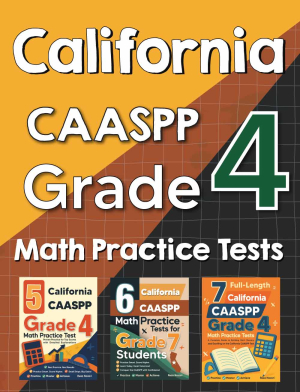
The Grade 4 practice bundle contains the five-, six-, and seven-test books. The study guide and workbook are available separately. Start with one worked lesson, give your child a few workbook problems on that skill, and save the practice tests for checking progress across topics. Leave time to discuss mistakes before opening a new set.
Start with a worked lesson
 Original price was: $29.99.$19.99Current price is: $19.99.
Read one example with your child and ask them to explain a step.
Practice the same skill
Original price was: $29.99.$19.99Current price is: $19.99.Use a workbook page while the example is still fresh.
Try a few mixed questions
Original price was: $27.99.$17.99Current price is: $17.99.Use selected questions from the five-test book and talk through a missed answer.
Check progress after a review
Original price was: $28.99.$18.99Current price is: $18.99.Choose a section from the six-test book and review it on a separate day.
Practice across topics
Original price was: $29.99.$19.99Current price is: $19.99.Use a seven-test book section to see which skills still need a short review.


California sources and Effortless Math practice
California Grade 4 math standards · CAASPP administration manual · California accessibility and calculator guidance · Effortless Math Online Center
Common questions
How long is the Grade 4 test?
The state uses about 1 hour 45 minutes for planning the math assessment, excluding setup and breaks. The assessment is untimed. Your school can confirm the schedule.
How much should we practice at home?
Start with 15–20 minutes a few days a week when there is enough time. If your child is tired, try one worked example and one fresh question.
What if my child does well on the quiz?
Ask how they solved a question and try a different skill later. The quiz is a sample. Use it with classwork and teacher feedback to decide what to practice.
Leave a comment
What has helped your fourth grader explain a tricky math problem? Share an example in the comments.

Related to This Article
More math articles
- 10 Most Common 7th Grade MAP Math Questions
- 10 Most Common TSI Math Questions
- Connecting People, Events, and Ideas
- The Function of a Sentence or Paragraph
- 49 Free RICAS Grade 5 Math Worksheets for Rhode Island Students (Aligned, One Skill Per Page)
- 3rd Grade PARCC Math Worksheets: FREE & Printable
- Functionalist, Conflict, and Interactionist Views of Education
- How to Help Your 4th Grade Student Prepare for the West Virginia WVGSA Math Test
- 3rd Grade NYSE Math Practice Test Questions
- IVF Due Date Calculator


What people say about "How to Help Your Child Prepare for the California Grade 4 CAASPP Math Test - Effortless Math"?
No one replied yet.