Free Grade 3 English Worksheets for Alaska Students
Somewhere around the middle of third grade, the reading homework changes shape. It stops being “read this list of words” and starts being “read this and tell me what it means.” That shift catches a lot of Alaska kids off guard, not because they can’t do it, but because nobody warned them the rules were about to change.
This page is a small pile of free worksheets for that moment. They’re aimed at Grade 3 students working through Alaska’s ELA standards, and they cover the slow, careful reading the AK STAR rewards. Each one is a single skill on a single page, and each one comes with an answer key that actually explains itself, not a one-line “C.” A real explanation of why C, written for the kid who got it wrong.
No accounts. No email forms. Click a title, the PDF opens, you print. If a teacher in Anchorage wants to use one in class and a parent in Bethel wants to print the same one at the kitchen table, both of you go right ahead.
What’s in here
The worksheets below cover what a Grade 3 teacher in Alaska is most likely working on between fall and spring: reading stories and pulling out what matters, reading articles without skipping the captions, spelling the words that don’t quite follow the rules, and writing sentences that actually say something. Alaska’s ELA standards are detailed, but the day-to-day skills look like this list.
A small confession: there are a lot of worksheets here. That’s not an invitation to print all of them. It’s an invitation to pick the one your kid needs *this week* and ignore the rest.
Reading: Literature
- Text Evidence in Stories, [RL.3.1] pointing to the sentence in the story that proves your answer
- Central Message, Lesson, or Moral, [RL.3.2] the lesson hiding behind the plot
- Describing Characters in a Story, [RL.3.3] traits, feelings, and why characters act the way they do
- Literal and Nonliteral Language, [RL.3.4] when words don’t quite mean what they say
- Parts of Stories, Dramas, and Poems, [RL.3.5] chapters, scenes, stanzas, and how they fit together
- Point of View in Stories, [RL.3.6] whose voice you’re listening to
- Illustrations in Stories, [RL.3.7] the picture is part of the reading
- Comparing Stories, [RL.3.9] two stories, side by side
Reading: Nonfiction
- Text Evidence in Nonfiction, [RI.3.1] back up the answer with the article, not your memory
- Main Idea and Key Details, [RI.3.2] what the article is mostly about, and what tells you so
- Sequence, Steps, and Cause & Effect, [RI.3.3] first, next, because, so
- Vocabulary in Nonfiction, [RI.3.4] the strange words science articles like to throw at you
- Text Features in Nonfiction, [RI.3.5] headings, captions, sidebars, the stuff people skip
- Author’s Point of View in Nonfiction, [RI.3.6] opinion vs. Fact
- Using Maps, Photos, and Diagrams, [RI.3.7] the picture does some of the work
- Logical Connections in Nonfiction, [RI.3.8] how one paragraph leads to the next
- Comparing Two Texts on the Same Topic, [RI.3.9] two writers, same subject, different angles
Foundational Reading Skills
- Prefixes and Suffixes, [RF.3.3a] un-, re-, -ful, -less
- Words with Latin Suffixes, [RF.3.3b] the -tion and -sion words that trip a lot of kids
- Decoding Multisyllable Words, [RF.3.3c] break the long words into pieces you can pronounce
- Irregularly Spelled Words (Sight Words), [RF.3.3d] the words you just have to know
- Reading Fluency: Rate and Expression, [RF.3.4b] read it so it sounds like a person talking
- Self-Correcting While You Read, [RF.3.4c] what to do when a sentence stops making sense
Working on Math Too? Try the Alaska AK STAR Grade 3 Math Bundle
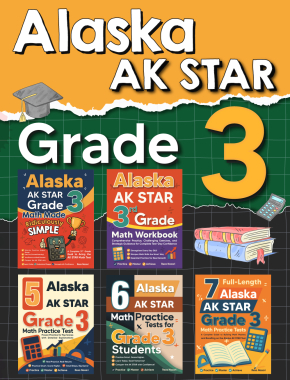
Many third graders are getting ready for the AK STAR in both subjects. If your child also needs math practice that matches the same standards, this companion bundle is the shortest path, workbook, study guide, and full practice tests in one download.
Writing
- Opinion Writing, [W.3.1] say what you think and prove it
- Informative / Explanatory Writing, [W.3.2] teach someone something
- Narrative Writing, [W.3.3] tell a story in order
- Organizing Writing for Task and Purpose, [W.3.4] different writing for different jobs
- Editing and Revising, [W.3.5] making a draft better, slowly
- Short Research Project, [W.3.7] ask a question, go find answers
- Gathering Information and Taking Notes, [W.3.8] writing down what matters
Listening and Speaking
- Listening for Main Idea (Read-Aloud), what was that read-aloud mostly about?
- Asking Questions of a Speaker, good questions after a talk
- Reporting on a Topic, telling the class about something clearly
Grammar
- Parts of Speech
- Regular and Irregular Plural Nouns
- Abstract Nouns
- Regular and Irregular Verbs
- Simple Verb Tenses
- Subject, Verb and Pronoun, Antecedent Agreement
- Comparative and Superlative Adjectives and Adverbs
- Coordinating and Subordinating Conjunctions
- Simple, Compound, and Complex Sentences
Capitalization, Punctuation, and Spelling
- Capitalizing Words in Titles
- Commas in Addresses and Dates
- Commas and Quotation Marks in Dialogue
- Possessives
- Conventional Spelling
- Spelling Patterns and Generalizations
- Using Reference Materials to Check Spelling
Vocabulary and Word Study
- Word Choice for Effect, [L.3.3a] pick vivid words on purpose
- Spoken vs. Written English, [L.3.3b] talking vs. Writing it down
- Context Clues, [L.3.4a] figure out a word from what’s around it
- Affixes for Vocabulary, [L.3.4b] word parts that change the meaning
- Root Words, [L.3.4c] the base word inside a bigger one
- Using Glossaries and Beginning Dictionaries
- Figurative Language: Similes, Metaphors, and Idioms
- Real-Life Word Connections, [L.3.5b] words tied to real things
- Shades of Meaning, [L.3.5c] close-but-not-the-same words
- Academic and Domain-Specific Vocabulary, [L.3.6] the school words
How to actually use these
The best way to use a stack of worksheets is to use almost none of them.
Pick a single skill your kid is struggling with right now. If the spelling pretests come home with red marks on multi-syllable words, start with Decoding. If your kid reads great but can’t tell you what the passage was about, start with Main Idea and Key Details. You’ll know which one when you look at last week’s homework.
Read the Quick Review out loud, together. The box at the top of every worksheet is the actual lesson. Treat it like a short conversation, not a paragraph to skim past.
Let the kid try the problems alone before you intervene. Hovering kills learning. Sit one room over with coffee. Come back when they’re done.
Go through the answer key together, including the right ones. Wrong answers teach. Right answers also teach, especially when your kid says “I guessed.” Then it’s a thinking conversation, not a grading conversation.
Wait a week before retrying the same skill. If a worksheet didn’t go well, don’t make them redo it tonight. Try a different worksheet on the same skill in five or six days. The forgetting and re-learning is where the strength comes from.
A note about AK STAR
A lot of Alaska families find pages like this in February or March because the AK STAR is on the calendar. The honest answer is that these worksheets aren’t a *cram-for-the-test* tool. They’re the same skills the test measures, taught one at a time. Steady practice over the year does more than two weeks of panic in April.
If you want one place to start, try Main Idea and Key Details for nonfiction and Text Evidence in Stories for fiction. Those two skills carry most of the reading test’s weight, and most third graders who struggle with AK STAR reading are struggling with one of them.
A few questions parents ask
Do these match the Alaska ELA standards? Yes. The Grade 3 standards focus on careful reading, evidence, and clear writing, and each worksheet targets one of those skills.
Can I use these for homeschool? Of course. Plenty of families in smaller Alaska districts and remote villages use online worksheets exactly this way, print, work, check, move on.
My kid reads way above grade level. Then what? Skip to Comparing Two Texts on the Same Topic and Figurative Language. Both push strong readers without being unfair.
My kid is struggling. Where do I start? Start with Context Clues and Prefixes and Suffixes. Those two are the secret levers, fix them, and a lot of other reading problems quietly get easier.
Before you go
If your kid prints a worksheet tonight, does half of it, and pushes it across the table, that’s fine. Try a shorter one. Try a different topic. Try again Saturday morning. The point isn’t to fill in every blank. It’s to think clearly for a few minutes. Come back when you need a fresh one.
Best Bundle to Ace the Alaska AK STAR Grade 3 ELA
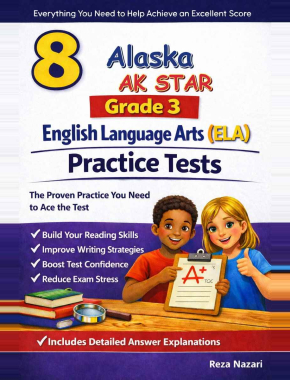
Looking for the best resource to help your kid ace the Alaska AK STAR? Try this bundle, four full practice-test books (5 + 6 + 7 + 8 tests) covering the same Grade 3 reading, writing, and language skills your child is already learning. Instant PDF download, answer keys included.

Related to This Article
More math articles
- How to Read Scientific Diagrams, Tables, and Graphs
- How to Add Three or More Fractions with Like Denominators
- Roulette Inside vs. Outside Bets: A Risk-Adjusted Comparison
- Top 10 ALEKS Math Practice Questions
- How to Grasp Orthogonal Vectors
- The Ultimate TExES Core Subjects Math Course (+FREE Worksheets & Tests)
- The Ultimate Algebra 2 Course
- The Best Grade 4 ELA Practice Tests for North Carolina Students
- Reading political maps
- Technology shifts the production relationship








What people say about "Free Grade 3 English Worksheets for Alaska"?
No one replied yet.