Exponent Rules Calculator (Product, Quotient, Power)
An exponent rules calculator simplifies powers by applying the laws of exponents one step at a time. With the same base, multiply by adding exponents, divide by subtracting them, and raise a power to a power by multiplying them: 23 × 24 = 27 = 128, and (2x3y)2 × x−4 = 4x2y2.
Show steps
- Read the expression(2x³y)²·x⁻⁴
- Power of a product rule(2x³y)² = 2²·x^(3·2)·y² = 4x⁶y² (raise every factor to the power and multiply exponents).
- Product rulex⁶ · x⁻⁴ = x^(6 + (−4)) = x² (same base: add the exponents).
- Answer4x²y²

How to use the exponent rules calculator
- Simplify mode: type an expression with numbers and letters, such as (3a^2b)^3/9a^4 or (16x^8y^-4)^(3/4). Use ^ for powers and put fractional exponents in parentheses.
- Two powers mode: enter a base and two exponents, then choose multiply, divide or power. This shows the product, quotient or power rule on its own, with the numeric value.
- One power mode: enter a base and a zero, negative or fractional exponent to see its exact value, such as 8−2/3 = 1/4.
The answer is written with positive exponents, followed by the same answer with negative exponents and, when there are fractional exponents, in radical form. A number check substitutes small primes for the letters and confirms that the original and the answer agree. For plain number powers such as 3.72.5, the numeric exponent calculator is the better tool.
The exponent rules
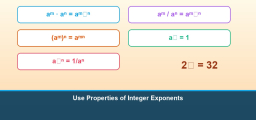
Every law of exponents comes from one idea: bn means n factors of b multiplied together. For a nonzero base b and rational exponents m and n:
- Product rule: bm · bn = bm + n. Same base, multiply, add the exponents.
- Quotient rule: bm ÷ bn = bm − n. Same base, divide, subtract the exponents.
- Power rule (power of a power): (bm)n = bmn. Multiply the exponents.
- Zero exponent rule: b0 = 1, because bn ÷ bn = b0 and anything nonzero divided by itself is 1.
- Negative exponent rule: b−n = 1/bn. A negative exponent means a reciprocal, not a negative number.
- Fractional exponent rule: bm/n = (n√b)m. The denominator is the root and the numerator is the power.
All the laws of exponents with examples
| Rule | Formula | Example |
|---|---|---|
| Product rule | bm × bn = bm+n | 23 × 24 = 27 = 128 |
| Quotient rule | bm ÷ bn = bm−n | 56 ÷ 52 = 54 = 625 |
| Power rule | (bm)n = bmn | (32)3 = 36 = 729 |
| Power of a product | (ab)n = anbn | (2x)3 = 8x3 |
| Power of a quotient | (a/b)n = an/bn | (x/3)2 = x2/9 |
| Zero exponent | b0 = 1 (b ≠ 0) | 70 = 1 |
| Negative exponent | b−n = 1/bn | 4−2 = 1/16 |
| Fractional exponent | bm/n = (n√b)m | 82/3 = 4 |
Worked examples: using several exponent rules at once
Example 1: (2x3y)2 × x−4
Power of a product rule first: (2x3y)2 = 22 · x3·2 · y2 = 4x6y2. Then the product rule for x: x6 · x−4 = x6 + (−4) = x2. The answer is 4x2y2. A common error is forgetting to square the 2, which gives 2x2y2.
Example 2: 6a5 ÷ 3a−2
Divide the numbers, 6 ÷ 3 = 2. Quotient rule for a: a5 − (−2) = a7. The answer is 2a7. Subtracting a negative exponent adds it, which is where most sign slips happen.
Example 3: (16x8y−4)3/4
Raise each factor to the 3/4 power. 163/4 = (4√16)3 = 23 = 8, x8·3/4 = x6 and y−4·3/4 = y−3. With positive exponents the answer is 8x6/y3.
Study tip: apply one rule at a time and write the rule’s name next to each line. If two lines in a row change more than one thing, a step was skipped.
Common mistakes with exponent rules
| Mistake | Correct version |
|---|---|
| Multiplying exponents in a product: x3 · x4 = x12 | Add them: x7. Multiply only for a power of a power. |
| Multiplying the bases: 23 · 24 = 47 | Keep the base: 27 = 128. |
| Treating a negative exponent as a negative number: 4−2 = −16 | It is a reciprocal: 1/16. |
| Forgetting parentheses: −32 vs (−3)2 | −32 = −9 but (−3)2 = 9; likewise 2x0 = 2 but (2x)0 = 1. |
| Raising only part of a product: (3x)2 = 3x2 | Every factor gets the power: 9x2. |
| Adding exponents across a sum: x2 + x3 = x5 | Exponent rules work for products and quotients, not sums; x2 + x3 does not simplify. |
Checking homework with the exponent rules calculator
Work the problem by hand first and name each rule as you use it. Then type the same expression and compare your lines with Show steps. If the answers differ, use the number check: substitute x = 2 (and y = 3) into your answer and into the original. If the two numbers do not match, your answer is wrong; if they match, the difference is only the form, for example x−2 versus 1/x2. Most teachers want the final answer with positive exponents only.
Exponent rules practice quiz: 10 questions
Test yourself with 10 multiple-choice questions. Choose an answer and press Submit to see if you are right and why. Your score appears at the end.
Product rule: same base, add the exponents. 4 + 5 = 9. Multiplying the exponents (x²⁰) is the power rule, which does not apply here.
Quotient rule: subtract the exponents, 10 − 4 = 6. Dividing the exponents is a common mistake.
A negative exponent means a reciprocal: 6⁻² = 1/6² = 1/36. It is not a negative number.
Any nonzero base to the power 0 equals 1. The whole product is in the parentheses, so the whole thing becomes 1.
Power of a product: every factor gets the power. 3³ = 27 and (x²)³ = x⁶.
The denominator 3 is a cube root and the numerator 2 is a square: (∛27)² = 3² = 9.
Multiply each exponent by −2: x^((−2)(−2)) = x⁴ and y^(3·(−2)) = y⁻⁶. With positive exponents: x⁴/y⁶.
2³ · 2² = 2^(3+2) = 2⁵. (2³)² = 2⁶ and 2¹⁰ ÷ 2² = 2⁸, while 2³ · 3² has different bases.
Quiz complete
Frequently asked questions
What are the exponent rules?
The main rules are the product rule (add exponents), the quotient rule (subtract exponents), the power rule (multiply exponents), the power of a product and of a quotient, the zero exponent rule (b0 = 1), the negative exponent rule (b−n = 1/bn) and the fractional exponent rule (bm/n is the nth root of bm).
What is the exponent power rule?
When a power is raised to another power, multiply the exponents: (bm)n = bmn. For example (x3)4 = x12. Do not confuse it with the product rule, x3 · x4 = x7, where the exponents are added.
What is the negative exponent rule?
A negative exponent means take the reciprocal: b−n = 1/bn. So 5−2 = 1/25, and a factor with a negative exponent in the denominator moves to the numerator: 1/x−3 = x3. The result is not negative.
What is the zero exponent rule?
Any nonzero base to the power 0 equals 1: 70 = 1 and (3xy)0 = 1. Watch the parentheses: 3x0 = 3 · 1 = 3, because only x has the 0 exponent. The expression 00 is left undefined in algebra.
How do exponent rules work with fractions?
A power of a fraction applies to the top and bottom: (2/5)2 = 4/25. A negative exponent flips the fraction: (2/5)−2 = (5/2)2 = 25/4. A fractional exponent is a root: 163/4 = (4√16)3 = 23 = 8.
How do you simplify expressions using exponent rules?
Remove parentheses with the power rules, combine the same bases with the product and quotient rules, then rewrite negative exponents as fractions. For (3a2b)3 ÷ 9a4: (3a2b)3 = 27a6b3, then 27 ÷ 9 = 3 and a6 − 4 = a2, giving 3a2b3.
Related calculators
- Exponent calculator: numeric powers such as 3.72.5
- Scientific notation converter: powers of ten in practice
- Radical simplifier: simplify roots that come from fractional exponents
- Logarithm calculator: solve for an unknown exponent
- Order of operations calculator: where exponents fit in PEMDAS

Related to This Article
More math articles
- Voting-eligible population
- Deciphering Chance: A Comprehensive Guide to Mutually Exclusive Events in Probability
- Top 10 Tips You MUST Know to Retake the CLEP College Math
- Agenda setting
- Advanced Vocabulary Words: Precocious to Redoubt
- Deciphering Change: Differential Equations in Daily Life
- The Best Grade 7 ELA Practice Tests for North Dakota Students
- Word Problems of Comparing and Ordering Rational Numbers
- Stair Calculator
- Top 10 Tips to Overcome ASVAB Math Anxiety








What people say about "Exponent Rules Calculator: Product, Quotient & Power Steps"?
No one replied yet.