Lived Religion, Conversion, and Religious Identity
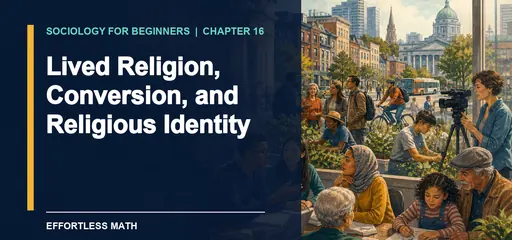
Chapter 16 of the Sociology for Beginners study guide on Effortless Math covers Lived Religion, Conversion, and Religious Identity: the key terms, the core ideas, and worked examples showing how this topic is tested on this course.
Sociology for Beginners · Chapter 16
Lived Religion, Conversion, and Religious Identity
Official doctrine tells only part of the story. Lived religion is the study of how people practice, interpret, and combine religious meanings in everyday life. A person may attend rarely yet pray daily, follow dietary rules, display a sacred object, care for relatives as a religious duty, or seek guidance online. Another person may attend services for family, music, or community while feeling uncertain about belief. Surveys of affiliation and attendance remain useful, but they measure different dimensions.
Religious identity can be assigned, chosen, inherited, challenged, or revised. Family socialization may introduce stories and rituals before a child can explain them. Schools, peers, migration, marriage, and political conflict can later strengthen or weaken identification. The key sociological question is not whether the identity is sincere. It is how people learn it, perform it, and negotiate it with other roles.
Conversion is a substantial change in religious identity, commitment, or worldview. Sudden transformation stories are memorable, yet many conversions unfold through relationships and repeated participation. A person may first join friends at events, adopt a new vocabulary, learn ritual expectations, build new ties, and later describe the experience as a decisive turning point. The biography is real, and the network helps explain how the change became possible.
Conversion can also require role exit. A convert may leave earlier routines, explain the change to relatives, and enter a community with new expectations. Researchers should avoid treating the convert as passively programmed. People interpret teachings, compare groups, resist some demands, and shape their own account of change.
Religious switching means changing affiliation. Disaffiliation means leaving an organized identity, although private belief or spiritual practice may remain. A survey showing growth in the religiously unaffiliated cannot by itself tell us whether respondents rejected belief, distrusted organizations, changed labels, or combined practices outside formal membership. Interviews can reveal those different pathways.
Quick review: Lived religion follows practice in ordinary life. Conversion changes religious identity or commitment and often develops through biography and relationships. Switching changes affiliation. Disaffiliation can occur while some beliefs and practices remain, so measurement must match the claim.
Watch the lesson connection
Religion in Society gives you a second explanation of the ideas surrounding this lesson. As you watch, pause when the lesson concept appears and explain how the example fits.
Try the idea yourself
Write one original example, one close nonexample, and one observation that would help you tell them apart. That small exercise turns a definition into a sociological tool you can use in daily life.

Related to This Article
More math articles
- The Best Grade 8 ELA Practice Tests for Missouri Students
- 8th Grade SBAC Math Worksheets: FREE & Printable
- Using Distributive Property to Factor Variable Expressions
- Oregon OSAS Grade 8 Math Free Worksheets: Printable Grade 8 Math Practice with Answer Keys
- The Ultimate 6th Grade NHSAS Math Course (+FREE Worksheets)
- How to Solve Radical Equations? (+FREE Worksheet!)
- Build a Word, Then Check It Against the Whole Word
- Negative Externalities: Social Cost and Corrective Taxes
- How to Understanding Onto (Surjective) Functions
- Greek Roots for Science, Time, and Thought






















What people say about "Lived Religion, Conversion, and Identity"?
No one replied yet.