Conflict, White-Collar Crime, and Corporate Power
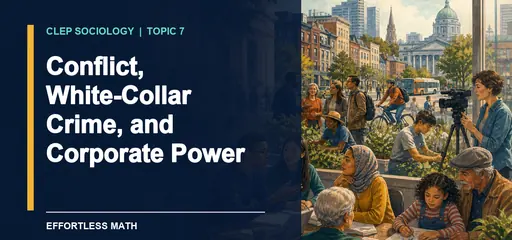
Chapter 7 of the CLEP Sociology study guide on Effortless Math covers Conflict, White-Collar Crime, and Corporate Power: the key terms, the core ideas, and worked examples showing how this topic is tested on the exam.

CLEP Sociology – Chapter 7
Conflict, White-Collar Crime, and Corporate Power
CLEP Introductory Sociology · Chapter 7
Conflict approaches ask how unequal power influences the creation of law, definitions of deviance, enforcement priorities, and penalties. Groups with greater political and economic resources may have more ability to present their interests as public interests or to keep harmful practices outside criminal categories.
This claim is not that every law serves only powerful groups. Laws can protect broad interests, emerge from social movements, and constrain elites. The conflict question remains useful because influence, surveillance, legal help, and the costs of punishment are distributed unequally.
White-collar crime, a term associated with Edwin Sutherland, refers to crime committed by respectable or high-status people in the course of occupation. Accounting fraud, insider trading, bribery, false claims, and deliberate regulatory violations are standard examples. Status and occupational setting define the category, not low harm.
Corporate crime is committed by employees or executives on behalf of a corporation or to advance its interests. An executive who conceals safety defects to protect company profit illustrates corporate crime. Occupational crime uses a job for personal gain, such as an employee secretly diverting client payments. Both can be white-collar offenses, but the intended beneficiary differs.
Organizational violations may create extensive financial or physical harm while receiving less public attention than visible street offenses. Their evidence can be buried in records, spread across many victims, and difficult to investigate without technical expertise. Visibility affects enforcement even before unequal influence is considered.
Power enters at several stages. Legislatures define offenses and penalties. Agencies decide inspection priorities. Police and prosecutors exercise discretion. Defendants differ in access to counsel, time, money, and public credibility. Sentences and criminal records can then carry unequal consequences across work, housing, family, and citizenship.
Disparity alone does not identify its cause. A difference in arrest totals can reflect population size, exposure, reporting, enforcement, behavior, legal definitions, or several processes together. A conflict claim needs evidence that a resource, rule, or institutional decision channels unequal treatment.
Labeling theory and conflict theory overlap in attention to rule application. Labeling usually follows what a designation does to identity and later opportunity. Conflict theory follows power in lawmaking, surveillance, enforcement, defense, and penalty. A criminal record becoming a master status supports labeling. Industry influence over a weak safety law supports conflict.
Researchers can test power rather than assume it. They can compare penalties for similar harms, trace lobbying and agenda setting, examine enforcement budgets, measure legal representation, and identify which violations receive public attention. Evidence should connect the resource or decision to the outcome.
Organizational structure can diffuse responsibility. One unit sets an aggressive sales target, another designs the reporting form, and a third approves transactions without seeing the whole pattern. That division can make harmful conduct routine while each participant claims a narrow task. Evidence from emails, incentive plans, reporting lines, and repeated warnings can connect the pieces. The mechanism differs from one employee secretly stealing for personal gain.
A matched-harm comparison can test a conflict claim. Researchers might compare financial loss, physical injury, legal classification, investigative staffing, and penalties across corporate and street offenses. Similar harm with sharply different treatment raises a question, though it still does not prove elite influence. Lobbying records, agency budgets, access to lawmakers, or documented charging policy can supply the missing link. In a CLEP stem, occupational setting identifies the offense category. Evidence about agenda control or enforcement resources identifies the conflict mechanism.
Regulatory capture is a specific claim, not a synonym for any weak rule. It occurs when an agency comes to serve the industry it is meant to oversee through personnel ties, information dependence, political pressure, or future employment incentives. Industry expertise alone does not establish capture. Researchers look for repeated decisions favoring regulated firms, suppressed internal warnings, revolving-door patterns, and access that affected groups lack. A CLEP stem must supply that institutional link before the term is justified.
Quick review: White-collar crime identifies status and occupational setting. Corporate crime benefits the organization. Occupational crime benefits the individual through a job. Conflict analysis asks how power shapes the rule and its enforcement.
Watch the chapter connection
Deviance gives you a second explanation of the chapter ideas surrounding this lesson. As you watch, pause when the lesson concept appears and explain how the example fits.
Use this lesson for CLEP practice
Write one original example, one close nonexample, and one observation that would help you choose between them. This turns vocabulary recognition into the kind of applied reasoning the exam expects.

Related to This Article
More math articles
- CHSPE Math FREE Sample Practice Questions
- Human Impact, Climate, and Biodiversity
- Modular Arithmetic Calculator (mod, Inverse & More)
- Best Calculator for the PSAT: Bluebook and 5 Handheld Options
- Scientific Reasoning in Chemistry: Observations, Models, and Fair Tests
- Advanced Vocabulary Words: Fantastic to Garrison
- Understanding Betting Odds
- Hyperbola Calculator — Vertices, Foci & Asymptotes
- 4th Grade PARCC Math Practice Test Questions
- Central Limit Theorem and Standard Error


















What people say about "Conflict, White-Collar Crime | CLEP Sociology"?
No one replied yet.