What is the Hardest Math on the GED Test?

If you’re preparing for the GED (General Educational Development) math test, you may wonder which topics are the most challenging. The GED Mathematical Reasoning test covers a wide range of concepts, but certain areas consistently give test-takers the most trouble. Understanding what’s hardest can help you focus your study time effectively, build confidence where it matters most, and create a targeted study plan that maximizes your score.
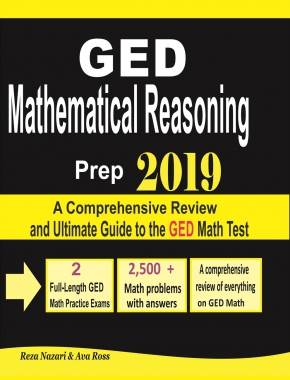
The Absolute Best Book to Ace the GED Math Test
Our Best Seller Books
The Most Challenging GED Math Topics
1. Algebra and Algebraic Reasoning
Many test-takers find algebra the hardest section. This includes solving linear equations and inequalities, working with expressions, understanding functions, and manipulating variables. Word problems that require setting up and solving equations are especially tricky because you must translate real-world situations into mathematical language. Common stumbling blocks include combining like terms, distributing correctly, and knowing when to add, subtract, multiply, or divide both sides of an equation. Practice with our GED math worksheets to build confidence.
2. Quadratic Equations and Functions
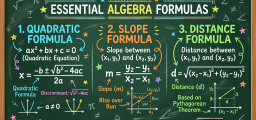
Quadratics—equations with x²—require factoring, the quadratic formula, and understanding parabolas. These concepts build on algebra basics, so a weak foundation makes them even harder. Many students struggle with recognizing when to use each method: factoring works for “nice” trinomials, while the quadratic formula handles any quadratic. Completing the square appears less often but is another valid approach. Understanding the discriminant (b² − 4ac) helps you predict whether solutions are real or complex.
3. Geometry and Measurement
Area, perimeter, volume, and the Pythagorean theorem appear frequently. Applying formulas to word problems and visualizing shapes can be difficult. You’ll need to know formulas for rectangles, triangles, circles, and common 3D shapes like cylinders and rectangular prisms. The Pythagorean theorem (a² + b² = c²) is essential for right triangles. Scale drawings and similar figures also show up. Our math resources include geometry practice for the GED.
4. Data Analysis and Statistics
Interpreting graphs (bar, line, scatter, pie), finding mean/median/mode, and understanding probability require careful reading and reasoning. Misreading a graph or mixing up statistical measures is a common mistake. You’ll also encounter box plots, histograms, and questions about data spread and outliers. Probability questions often involve counting outcomes or using simple formulas like P(A) = favorable outcomes / total outcomes.
5. Multi-Step Word Problems
Perhaps the biggest challenge isn’t a single topic but word problems that combine multiple skills. You must read carefully, identify what’s being asked, choose the right approach, and execute several steps correctly. A single problem might require setting up an equation, solving it, and then interpreting the result in context. Time pressure makes these even harder.
Why These Topics Are Hard
Many adult learners have gaps from earlier schooling. Algebra and geometry build on arithmetic and fractions—if those foundations are shaky, advanced topics feel impossible. The GED test assumes you can work fluently with fractions, decimals, and percent before tackling algebra. The good news: with focused practice, these skills can be rebuilt. Check out our GED math books for structured preparation.
How to Tackle the Hardest Parts
- Start with basics: Strengthen fractions, decimals, and percent before algebra. Many algebra errors stem from arithmetic mistakes.
- Practice word problems daily: They’re the most common format on the test. Work on translating words into equations.
- Use the calculator wisely: The GED provides an on-screen calculator for part of the test. Know when to use it and when mental math is faster.
- Take full-length practice tests: Build stamina and identify weak areas. The test is long—practice sitting through it.
- Learn from mistakes: After each practice problem, understand why you got it wrong and how to avoid that error next time.
Test Format and Time Management
Our Top Picks for This Month
Recommended Math Practice Resource
The GED Mathematical Reasoning test is divided into two parts. Part 1 allows a calculator; Part 2 does not. Knowing which part you’re in helps you plan. Budget your time—don’t get stuck on one hard problem. Skip it, answer easier questions, and return if time permits.
Frequently Asked Questions
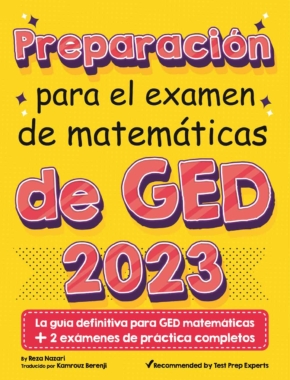
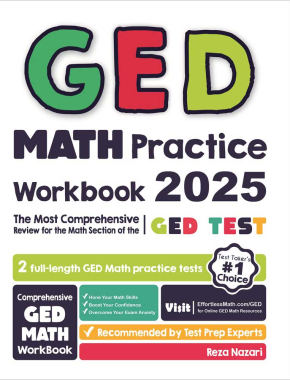
Recommended Resources
Is the GED math test mostly algebra?
Roughly 45% is algebraic reasoning, 55% quantitative problem-solving (which includes number operations, geometry, and data). Both areas matter, so don’t neglect arithmetic or geometry.
Can I pass the GED math without knowing quadratics?
You can pass, but quadratics do appear. A basic understanding improves your score and confidence. At minimum, know the quadratic formula and when to use it.
How many questions are on the GED math test?
The test has about 46 questions and is 115 minutes long. That’s roughly 2.5 minutes per question, so pacing is important.
What’s the passing score?
You need a score of 145 or higher on each subject test. A score of 165 or above is “College Ready,” indicating you’re prepared for credit-bearing college courses.

Related to This Article
More math articles
- Best Calculators fоr Algеbrа
- Grade 3 Math: Telling Time
- Geometry Puzzle – Challenge 61
- Convert Rational Numbers to a Fraction
- 4th Grade MEAP Math FREE Sample Practice Questions
- How to Prepare for the CLEP College Mathematics Test?
- Clearing the Fog: How to Identify Independent and Dependent Variables
- Integrals: Everything You Need To Know
- Innovative Forecasts: Population Models are Predicting the Future
- Multi-Digit Multiplication for 5th Grade: Standard Algorithm

What people say about "What is the Hardest Math on the GED Test? - Effortless Math: We Help Students Learn to LOVE Mathematics"?
No one replied yet.