Top 10 7th Grade Common Core Math Practice Questions

TL;DR: Heading into seventh-grade math with a Common Core test on the horizon? These 10 practice questions zero in on what shows up most: proportional relationships, percent change, integer operations, expressions, and basic statistics. Each one comes with the full work shown, so when your student misses one you can talk through the reasoning instead of just the answer. Use them as a quick warm-up to find which topics still need a little more time.
Key takeaways:
- These 10 questions span every grade-7 Common Core cluster.
- Aligned with the CCSS-M grade 7 standards (7.RP, 7.NS, 7.EE, 7.G, 7.SP).
- Each question has a worked solution showing the full reasoning chain.
- Useful in any state that uses Common Core or a Common Core-based framework.
- Practice steadily – grade 7 introduces proportional reasoning, the foundation for algebra.
1- A rope weighs \(800\) grams per meter of length. What is the weight in kilograms of \(12.2\) meters of this rope? (\(1\) kilogram \(= 1000\) grams)
A. \(0.0976\)
B. \(0.976\)
C. \(9.76\)
D. \(9760\)
2- Jason needs an \(75\%\) average in his math class to pass. On his first four exams, he earned scores of \(68\), \(72\), \(85\), and \(90\). What is the minimum score Jason can earn on his fifth and final test to pass?_________
3- In the figure below, the two triangles are similar. What is the value of \(x\)?
A. \(7\)

B. 8
C. 18
D. 45
4- Right triangle ABC has two legs of lengths 6 cm (AB) and 8 cm (AC). What is the length of the third side (BC)?
A. 4 cm
B. 6 cm
C. 8 cm
D. 10 cm
5- The marked price of a computer is D dollar. Its price decreased by \(20\%\) in January and later increased by \(10\%\) in February. What is the final price of the computer in D dollar?
A. 0.80 D
B. 0.88 D
C. 0.90 D
D. 1.20 D
6- \([6 × (–24) + 8] – (–4) + [4 × 5] ÷ 2 = \)?
A. \(-122\)
B. \(-112\)
C. \(-102\)
D. \(-92\)
7- The area of a circle is \(64 π\). What is the circumference of the circle?
A. \(8 π\)
B. \(16 π\)
C. \(32 π\)
D. \(64 π\)
8- A $40 shirt now selling for $28 is discounted by what percent?
A. \(20\%\)
B. \(30\%\)
C. \(40\%\)
D. \(60\%\)
9- From last year, the price of gasoline has increased from $1.25 per gallon to $1.75 per gallon. The new price is what percent of the original price?
A. \(72\%\)
B. \(120\%\)
C. \(140\%\)
D. \(160\%\)
10- If \(40\%\) of a class are girls, and \(25\%\) of girls play tennis, what fraction of the class play tennis?

A. \(10\%\)
B. \(15\%\)
C. \(20\%\)
D. \(40\%\)
Best 7th Grade Common Core Math Workbook Resource for 2026
Answers:
1- C
The weight of 12.2 meters of this rope is: 12.2 \(×\) 600 g = 7320 g
1 kg = 1000 g therefore,
7320 g \(÷\) 1000 = 7.32 kg
2- 60
Jason needs an \(75\%\) average to pass for five exams. Therefore, the sum of 5 exams must be at lease \(5 × 75 = 375\)
The sum of 4 exams is:
68 + 72 + 85 + 90 = 315
The minimum score Jason can earn on his fifth and final test to pass is:
375 to 315 = 60
3- A
It’s needed to have a ratio to find value of \(x\).
\(\frac{45}{40}=\frac{2x+4}{16}⇒ 40(2x+4)=45×16 ⇒ x=7\)
4- D
Use Pythagorean Theorem: \(a^2 + b^2 = c^2\)
\(62 + 82 = c^2 ⇒ 100 = c^2 ⇒ c = 10\)
5- B
To find the discount, multiply the number by (\(100\% -\) rate of discount).
Therefore, for the first discount we get:
(D) (\(100\% – 20\%) =\) (D) (0.80) = 0.80 D
For increase of \(10%\):
(0.80 D) (\(100\% + 10\%) =\) (0.85 D) (1.10) = 0.88 D \(= 88\%\) of D
6- A
Use PEMDAS (order of operation):
\([6 × (– 24) + 8] – (– 4) + [4 × 5] ÷ 2 = [– 144 + 8] – (– 4) + [20] ÷ 2 = [– 144 + 8] – (– 4) + 10 =
[– 136] – (– 4) + 10 = [– 136] + 4 + 10 = – 122\)
7- B
Use the formula of areas of circles.
Area \(= πr^2 ⇒ 64 π = πr^2 ⇒ 64 = r^2 ⇒ r = 8\)
Radius of the circle is 8. Now, use the circumference formula:
Circumference \(= 2πr = 2π (8) = 16 π\)
8- B
Use the formula for Percent of Change
\(\frac{New \space Value \ – \ Old \space Value}{Old \space Value}× 100\%\)
\(\frac{28-40}{40}× 100\% = – 30\% \)
(negative sign here means that the new price is less than old price).
9- C
The question is this: 1.75 is what percent of 1.25?
Use percent formula:
part \(= \frac{percent}{100}×\) whole
\(\frac{percent}{100}× 1.25 ⇒ 1.75 = \frac{percent ×1.25}{100}⇒175 =\) percent \(×1.25 ⇒\) percent \(= \frac{175}{1.25}= 140\)
10- A
Let \(x\) be the amount of students in the class.
\(40\%\) of \(x =\) girls
\(25\%\) of girls = tennis \space player
Input \(40\%\) of a class instead of girls in second formula. Therefore, \(25\%\) of \(40\%\) of a class = tennis player
tennis player \(= 10\%\)
Looking for the best resource to help you succeed on the 7th Grade Common Core Math test?
The Best Books to Ace the 7th Grade Common Core Math Test
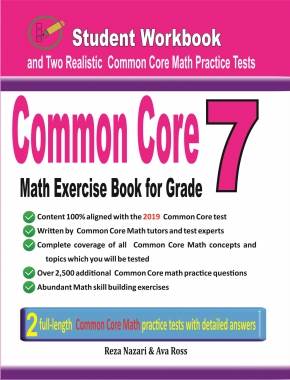
Common Core Math Exercise Book for Grade 7 Student Workbook and Two Realistic Common Core Math Tests
Recommended EffortlessMath Books
For more practice on every grade-7 skill, Pre-Algebra for Beginners covers ratios, percents, integers, and expressions with worked examples. For extra word-problem reps (the hardest section for many seventh graders), Mastering Grade 7 Math Word Problems packs in hundreds of problems with full solutions.
Frequently Asked Questions
What’s on the Common Core Grade 7 math test?
Five clusters: Ratios and Proportional Relationships (7.RP), The Number System with integers and rationals (7.NS), Expressions and Equations including linear equations (7.EE), Geometry with area and circles (7.G), and Statistics and Probability (7.SP). Proportional reasoning is the headline skill – it carries into grade 8 and Algebra I.
What’s a proportional relationship?
A relationship where two quantities scale together at a constant rate: \(y = kx\) for some constant \(k\). If 3 books cost \(\$12\), then 5 books cost \(\$20\) – the rate is \(\$4\) per book, and \(y = 4x\). On a graph, proportional relationships are straight lines through the origin.
How do I solve a percent change problem?
Use the formula \(\text{percent change} = \dfrac{\text{new} – \text{old}}{\text{old}} \times 100\%\). Going from 80 to 100: \(\dfrac{100-80}{80} \times 100\% = 25\%\) increase. Going from 100 to 80: \(\dfrac{80-100}{100} \times 100\% = -20\%\), a 20% decrease. The base is always the OLD value.
How do I add negative numbers?
If signs match, add the absolute values and keep the sign: \(-5 + (-3) = -8\). If signs differ, subtract the smaller absolute value from the bigger one and take the sign of the bigger: \(-5 + 3 = -2\); \(5 + (-3) = 2\). Picture a number line – you’re always moving left for adding negatives.
How do I multiply two negatives?
The result is positive: \((-3) \times (-4) = 12\). Same with division: \((-15) \div (-3) = 5\). The rule: two negatives make a positive. One negative makes the answer negative: \(3 \times (-4) = -12\). This trips kids up; practice until the sign-tracking is automatic.
How do I find the circumference and area of a circle?
Circumference: \(C = 2\pi r\) or \(C = \pi d\). Area: \(A = \pi r^2\). For a circle with radius 5: \(C = 2\pi(5) = 10\pi \approx 31.4\); \(A = \pi(5)^2 = 25\pi \approx 78.5\). Use \(\pi \approx 3.14\) or \(\dfrac{22}{7}\) – check what the question wants.
What’s the difference between theoretical and experimental probability?
Theoretical probability is what should happen based on the math: rolling a 6 on a fair die is \(\dfrac{1}{6}\). Experimental probability is what actually did happen: roll the die 60 times and get 9 sixes, so the experimental probability is \(\dfrac{9}{60} = 0.15\). Over many trials, experimental approaches theoretical.
How do I solve a two-step linear equation?
Reverse the order of operations. For \(3x – 7 = 14\), first undo the subtraction (add 7 to both sides): \(3x = 21\). Then undo the multiplication (divide both sides by 3): \(x = 7\). Always do the same thing to both sides, and check by substituting back: \(3(7) – 7 = 14\).
What statistics show up at grade 7?
Mean, median, mode, range, mean absolute deviation, plus drawing inferences from samples. Big idea: a random sample of a population can tell you about the whole population if the sample is large and unbiased. Example: “A sample of 50 students prefers chocolate over vanilla 30 to 20. Estimate the preference in a population of 500.” Scale up: about 300 chocolate, 200 vanilla.
Where can we get more Common Core Grade 7 practice?
EffortlessMath has Common Core Grade 7 full-length practice tests, the Pre-Algebra for Beginners workbook, and a focused Grade 7 Math Word Problems book. The Related Lessons section below links to step-by-step explanations of the biggest seventh-grade skills.
Related EffortlessMath Lessons
If a topic on this page feels rusty, these short lessons go deeper:
- How to find the percent of a number
- How to solve percent of change
- How to find the slope
- How to solve discount, tax, and tip word problems
- How to solve multi-step word problems

Related to This Article
More math articles
- Volume Practice — Prisms & Cubes (Free Drills)
- Reading and Writing Numbers for 5th Grade: Standard, Word, and Expanded Form
- Free Grade 8 English Worksheets for New Hampshire Students
- Hyperbola in Standard Form and Vertices, Co– Vertices, Foci, and Asymptotes of a Hyperbola
- Maryland Grade 4 Math Worksheets: 43 Free Printable PDFs
- RBT Partial Interval vs Whole Interval vs Momentary Time Sampling (2027 Prep)
- 7th Grade AZMerit Math Worksheets: FREE & Printable
- Split-ticket voting
- Selecting and Integrating Evidence
- How to Use Lattice Multiplication Method



What people say about "Top 10 7th Grade Common Core Math Questions"?
No one replied yet.