How to Identify Errors Involving the Order of Operations?
Order of operations errors are among the most frequent mistakes on the GED Math test. A single misstep — like adding before multiplying — can turn a correct setup into a wrong answer. This lesson teaches you to identify, understand, and correct those errors using the PEMDAS framework, so you can catch mistakes in your own work and in test questions that ask you to spot someone else’s error.
What Is the Order of Operations?
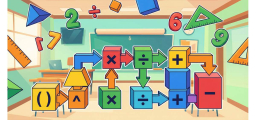
The order of operations is a set of rules that tells you which calculations to perform first in a mathematical expression. The standard acronym is PEMDAS:
- P — Parentheses (and all grouping symbols: brackets, braces, absolute value)
- E — Exponents (powers and roots)
- \(\color{blue}{\frac{M}{D}}\) — Multiplication and Division (left to right)
- \(\color{blue}{\frac{A}{S}}\) — Addition and Subtraction (left to right)
When two operations share the same priority (multiplication and division, or addition and subtraction), you work from left to right.
Common Errors and How to Identify Them
Error 1: Adding or subtracting before multiplying or dividing
Wrong: \(\color{blue}{3 + 4 \times 2 = 7 \times 2 = 14}\)
Correct: Multiply first: \(\color{blue}{4 \times 2 = 8}\), then add: \(\color{blue}{3 + 8 = 11}\).
The error is performing addition before multiplication.
Error 2: Ignoring exponents before other operations
Wrong: \(\color{blue}{2^{3} + 4 \div 2 = 2^{7} = 128}\) (adding the exponent to the next number)
Correct: Evaluate exponent first: \(\color{blue}{2^{3} = 8}\); then divide: \(\color{blue}{4 \div 2 = 2}\); then add: \(\color{blue}{8 + 2 = 10}\).
Error 3: Performing left-to-right operations out of order
Wrong: \(\color{blue}{18 \div (2 + 1) \times 3 = 18 \div 3 = 6}\) (divides all of 18 by 3 then ignores the ×3)
Correct: Parentheses first: \(\color{blue}{2 + 1 = 3}\); then left to right: \(\color{blue}{18 \div 3 = 6}\), \(\color{blue}{6 \times 3 = 18}\).
Error 4: Not squaring before subtracting
Wrong: \(\color{blue}{5^{2} – 3 \times (4 – 1) = 25 – 3 \times 3}\) but then computed as \(\color{blue}{22 \times 3 = 66}\)
Correct: Parentheses: \(\color{blue}{4 – 1 = 3}\); Exponent: \(\color{blue}{5^{2} = 25}\); Multiply: \(\color{blue}{3 \times 3 = 9}\); Subtract: \(\color{blue}{25 – 9 = 16}\).
Step-by-Step Summary
- Scan the expression for grouping symbols (parentheses, brackets). Evaluate innermost first.
- Evaluate all exponents.
- Perform all multiplication and division, working left to right.
- Perform all addition and subtraction, working left to right.
- When checking someone else’s work, redo each step yourself and identify the first step that differs.
Watch: Order of Operations Explained (Math Antics)
Math Antics provides a clear, visual explanation of PEMDAS and why the rules exist:
Worked Examples
Example 1: Find and correct the error: a student wrote \(\color{blue}{10 – 2 \times 3 + 1 = 25}\).
The student likely computed \(\color{blue}{(10 – 2) \times (3 + 1) = 8 \times 4 = 32}\) or some other wrong grouping.
Correct: Multiply first: \(\color{blue}{2 \times 3 = 6}\). Then left to right: \(\color{blue}{10 – 6 + 1 = 5}\).
The error: performing subtraction and addition before multiplication.
Example 2: A student simplified \(\color{blue}{(5 + 3)^{2} \div 4}\) as follows: \(\color{blue}{25 + 9 \div 4 = 25 + 2.25 = 27.25}\). What is the error?
The student incorrectly expanded \(\color{blue}{(5 + 3)^{2}}\) as \(\color{blue}{5^{2} + 3^{2}}\).
Correct: Parentheses first: \(\color{blue}{5 + 3 = 8}\); Exponent: \(\color{blue}{8^{2} = 64}\); Divide: \(\color{blue}{64 \div 4 = 16}\).
Example 3: Evaluate correctly: \(\color{blue}{6 + 2^{3} \times 5 – 4}\).
Exponent: \(\color{blue}{2^{3} = 8}\). Multiply: \(\color{blue}{8 \times 5 = 40}\). Left to right: \(\color{blue}{6 + 40 – 4 = 42}\).
Example 4: Evaluate: \(\color{blue}{4 \times (3 + 2^{2}) – 6}\).
Inside parentheses, exponent first: \(\color{blue}{2^{2} = 4}\), then \(\color{blue}{3 + 4 = 7}\). Multiply: \(\color{blue}{4 \times 7 = 28}\). Subtract: \(\color{blue}{28 – 6 = 22}\).
More Practice: Order of Operations with 4 Examples (Math with Mr. J)
Math with Mr. J demonstrates PEMDAS with four complete worked examples:
Exercises
Evaluate each expression correctly using PEMDAS.
- \(\color{blue}{3 + 4 \times 2}\)
- \(\color{blue}{2^{3} + 4 \div 2}\)
- \(\color{blue}{(5 + 3)^{2} \div 4}\)
- \(\color{blue}{10 – 2 \times 3 + 1}\)
- \(\color{blue}{18 \div (2 + 1) \times 3}\)
- \(\color{blue}{5^{2} – 3 \times (4 – 1)}\)
Answers
- \(\color{blue}{11}\) (multiply first: \(\color{blue}{4\times 2=8}\), then \(\color{blue}{3+8}\))
- \(\color{blue}{10}\) (\(\color{blue}{2^{3}=8}\), \(\color{blue}{4\div 2=2}\), then \(\color{blue}{8+2}\))
- \(\color{blue}{16}\) (\(\color{blue}{(5+3)=8}\), \(\color{blue}{8^{2}=64}\), \(\color{blue}{64\div 4}\))
- \(\color{blue}{5}\) (\(\color{blue}{2\times 3=6}\), then \(\color{blue}{10-6+1}\))
- \(\color{blue}{18}\) (\(\color{blue}{2+1=3}\), \(\color{blue}{18\div 3=6}\), \(\color{blue}{6\times 3}\))
- \(\color{blue}{16}\) (\(\color{blue}{4-1=3}\), \(\color{blue}{5^{2}=25}\), \(\color{blue}{3\times 3=9}\), \(\color{blue}{25-9}\))
Pre-Algebra for Beginners 2026 The Ultimate Step by Step Guide to Preparing for the Pre-Algebra Test
Frequently Asked Questions
What does PEMDAS stand for?
PEMDAS stands for Parentheses, Exponents, Multiplication/Division (left to right), Addition/Subtraction (left to right). It is the standard order in which to perform mathematical operations.
Does multiplication always come before division?
No. Multiplication and division have the same priority level. When both appear, you work from left to right. For example, \(\color{blue}{12 \div 4 \times 3 = 3 \times 3 = 9}\) (divide first because it is leftmost).
How can I check my order of operations work?
Work through the expression step by step and write down each intermediate result. Then re-check each step by asking: “Should I have done this operation before the previous one?” Using parentheses to mark completed sub-expressions helps avoid mistakes.
Related Topics

Related to This Article
More math articles
- Judicial independence
- Minnesota MCA Grade 4 Math Free Worksheets: Printable Grade 4 Math Practice You Can Download Free
- How to Find Midpoint? (+FREE Worksheet!)
- Recruiting candidates
- Top 10 PSAT 8/9 Math Prep Books (Our 2026 Favorite Picks)
- The Atmosphere and Air Pressure
- The Best Grade 3 ELA Practice Tests for Utah Students
- HSPT Math FREE Sample Practice Questions
- The Fascinating Applications of Algebraic Manipulation in Limits
- Collective Action, Environmental Inequality, and Environmental Racism



What people say about "How to Identify Errors Involving the Order of Operations? - Effortless Math"?
No one replied yet.