How to Understand the Real Number Line
Step 1: Distinction Between Rational and Irrational Numbers
- Rational Numbers (Q): These can be expressed as the quotient or fraction (frac{p}{q}) of two integers, where (p) (numerator) and (q) (denominator) are integers and (q≠0). Examples include (frac{1}{2}, 5, -3), etc.
- Irrational Numbers: Numbers that can’t be written as simple fractions or ratios. This set includes numbers like (π) and (sqrt{2}), which don’t terminate or repeat in their decimal form.
Step 2: Bridging The Gap, The Union
Step 3: Visualizing the Infinite: The Real Number Line
Step 4: Diving Deeper: Intervals and Bounds
- Open Intervals: Represented as ((a, b)), it includes all numbers between (a) and (b) but not the endpoints themselves.
- Closed Intervals: ([a, b]) includes all the numbers between and including (a) and (b).
- Infinite Intervals: These can be open or closed on one side and stretch infinitely on the other, like ([a, ∞)) or ((-∞, b]).
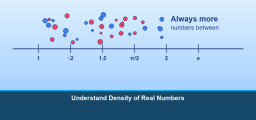
Step 5: Density Property
Step 6: Beyond the Real, A Glimpse
Step 7: Conclusion
Examples:

Locate (−2.5) on the number line.
Solution:
Consider the number (−2.5). This is a rational number, and on the real number line, it would be located to the left of (0) and halfway between (-2) and (-3).

Original price was: $109.99.$54.99Current price is: $54.99.
Original price was: $109.99.$54.99Current price is: $54.99.

Related to This Article
More math articles
- How to Use Comparison test for Convergence
- 10 Most Common 6th Grade ACT Aspire Math Questions
- Grade 3 Math: Multiplying by 10s and 100s
- ASVAB Shop Information Study Guide: A 28-Lesson Roadmap
- Relationships and Populations
- Overview of ATI TEAS 7 Mathematics Test
- Unlock the Answers: “ASVAB Math for Beginners” Complete Solution Reference
- How to Round Decimals? (+FREE Worksheet!)
- Understanding Quadrants
- How to Solve Literal Equations? (+FREE Worksheet!)







What people say about "The Real Number Line Explained"?
No one replied yet.