How to Find the End Behavior of Polynomials?
The end behavior of a polynomial function is the behavior of the graph \(f (x)\) where \(x\) approaches infinitely positive or infinitely negative. Here you will learn how to find the end behavior of a polynomial.

Find the End Behavior of Polynomials: what to notice and how to work it
What to notice first
Common student mistake
Key formulas and cues
A reliable path
- Organize by degreeWrite terms from highest power to lowest power.
- Look for structureTry GCF, special products, grouping, or division depending on the expression.
- Check with featuresZeros, multiplicity, and end behavior should agree with your algebra.
Worked examples
Combine like terms
- Group x squared terms.
- Group x terms.
- Combine each group.
Factor a difference of squares
- Recognize a squared term minus a squared term.
- Use a^2 – b^2.
- Write conjugate factors.
Try one before moving on
Find the End Behavior of Polynomials: pop-up practice
To predict the end behavior of a polynomial function, first, check whether the function is an odd-degree or even-degree function and whether the leading coefficient is positive or negative.
Related Topics
A step-by-step guide to end behavior of polynomials
The end behavior of a polynomial function describes how the graph behaves as \(x\) approaches \(±∞\). We can determine the end behavior by looking at the leading term (the term with the highest \(n\)-value for \(ax^n\), where \(n\) is a positive integer and \(a\) is any nonzero number) of the function.
The leading coefficient is significant compared to the other coefficients in the function for the very large or very small numbers. Therefore, the leading coefficient sign is sufficient to predict the end behavior of the function.
Depending on the sign of the coefficient \((a)\) and the parity of the exponent \((n)\), the end behavior differs:
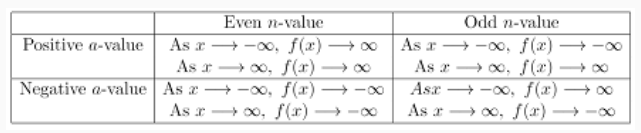
End Behavior of Polynomials , Example 1:
Find the end behavior of the function \(f(x)= x^4-4x^3+3x+25\).
Solution:
The degree of the function is even and the leading coefficient is positive. So, the end behavior is:
\(f(x)\)→\(+∞\), as \(x\) →\(−∞\)
\(f(x)\)→\(+∞\), as \(x\) →\(+∞\)
Exercises for End Behavior of Polynomials
Find the end behavior of each function.
- \(\color{blue}{f(x)=-x^5+4x^3-9x, x→−∞}\)
- \(\color{blue}{f(x)=6x^6-4x^4+2x-3, x→+∞}\)
- \(\color{blue}{f(x)=(x+4)^2+x^4+3, x→-∞}\)
- \(\color{blue}{f(x)=-8x^4+3x^3+11x^2+7, x→+∞}\)

- \(\color{blue}{f(x)→+∞}\)
- \(\color{blue}{f(x)→+∞}\)
- \(\color{blue}{f(x)→+∞}\)
- \(\color{blue}{f(x)→-∞}\)

Related to This Article
More math articles
- The Best Grade 7 Math Book for Montana Students
- Full-Length ISEE Middle Level Math Practice Test
- The Best Grade 7 ELA Practice Tests for Idaho Students
- Seeing Society Sociologically
- How to Unravel the Mysteries of Nonexistent Limits in Calculus
- DC CAPE Grade 8 Math Worksheets: 72 Free PDF Links
- 6th Grade MAAP Math Worksheets: FREE & Printable
- Graphing on the Coordinate Plane for 5th Grade: Plot Points
- How to Find Volume by Spinning: Washer Method
- CLEP U.S. History I 066: Indian Removal and Native Resistance


What people say about "How to Find the End Behavior of Polynomials"?
No one replied yet.