Free Grade 3 PARCC Math Practice: 20 Questions and Answers

This free page offers 20 unofficial math review questions under its original PARCC title: 18 multiple-choice questions and two written-response questions, followed by explanations. It is a short skill check, not a released official exam, a full-length test, or a prediction of a state-test score.
Before your child starts
Use paper and a pencil. Let your child explain a drawing, equation or mental strategy before looking at an answer. Break the set into two groups of ten if needed; there is no required timer for this review.
Check the level: This mixed set includes extension work. Questions 2, 4 and 7 use multiplication beyond the Grade 3 Common Core expectation of a one-digit number times a multiple of ten. Questions 8, 15 and 19 include fraction denominators beyond the Grade 3 set of 2, 3, 4, 6 and 8. Treat these as optional extensions if your child has not learned them. See the official Grade 3 base-ten standards and Grade 3 fraction standards for the scope.
Preparing for a current state assessment? Confirm the assessment name with your child’s school. Item types, timing and tool rules depend on the program. For example, Illinois provides its current IAR Grade 3 practice items through the official Illinois practice portal. This page does not reproduce that test or establish its rules.
20 math practice questions
1- There are 6 numbers in the box below. Which of the following list shows only even numbers from the numbers in the box?

A. \(15, 29, 42\)
B. \(15, 29, 83\)
C. \(15, 30, 42\)
D. \(42, 18, 30\)
2- Noah packs 18 boxes with crayons. Each box holds 40 crayons. How many crayons Noah can pack into these boxes?
A. 480
B. 540
C. 680
D. 720
3- A cafeteria menu had spaghetti with meatballs for $10 and bean soup for $6. How much would it cost to buy three plates of spaghetti with meatballs and two bowls of bean soup? __________
4- Which number correctly completes the number sentence \(25 × 50 =\)?
A. 225
B. 900
C. 1250
D. 2250
5- Michael has 745 marbles. What is this number rounded to the nearest ten? ____________
6- There are 60 minutes in an hour. How many minutes are in 6 hours?
A. 300 minutes
B. 320 minutes
C. 360 minutes
D. 400 minutes
7- Which number correctly completes the number sentence \(55 × 14 =\)?
A. 550
B. 660
C. 770
D. 990
8- Use the picture below to answer the question.

Which fraction shows the shaded part of this square?
A. \(\frac{88}{100}\)
B. \(\frac{88}{10}\)
C. \(\frac{8.8}{100}\)
D. \(\frac{8}{100}\)
9- What number makes this equation true?
\(12 × 8 = ⎕\)
A. 88
B. 96
C. 100
D. 108
10- Kayla has 109 red cards and 88 white cards. How many more red cards than white cards does Kayla have?
A. 17
B. 19
C. 21
D. 27
11- A number sentence is shown below.
\(3 × 7 \space ⎕ \space 6 = 126\)
What symbol goes into the box to make the number sentence true?
A. \(×\)
B. \(÷\)
C. \(+\)
D. \(-\)
12- Liam had 845 marbles. Then, he gave 455 of the marbles to his friend Ethan. After that, Liam lost 116 marbles.
Which equation can be used to find the number of marbles Liam has now?
A. \(845 – 455 + 116 = \)
B. \(845 – 455 – 116 =\)
C. \(845 + 455 + 116 = \)
D. \(845 + 455 – 116 = \)
13- What is the value of “B” in the following equation?
\(33 + B + 8 = 66\)
A. 16
B. 18
C. 22
D. 25
14- Mason is 18 months now and he usually eats six meals a day. How many meals does he eat in a week?
A. 36
B. 40
C. 42
D. 48
15- Which of the following list shows only fractions that are equivalent to \(\frac{1}{3}\)?
A. \(\frac{3}{9},\frac{5}{15},\frac{24}{72}\)
B. \(\frac{6}{12},\frac{5}{15},\frac{9}{27}\)
C. \(\frac{3}{9},\frac{4}{15},\frac{6}{18}\)
D. \(\frac{3}{9},\frac{5}{10},\frac{8}{24}\)
16- What mixed number is shown by the shaded rectangles?
A. \(3\frac{1}{2}\)
B. \(4\frac{1}{2}\)
C. 3
D. 4

17- The perimeter of a square is 24 units. Each side of this square is the same length.
What is the length of one side of the square in units?
A. 4
B. 5
C. 6
D. 7
18- There are two different cards on the table.
There are 3 rows that have 13 red cards in each row.
There are 24 white cards.
How many cards are there on the table?
A. 59
B. 63
C. 68
D. 70
19- Which of the following comparison of fractions is true?
A. \(\frac{2}{5}=\frac{4}{10}\)
B. \(\frac{2}{5}> \frac{4}{10}\)
C.\(\frac{2}{5}< \frac{4}{10}\)
D. \(\frac{2}{5}< \frac{2}{10}\)
20- What is the value of \(A\) in the equation \(64 ÷ A = 8\)
A. 2
B. 4
C. 6
D. 8
Answers and explanations
1- D
Even numbers always end with a digit of \(0, 2, 4, 6\) or \(8\).
So numbers \(30, 42, 18\) are just even numbers.
2- D
\(18 × 40 = 720\)
3- 42
3spaghetti with meatballs cost: \(3 × $10 = $30\)
2bowls of bean soup cost: \(2 × $6 = $12\)
3spaghetti with meatballs \(+\) 2bowls of bean soup cost: \($30 + $ 12 = $42\)
4- C
\(25 × 50 = 1250\)
5- 750
We round the number up to the nearest ten if the last digit in the number is 5, 6, 7, 8, or 9.
We round the number down to the nearest ten if the last digit in the number is 1, 2, 3, or 4.
If the last digit is 0, then we do not have to do any rounding, because it is already to the ten.
Therefore, rounded number of 745 to the nearest ten is 750.
6- C
\(1\) hour \(= 60\) minutes
\(6\) hours\( = 6 × 60\) minutes\(⇒ 6\) hours\( = 360\) minutes
7- C
\(55 × 14 = 770\)
8- A
The model for the fraction is divided into 100 equal parts. We shade 88 parts of these 100 parts that it’s equal to \(\frac{88}{100}\)
9- B
\(12 × 8 = 96\)
10- C
Subtract 109 red cards and 88 white cards. The answer is 21
11- A
\(3 × 7 \space ⎕ \space 6 = 126\)
\(21\space ⎕\space 6= 126 ⇒ 126=21×6\)
12- B
Liam gave 455 of his marbles to his friend that means his marbles decreased then he lost 116 of his marbles that means his marbles decreased again.
13- D
\(33 + B + 8 = 66 ⇒ 41+B =66 ⇒ B =66 – 41 =25\)
14- C
If he eats 6 meals in 1 day
So in a week (7 days) he eats \((7 × 6 = 42)\) meals.
15- A
All these fractions; \(\frac{3}{9},\frac{5}{15},\frac{24}{72}\) after simplification are equivalent to \(\frac{1}{3}\).
16- A
This shape shows 3 completely shaded rectangles and half of another rectangle that is equal to \(3\frac{1}{2}\)
17- C
Perimeter of square formula \(= 4 ×\) side \(⇒ 24 = 4 ×\) side \(⇒\) side \(= 6\)
18- B
3 rows that have 13 red cards in each row means: \(3 × 13 = 39\) red cards
And there are 24 white cards on table too, so in total there are \(39 + 24 = 63\) cards on table
19- A
Simplify \(\frac{4}{10}\) that’s equal to \(\frac{2}{5}\)
20- D
\(64 ÷ 8 = 8\)
Choose the next review step
For each missed question, note whether your child needed help with the operation, a fact, the wording or the diagram. Revisit that skill, then ask them to solve the original problem again and explain why their answer makes sense.
- Need one skill at a time? Choose a matching printable page from the Grade 3 worksheet collection.
- Want a broader review path? The Grade 3 Math Online Center brings together public lessons and study resources.
- For fraction questions, review how to compare fractions. For rounding and digit values, revisit place value.
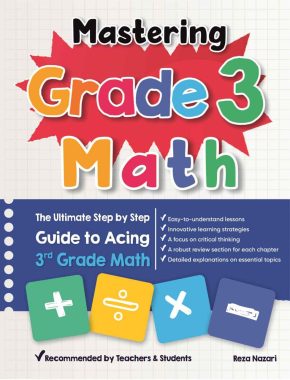
Compare a Grade 3 study book
If your child needs a book alongside free practice, open the product page below and check its preview, format and contents before choosing. This is a general Grade 3 resource; it is not an official PARCC test.

Related to This Article
More math articles
- The Best Algebra 1 Book for Massachusetts Students
- The Best Grade 3 Math Book for North Carolina Students
- The Best Algebra 1 Book for Colorado Students
- CLEP College Algebra Math Practice Test Questions
- Grade 3 Math: Division Facts
- French and Dutch Colonization: Trade, Alliances and Power
- Community
- The Best Grade 5 ELA Practice Tests for Massachusetts Students
- Top 10 PERT Math Practice Questions
- Free Grade 8 English Worksheets for Virginia Students




What people say about "Free 3rd Grade PARCC Math Practice Test"?
No one replied yet.