Divide and Conquer: How to Tackle Word Problems with Division Facts up to Twelve
TL;DR: Division word problems with facts up to 12 are almost always asking you to do one of two things: share items equally among groups, or figure out how many groups of a given size you can make from a total. Find the total in the story, decide whether you know the group size or the number of groups, then divide. Knowing your basic division facts cold means you skip the long-division grind and finish these in seconds, not minutes.
Key takeaways:
- Division facts up to 12 are the inverse of multiplication facts up to 12.
- Two common forms: sharing equally ("split 36 cookies among 9 friends") and grouping ("how many groups of 12 fit in 144?").
- Keywords to spot: "each," "per," "split," "share," "equally," "groups of."
- If \(a \div b = c\), then \(b \times c = a\) - use this to check your division.
- Memorizing facts up to \(12 \times 12\) makes division word problems much faster.
Division is a fundamental operation in mathematics, and mastering division facts up to twelve is essential for tackling a variety of real-world problems. Let’s explore some word problems that involve these division facts.

Division Facts to Twelve in Word Problems
Example 1:
Liam has \(36\) cookies. He wants to share them equally among his \(9\) friends, including himself. How many cookies will each friend get?
Solution Process:
Divide the total number of cookies by the number of friends: \(36 \div 9 = 4\).
Answer:
Each friend will get \(4\) cookies.
The Absolute Best Book for 5th Grade Students
Example 2:
A school supply store packs pencils in boxes of \(12\). If they have \(144\) pencils, how many boxes will they need?
Solution Process:
Divide the total number of pencils by the number in each box: \(144 \div 12 = 12\).
Answer:
They will need \(12\) boxes.
Division word problems often revolve around sharing or grouping items equally. By understanding the division facts up to twelve, you can easily solve these problems and apply this knowledge to various real-world scenarios. Whether it’s sharing resources, distributing items, or grouping entities, division plays an important part. Keep practicing with different word problems to become adept at using division facts in practical situations!
Practice Questions:
1. A farmer has \(60\) apples and wants to pack them in bags of \(5\). How many bags will he need?
2. There are \(84\) students in a school who need to be divided into teams of \(7\) for a competition. How many teams will there be?
3. A bakery made \(108\) muffins and wants to pack them in dozens. How many packs will they make?
4. A library has \(48\) books and wants to distribute them equally among \(6\) tables. How many books will each table get?
5. A factory produces \(72\) toys and packs them in boxes of \(6\). How many boxes will they use?
A Perfect Book for Grade 5 Math Word Problems!

Answers:
1. \(12\) bags
2. \(12\) teams
3. \(9\) packs
4. \(8\) books per table
5. \(12\) boxes
The Best Math Books for Elementary Students
Recommended EffortlessMath Books
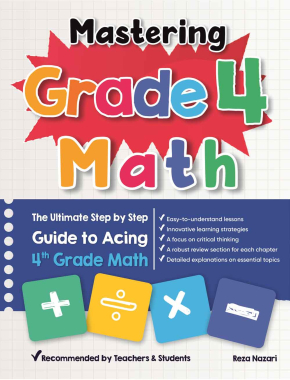
For a workbook that builds division and word-problem skills together, the Mastering Grade 4 Math covers division facts up to 12 with worked examples and practice. For pure word-problem reps, the Mastering Grade 4 Math Word Problems includes hundreds of division scenarios with full solutions.
Frequently Asked Questions
What are division facts up to 12?
The division facts you can derive from the multiplication facts up to \(12 \times 12 = 144\). Examples: \(72 \div 8 = 9\), \(132 \div 11 = 12\), \(144 \div 12 = 12\). Knowing these cold turns most elementary division word problems into one-step problems.
Why are division facts so important?
They’re the foundation for long division, fractions, and ratios. A child who doesn’t know \(72 \div 9\) instantly will struggle with simplifying \(\dfrac{72}{9}\), with finding equivalent ratios, and with long division. Drill these facts in grade 3-4 and the rest of elementary math gets a lot easier.
How do I know whether to divide or multiply?
If you have a total and need to split it into equal groups, divide. If you have a group size and a number of groups and need the total, multiply. Quick check: if you’re finding “per” or “each,” you’re usually dividing.
What keywords tell me it’s a division problem?
“Each,” “per,” “equally,” “split,” “share,” “groups of,” “how many in each,” “divided by,” “every.” Examples: “How many cookies does each child get?” “How many boxes do they need?” “What’s the cost per item?”
Walk me through an example.
“Liam has 36 cookies. He wants to share them equally among 9 friends. How many cookies will each friend get?” Total: 36. Number of groups: 9. Each friend gets \(36 \div 9 = 4\) cookies. Check: \(9 \times 4 = 36\). Answer: each friend gets 4 cookies.
What if the division doesn’t come out even?
If the problem allows remainders, write the quotient with the remainder: \(25 \div 4 = 6\) remainder 1. If the problem is about real items (cookies, kids), think about what the remainder means in context – one cookie left over might go to someone, get split, or stay in the jar.
How do I check a division answer?
Multiply the quotient by the divisor. If you got \(36 \div 9 = 4\), check \(9 \times 4 = 36\) – yes, that matches. If multiplying gives a different total, your division is wrong somewhere. This inverse check works on every division problem.
How do I learn my division facts faster?
Learn them as the inverses of multiplication facts. If you know \(8 \times 7 = 56\), then you automatically know \(56 \div 7 = 8\) and \(56 \div 8 = 7\). Practice 10 minutes a day with flashcards or quick-recall apps. Most kids master facts up to \(12 \times 12\) in 6-8 weeks of daily practice.
Are there any tricks for dividing by 12?
Yes – learn the times-12 table, since dividing by 12 is just reversing it. Common ones: \(24 \div 12 = 2\), \(48 \div 12 = 4\), \(72 \div 12 = 6\), \(96 \div 12 = 8\), \(120 \div 12 = 10\), \(144 \div 12 = 12\). Many real problems (dozens of eggs, months in a year) use 12, so the facts pay off.
Where do these division problems show up on tests?
State grade 3-5 tests, the ISEE Lower Level, the SSAT Lower Level, and most elementary placement exams. Typical scenarios: sharing food or supplies, packing items in boxes, forming teams, finding cost per item. Drill division facts and most of these become quick one-step problems.
Related EffortlessMath Lessons
If a topic on this page feels rusty, these short lessons go deeper:
- How to divide multi-digit numbers
- How to multiply multi-digit numbers
- How to solve word problems with two-digit divisors
- How to solve multi-digit by one-digit division word problems
- How to solve multi-step word problems

Related to This Article
More math articles
- 8th Grade WY-TOPP Math Worksheets: FREE & Printable
- Ecology and Ecosystems: A Beginner’s Guide
- How to Compare Linear Functions: Equations, Tables, and Graphs
- Sex and Gender
- How to Find the Center and the Radius of Circles? (+FREE Worksheet!)
- Top 10 3rd Grade ACT Aspire Math Practice Questions
- Free Grade 4 English Worksheets for Indiana Students
- Subtraction of Four-Digit Numbers
- Bargaining and persuasion
- How to Use the Associative and Commutative Properties to Multiply











What people say about "Word Problems with Division Facts to Twelve"?
No one replied yet.