Comparing and Ordering Decimals for 5th Grade: Step-by-Step Guide
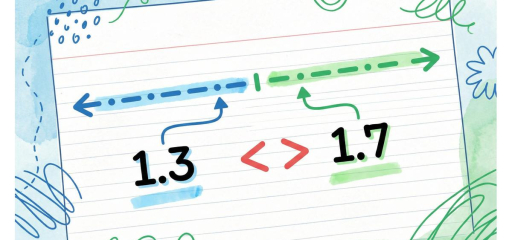
Comparing and ordering decimals is essential for estimation, problem-solving, and understanding measurements and data. In Grade 5, students compare decimals to hundredths or thousandths using the symbols > (greater than), < (less than), and = (equal to). They also order sets of decimals from least to greatest or greatest to least. This skill helps students decide which price is cheaper, which time is faster, which measurement is larger, and how to organize data.
The key idea behind comparing decimals is place value: we compare digit by digit from left to right, starting with the whole number part and then moving into tenths, hundredths, and thousandths. When decimals have different numbers of decimal places, we can append zeros to the right without changing the value (e.g., 2.34 = 2.340) so that all numbers have the same number of decimal places for easier comparison. The first place where the digits differ tells us which number is greater.
DETAILED EXPLANATION
To compare two decimals:
1. First compare the whole number parts. The number with the larger whole number part is greater (e.g., 3.5 > 2.9).
The Absolute Best Book to Ace Grade 5 Math
2. If the whole number parts are equal, compare tenths, then hundredths, then thousandths from left to right.
3. The first place where the digits differ determines which is greater. The number with the larger digit in that place is greater.
4. If all digits are the same, the numbers are equal.
To make comparison easier, write decimals with the same number of decimal places by appending zeros (e.g., 2.4 = 2.40, 2.34 = 2.340). This ensures we compare like place values.
Symbols: > means “greater than,” < means "less than," = means "equal to." The symbol always "points" to the smaller number (e.g., 0.5 < 0.7 reads "0.5 is less than 0.7").
WORKED EXAMPLES WITH STEP BY STEP SOLUTIONS
Example 1
Liam ran 9.4 seconds and Mason ran \(9 \frac{3}{5}\) seconds. Who ran faster?
The Ultimate Middle School Math Bundle: Grades 6–8
Solutions:
Step 1: Convert \(9 \frac{3}{5}\) to a decimal. \(\frac{3}{5} = \frac{6}{10} = 0.6\), so \(9 \frac{3}{5} = 9.6\).
Step 2: Compare the two times: 9.4 vs 9.6. Both have 9 in the ones place. Compare tenths: 4 vs 6. Since \(4 < 6\), we have \(9.4 < 9.6\).
Step 3: Lower time means faster. Liam ran 9.4 seconds and Mason ran 9.6 seconds.
Step 4: Therefore, Liam ran faster because 9.4 < 9.6.
Answer: Liam ran faster (9.4 seconds).
Example 2
Order from least to greatest: 2.34; 2.43; 2.304
Solutions:
Mastering Grade 5 Math
Step 1: Write all decimals with the same number of decimal places (3 places) so we can compare easily: 2.340; 2.430; 2.304.
Step 2: Compare tenths: 3, 4, 3. The number with 4 tenths (2.430) is the greatest.
Step 3: Compare 2.340 and 2.304. Both have 3 tenths. Compare hundredths: 4 vs 0. Since \(4 > 0\), we have \(2.340 > 2.304\).
Step 4: Order from least to greatest: 2.304; 2.340; 2.430. In original form: 2.304; 2.34; 2.43.
Answer: 2.304; 2.34; 2.43
Example 3
Which is greater: 0.7 or 0.07?
Solutions:
Step 1: Write 0.7 with two decimal places for comparison: 0.7 = 0.70.
Step 2: Compare 0.70 and 0.07. Both have 0 in the ones place. Compare tenths: 7 vs 0. Since \(7 > 0\), we have \(0.70 > 0.07\).
Step 3: Alternatively: 0.7 = 7 tenths = 70 hundredths. 0.07 = 7 hundredths. So 70 hundredths > 7 hundredths.
Answer: 0.7 is greater.
Example 4
Replace the □ with <, >, or =: 5.678 □ 5.687
Solutions:
Step 1: Both have the same whole number part (5) and same tenths digit (6). Compare hundredths: 7 vs 8.
Step 2: \(7 < 8\), so \(5.678 < 5.687\).
Answer: 5.678 < 5.687

Related to This Article
More math articles
- The Ultimate CLEP Calculus Course: A Comprehensive Review
- Top 10 Tips to Create an ATI TEAS 7 Math Study Plan
- 10 Most Common 7th Grade IAR Math Questions
- Best Office Chairs For Online Teachers
- Best Laptops for Back to School
- FREE 7th Grade ACT Aspire Math Practice Test
- The Math Expedition: How to Use Theoretical Probability to Predict the Unpredictable
- The Ultimate College Mathematics Placement Course (+FREE Worksheets & Tests)
- What is the Best Scientific Calculator for College Students?
- The Best Calculator for the SAT or ACT










What people say about "Comparing and Ordering Decimals for 5th Grade: Step-by-Step Guide - Effortless Math: We Help Students Learn to LOVE Mathematics"?
No one replied yet.