Parallel Lines and Transversals: Rules, Examples and Free Worksheet
When a transversal crosses two parallel lines, first identify the angle pair. Corresponding and alternate angles are equal; same-side interior angles add to 180°. Use that relationship to write an equation, solve it, and check the resulting angle measures.
Which angle rule should you use?
A transversal is a line that crosses two other lines. Check for parallel markings or a statement that the lines are parallel before using the equal-angle rules across the two intersections.
- Corresponding: the same corner at each intersection. For parallel lines, these angles are equal.
- Alternate interior: between the parallel lines, on opposite sides of the transversal. These angles are equal.
- Alternate exterior: outside the parallel lines, on opposite sides of the transversal. These angles are equal.
- Same-side interior (co-interior): between the parallel lines, on the same side of the transversal. Their measures add to 180°.
- Vertical angles: opposite at one intersection; they are always equal. A linear pair forms a straight line and always adds to 180°, even without parallel lines.
For an equation problem, write “equal” or “sum to 180°” before substituting the expressions. A calculator can check arithmetic, but it cannot choose the angle relationship for you. Do not estimate from how the drawing looks; use the marked measures.
Four worked examples
1. Corresponding angles with two expressions
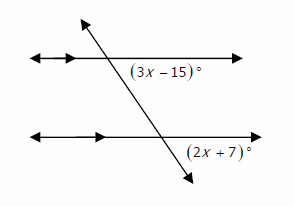
The marked angles occupy the lower-right corner at both crossings, so they are corresponding.
3x − 15 = 2x + 7
3x − 2x = 7 + 15
x = 22
Check: 3(22) − 15 = 51° and 2(22) + 7 = 51°. The variable is 22; each marked angle is 51°.
2. Corresponding angles with a known measure
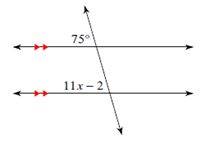
The two upper-left angles are corresponding and therefore equal.
11x − 2 = 75
11x = 77
x = 7
Check: 11(7) − 2 = 75°. Notice that x is 7, while the angle measure is 75°.
3. Alternate exterior angles
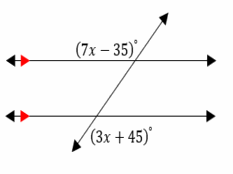
The marked angles are outside the parallel lines on opposite sides of the transversal, so they are alternate exterior angles.
7x − 35 = 3x + 45
4x = 80
x = 20
Check: 7(20) − 35 = 105° and 3(20) + 45 = 105°.
4. Another corresponding-angle equation
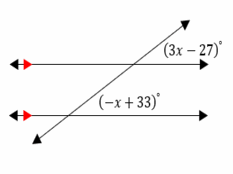
Both marked angles occupy the upper-right corner at their intersections, so set their measures equal.
3x − 27 = −x + 33
4x = 60
x = 15
Check: 3(15) − 27 = 18° and −15 + 33 = 18°. Both are valid angle measures.
Try four problems
In each diagram, the matching arrow marks show that the two lines are parallel. Identify the relationship before calculating. Then compare your reasoning with the explanations below.
Problem 1
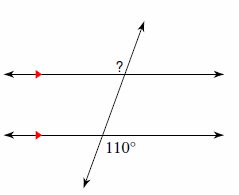
Find the angle marked with a question mark; the given exterior angle is 110°.
Problem 2
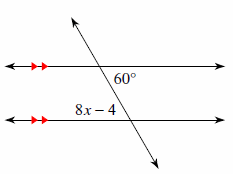
Solve for x when the marked interior angles are 60° and (8x − 4)°.
Problem 3
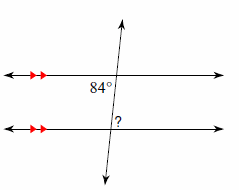
Find the angle marked with a question mark; the given interior angle is 84°.
Problem 4
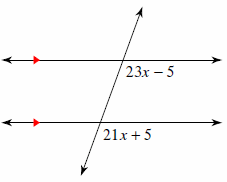
Solve for x when the marked angles are (23x − 5)° and (21x + 5)°.
Answers and explanations
- 110°. The marked angles are alternate exterior angles, so they are equal.
- x = 8. Alternate interior angles are equal: 8x − 4 = 60, so 8x = 64 and x = 8. The angle is 60°.
- 84°. The marked angles are alternate interior angles and have the same measure.
- x = 5. The marked angles are corresponding: 23x − 5 = 21x + 5, so 2x = 10. Substitution gives 110° for both angles.
A common mistake is reporting x as the angle measure. Substitute x into the original expression whenever the question asks for an angle. If you get a negative measure or one greater than 180° for these non-reflex angles, recheck the relationship and arithmetic.
Print additional angle practice
Download the parallel lines and transversals worksheet (PDF). This four-page, ASVAB-branded resource reviews the same geometry skill with 30 practice problems, answer keys and explanations. It is supplemental practice, not an official exam paper.
Need a wider review? The Grade 8 Math Online Center provides public lessons and organized practice. You can also review Khan Academy’s line and angle proofs for another approach to explaining the relationships.
Optional Grade 8 book practice
If you want a paid study resource, review the existing Grade 8 book’s contents and preview before choosing. The lesson and worksheet above remain free.
Optional fraction prerequisite review
The existing fraction practice tool is available if you need arithmetic review; it is not parallel-line angle practice.

Related to This Article
More math articles
- How to Identify the Change, Price, or Amount Paid
- The Best Scientific Calculator to Buy for School and Work
- The Best Grade 8 ELA Practice Tests for New York Students
- Louisiana LEAP Grade 8 Math Free Worksheets: Free PDF Math Worksheets with Clear Answer Keys
- ATI TEAS 7 Math Formulas
- Chemistry Final Review: Fix Mistakes and Plan Practice
- 3D Shapes for 5th Grade: Faces, Edges, and Vertices
- Cruel and unusual punishment
- Extinction and Fossils
- FREE 3rd Grade Georgia Milestones Assessment System Math Practice Test
What people say about "Parallel Lines and Transversals: Free Worksheet"?
No one replied yet.