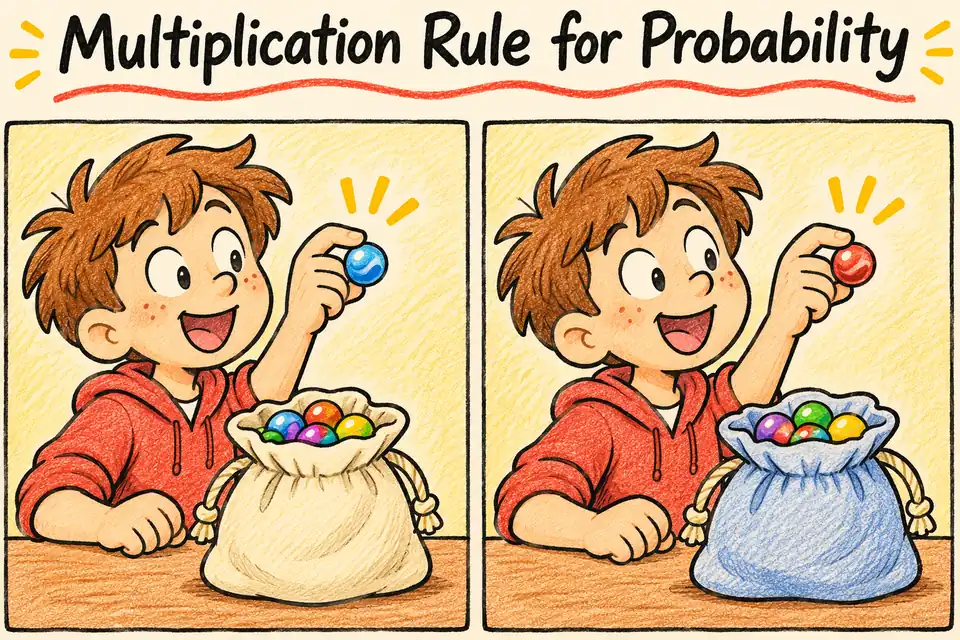
Multiplication Rule for Probability definition
The multiplication rule finds the chance that two events both occur by multiplying one event’s probability by the chance of the other given the first.
Multiplication Rule for Probability in a picture
How it works
For P(A) > 0, P(A and B) = P(A) × P(B given A). If A and B are independent, P(B given A) equals P(B). When the first event changes the second probability, keep the conditional probability in the formula.
Worked examples
Find the chance of heads twice on independent fair flips.
1/2 × 1/2 = 1/4.
A bag has 4 red and 1 blue. Find the chance of drawing two red without replacement.
4/5 × 3/4 = 3/5.
Find the chance if the first marble is replaced.
4/5 × 4/5 = 16/25.
Common mistake
After a draw without replacement, update the bag before calculating the second probability.
Quick check
What word signals a joint event?
Show answer
And.
When can you multiply P(A) and P(B) directly?
Show answer
When the events are independent.
Does replacement generally keep the same draw probabilities?
Show answer
Yes, if the bag returns to its original composition and is sampled the same way.
Sources
Flashcard
Multiplication Rule for Probability
Reveal the definition
The multiplication rule finds the chance that two events both occur by multiplying one event’s probability by the chance of the other given the first.
Effortless Math. “Multiplication Rule for Probability.” Math Dictionary.