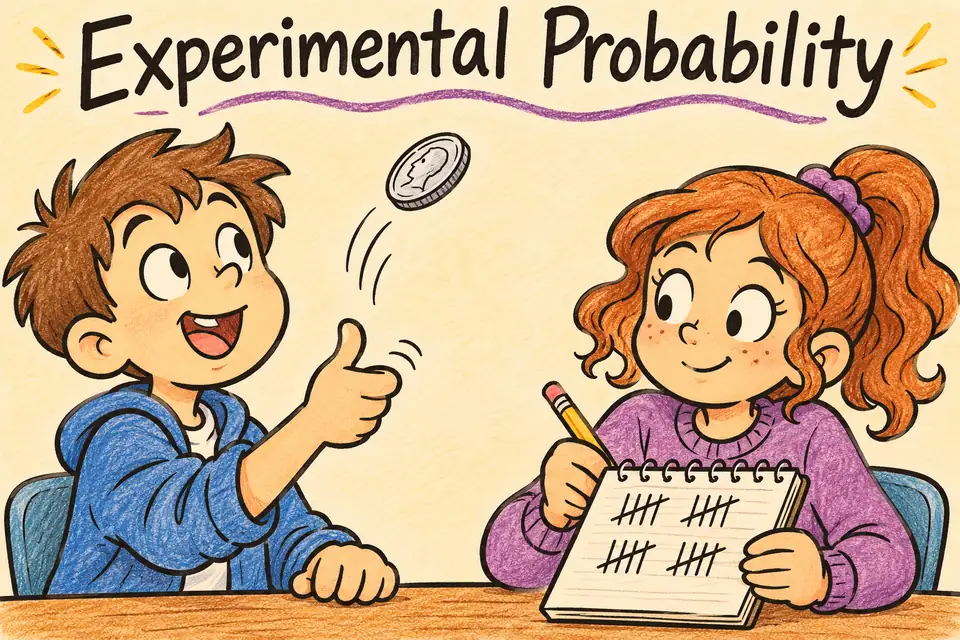
Experimental Probability definition
Experimental probability is the fraction of recorded trials in which an event occurred.
Experimental Probability in a picture
How it works
Divide the number of observed successes by the total number of trials. The result is a relative frequency. Repeating a stable process many times usually makes the observed fraction more representative of its underlying probability, although no individual run has to match it exactly.
Worked examples
A spinner lands on blue 7 times in 25 spins. Find the experimental probability.
7/25 = 0.28.
Find the experimental chance of rolling a 6 if it appears 0 times in 10 rolls.
0/10 = 0 for that run. A 6 can still occur in future trials.
A coin lands heads 27 times in 50 flips. Compare with the fair-coin prediction.
27/50 = 0.54, compared with the theoretical value 0.50.
Common mistake
Use the number of recorded trials in the denominator. The number of distinct possible outcomes is a different quantity.
Quick check
Find the fraction if an event occurs in 6 of 15 trials.
Show answer
6/15 = 0.4.
Does one experiment have to match the theoretical probability exactly?
Show answer
No.
What does the fraction describe?
Show answer
What happened in the trials that were recorded.
Sources
Flashcard
Experimental Probability
Reveal the definition
Experimental probability is the fraction of recorded trials in which an event occurred.
Effortless Math. “Experimental Probability.” Math Dictionary.