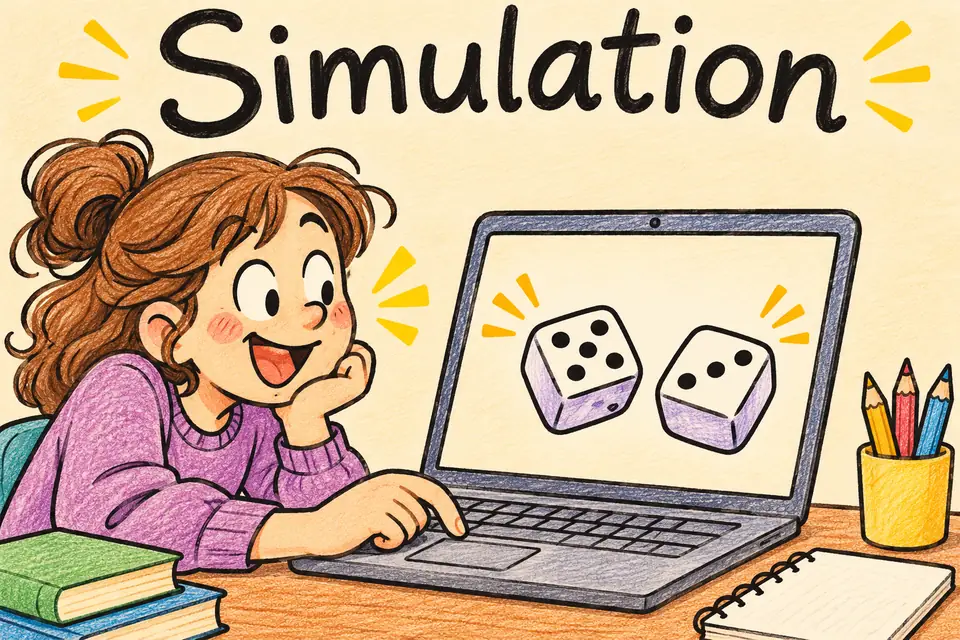
Simulation definition
A probability simulation uses a model to imitate a random process and estimate what happens over repeated trials.
Simulation in a picture
How it works
Choose a random tool that matches the real probabilities and dependencies. Define one complete trial, repeat it, and divide the number of times the event occurs by the number of trials. The result is an estimate. A simulation with the wrong model can give a misleading estimate.
Worked examples
How can a fair coin model an event with chance 1/2?
Assign heads to the event and tails to its complement.
How would you simulate 30 independent pairs of coin flips?
Flip twice for each trial and repeat the two-flip trial 30 times.
An event occurs in 13 of 50 simulated trials. What is the estimate?
13/50 = 0.26.
Common mistake
Match the real process. Drawing with replacement does not model a draw without replacement.
Quick check
Can a computer generate outcomes for a simulation?
Show answer
Yes.
Does one simulated outcome give a reliable frequency estimate?
Show answer
Usually not. Repeat the trial.
What must a simulation preserve?
Show answer
The probabilities and dependence of the process it models.
Sources
Flashcard
Simulation
Reveal the definition
A probability simulation uses a model to imitate a random process and estimate what happens over repeated trials.
Effortless Math. “Simulation.” Math Dictionary.