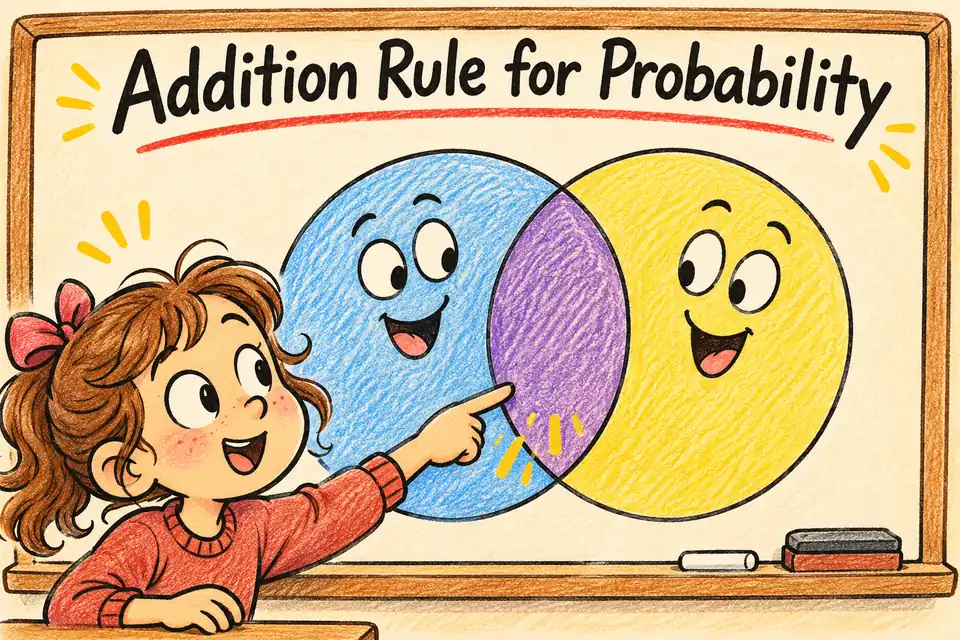
Addition Rule for Probability definition
The addition rule finds the chance that event A or event B occurs. Add their probabilities and subtract the probability that both occur.
Addition Rule for Probability in a picture
How it works
The word or includes the overlap. Adding P(A) and P(B) counts the overlap twice, so subtract it once. For mutually exclusive events the overlap is zero, so their probabilities can be added directly.
Worked examples
If P(A)=0.4, P(B)=0.5, and P(both)=0.2, find P(A or B).
0.4 + 0.5 − 0.2 = 0.7.
Find the chance of a 1 or 2 on a fair die.
The events cannot both occur. Add 1/6 and 1/6 to get 1/3.
Find the chance of rolling an even number or a number above 4.
The union is {2, 4, 5, 6}. Four of six outcomes gives 2/3.
Common mistake
Check for overlap before adding. Even independent events can occur together.
Quick check
What is subtracted in the addition rule?
Show answer
The probability that both events occur.
When is the overlap zero?
Show answer
When the events are mutually exclusive.
Does probability or include both?
Show answer
Yes.
Sources
Flashcard
Addition Rule for Probability
Reveal the definition
The addition rule finds the chance that event A or event B occurs. Add their probabilities and subtract the probability that both occur.
Effortless Math. “Addition Rule for Probability.” Math Dictionary.