New York Grade 4 Math Worksheets: 43 Topic Links
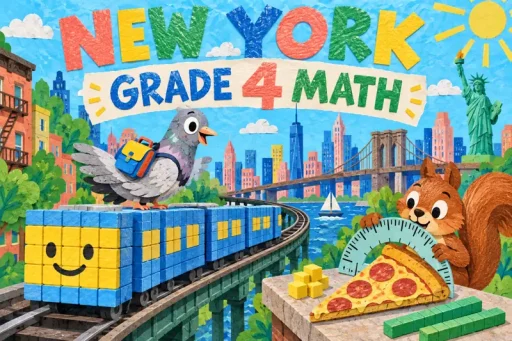
Choose from 43 existing New York Grade 4 math worksheet links, grouped by skill. Start with a topic your child is learning, complete a manageable amount of practice, and use the next attempt to check whether the method is clearer. The collection includes whole-number arithmetic, fractions, decimals, measurement, angles, and geometry.
These are independent practice resources, not NYSED test questions or a guarantee of complete state-test coverage. The topic labels and standard codes below help you locate a skill; match your selection to the teacher’s current instruction and New York’s learning standards.
Place Value & Multi-Digit Numbers
- Understanding Place Value Relationships, [4.NBT.A.1] each place is ten times the one to its right
- Reading and Writing Multi-Digit Numbers, [4.NBT.A.2] standard form, word form, and expanded form
- Comparing and Ordering Multi-Digit Numbers, [4.NBT.A.2] use place value and the symbols >, <, and =
- Rounding Multi-Digit Numbers, [4.NBT.A.3] round to any place from tens to hundred-thousands
Multi-Digit Arithmetic
- Adding Multi-Digit Whole Numbers, [4.NBT.B.4] the standard addition algorithm, with regrouping
- Subtracting Multi-Digit Whole Numbers, [4.NBT.B.4] the standard subtraction algorithm, including across zeros
- Multiplying by a One-Digit Number, [4.NBT.B.5] multiply up to four digits by a single digit
- Multiplying Two Two-Digit Numbers, [4.NBT.B.5] the area model and the standard algorithm side by side
- Dividing with Remainders, [4.NBT.B.6] divide and name the leftover as a remainder
- Finding Factors and Multiples, [4.OA.B.4] list every factor of a number and its first multiples
- Prime and Composite Numbers, [4.OA.B.4] exactly two factors means prime; more means composite
Operations & Problem Solving
- Multiplicative Comparisons, [4.OA.A.1] read ‘4 times as many’ as a multiplication statement
- Multiplicative Comparison Word Problems, [4.OA.A.2] solve ‘times as many’ stories with multiplication or division
- Multi-Step Word Problems, [4.OA.A.3] two or more operations in one real-world problem
- Interpreting Remainders, [4.OA.A.3] decide what the leftover means, round up, drop it, or use it
- Number and Shape Patterns, [4.OA.C.5] follow a rule and find the next terms in a pattern
Fractions
- Equivalent Fractions, [4.NF.A.1] the same amount written with different numbers
- Comparing Fractions, [4.NF.A.2] compare fractions with unlike denominators using benchmarks
- Adding Fractions with Like Denominators, [4.NF.B.3a] add the numerators, keep the denominator
- Subtracting Fractions with Like Denominators, [4.NF.B.3a] subtract the numerators, keep the denominator
- Decomposing Fractions, [4.NF.B.3b] break a fraction into a sum of unit fractions
- Adding and Subtracting Mixed Numbers, [4.NF.B.3c] work with the whole and fraction parts, including regrouping
- Multiplying a Fraction by a Whole Number, [4.NF.B.4b] repeated addition of a fraction, written as multiplication
- Fraction Word Problems, [4.NF.B.3d] real-world stories that call for adding or subtracting fractions
Decimals
- Fractions with Denominators 10 and 100, [4.NF.C.5] rename tenths as hundredths and add the two
- Decimal Notation for Fractions, [4.NF.C.6] write tenths and hundredths as decimals, and back
- Comparing Decimals to Hundredths, [4.NF.C.7] line up the place values and compare with >, <, =
- Adding Decimal Fractions, [4.NF.C.5] add decimals to the hundredths place
Measurement & Data
- Converting Measurement Units, [4.MD.A.1] change from a larger unit to a smaller one
- Measurement Word Problems, [4.MD.A.2] length, weight, volume, and time in real situations
- Area of Rectangles, [4.MD.A.3] length times width, the space inside a rectangle
- Perimeter of Rectangles, [4.MD.A.3] the distance all the way around a rectangle
- Area and Perimeter Word Problems, [4.MD.A.3] decide whether a problem needs area or perimeter
- Line Plots with Fractions, [4.MD.B.4] read and use a line plot of fraction measurements
Angles
- Angles as Fractions of a Circle, [4.MD.C.5] a full turn is 360 degrees, find a fraction of it
- Measuring Angles with a Protractor, [4.MD.C.6] name angles acute, right, or obtuse by their measure
- Drawing Angles with Given Measures, [4.MD.C.6] know what a given degree measure should look like
- Adding and Subtracting Angles, [4.MD.C.7] an angle split into parts, find the missing part
Geometry
- Points, Lines, Rays, and Angles, [4.G.A.1] the building blocks of geometry and how to tell them apart
- Parallel and Perpendicular Lines, [4.G.A.1] lines that never meet, and lines that cross at a square corner
- Classifying Triangles, [4.G.A.2] sort triangles by their angles and their sides
- Classifying Quadrilaterals, [4.G.A.2] name four-sided shapes by their sides and angles
- Lines of Symmetry, [4.G.A.3] find the lines that fold a shape onto itself
How to use these worksheets at home
Start with a short session and adjust it to your child’s attention and understanding. Ask the child to explain one method, then review any errors together before assigning more practice.
Pairing related skills helps the pieces click. Run “Adding Multi-Digit Whole Numbers” one day and “Subtracting Multi-Digit Whole Numbers” the next, and the second feels like a sibling of the first. The same goes for “Equivalent Fractions” followed by “Comparing Fractions”, once a child can rename a fraction, comparing two of them stops being guesswork. “Area of Rectangles” then “Perimeter of Rectangles” is another natural pair, since the contrast between the two ideas is half the lesson.
Have your child explain how they solved a problem before checking it together. If a skill remains confusing, return to a familiar example or ask the teacher which method the class is using. More problems are useful only when the student understands what to try next.
A note about NYSTP at Grade 4
NYSED distinguishes the full year’s learning standards from the standards eligible for the spring assessment. Use the official guidance and your school’s current schedule to plan review; this worksheet list alone is not a complete assessment checklist.
Include explanations, models, and multi-step reasoning alongside computation. Use a missed problem to identify the specific step needing review rather than treating completion of a worksheet as evidence of test readiness.
A short closing
Fourth-grade math grows fast, but it grows in a direction you can follow, one skill, one short sitting at a time. Bookmark this page, print a single PDF tonight, and let your child start with something small and winnable. New York kids handle big things well when the next step is clear, and a worksheet on the table is about as clear as a next step gets.
Optional New York Grade 4 Math Review Bundle
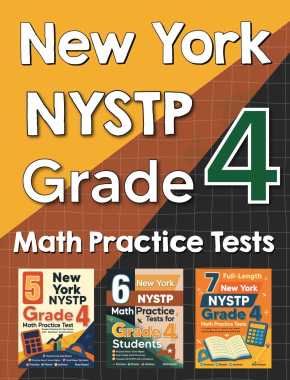
For additional review, inspect the existing bundle’s product page and preview before choosing it. Compare its level and contents with the skills your child needs; keep free topic practice as your starting point.
Official guidance: NYSED mathematics guidance and resources.

Related to This Article
More math articles
- How to Solve Systems of Equations? (+FREE Worksheet!)
- Logrolling
- How to Study Science Effectively
- How to Decipher Limits and Function Values
- Horse-race coverage
- What is the Highest ASVAB Score?
- What is the Best Algebra Book in the World?
- 8th Grade SC Ready Math Worksheets: FREE & Printable
- FREE FTCE Math Practice Test
- 10 Most Common 7th Grade ACT Aspire Math Questions










What people say about "New York NYSTP Grade 4 Math: Free Worksheets"?
No one replied yet.