Grade 3 Math: Comparing and Ordering Numbers
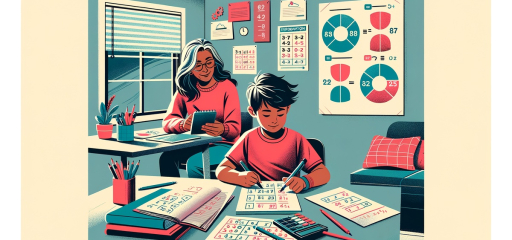
Once upon a time, in the bustling town of Numville, there lived two friendly number characters – Max the Mighty and Lily the Lovely. Max was a big, burly number, always eager to prove he was the greatest. Lily, on the other hand, was a gentle and graceful number, known for her patience and kindness. One sunny day, a Math Wizard arrived in Numville with a challenge that would test Max and Lily’s friendship like never before.
Understanding the Concept
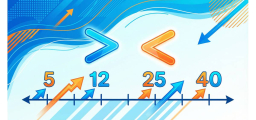
The Math Wizard explained that in the land of numbers, it’s essential to know how to compare and order numbers. To do this, we use special symbols:
- Greater than: \(>\)
- Less than: \(<\)
- Equal to: \(=\)
To start comparing numbers, always remember the wise advice: “Compare from left to right! The alligator eats the bigger number!” Now, let’s \dive into understanding these concepts with the help of Max and Lily.
Imagine Max and Lily standing proudly, ready for the challenge. The Math Wizard showed them two golden number cards: \(18\) and \(25\). Max, eager to win, roared, “I am the mightiest! I am greater than \(25\)!” Lily, in her calm voice, gently corrected him, “No, Max. See, \(25\) is greater than \(18\).”
The Absolute Best Book to Ace Grade 3 Math
Lily’s gentle wisdom prevailed, teaching us that \(25\) is indeed greater than \(18\). Now, let’s explore more with Max and Lily’s journey through number comparisons.
Key Concepts Explained
Max and Lily encountered a magical pathway filled with number challenges. The first challenge presented them with two sparkling numbers in an enchanted forest: \(39\) and \(47\). Max, feeling competitive, confidently claimed, “I am greater than \(47\)!” Lily, with her patience, explained, “No Max, look closely. \(47\) is greater than \(39\).”
Understanding the sequence of numbers helps us determine their order. When we see \(39\) and \(47\), we compare the tens place first (which is \(3\) and \(4\)). Since \(4\) is greater than \(3\), \(47\) is greater than \(39\).
Let’s unveil the secret behind comparing numbers. When comparing multi-digit numbers:
- Start from the leftmost digit.
- If the leftmost digits are different, the number with the greater leftmost digit is greater overall.
- If the leftmost digits are the same, move to the next digit on the right and continue the comparison.
Max and Lily learned this rule and continued their journey. They encountered another challenge with numbers \(562\) and \(596\). Lily demonstrated the comparison step by step:
In this scenario, they found that \(596\) is greater than \(562\) because the hundreds place in \(596\) (\(5\)) is greater than the hundreds place in \(562\) (\(5 > 5\)). Next, they compared the tens place and then the ones place to ensure \(596\) is indeed greater than \(562\).
The Most Comprehensive Grade 3 Math Workbook
Common Mistakes to Avoid
One common mistake students make is comparing numbers from right to left instead of left to right. Remember, always start comparing from the leftmost digit!
Another error is overlooking the importance of each place value. Each digit’s position, whether hundreds, tens, or ones, contributes to the number’s magnitude.
Lastly, rushing the comparison process can lead to incorrect conclusions. Take your time, compare each digit carefully, and use the greater than, less than, and equal to symbols accurately.
Summary and Key Takeaways
Today, we embarked on a thrilling adventure with Max and Lily, learning the art of comparing and ordering numbers. Remember, when facing numbers, channel your inner Lily – be patient, meticulous, and always compare from left to right.
By mastering these skills, you can impress even the Math Wizards of Numville. So, practice, explore, and soon you’ll be a master of number comparisons just like Max and Lily!
💡 Teaching Tip: Compare from left to right! The alligator eats the bigger number!
Additional Practice Resources

Related to This Article
More math articles
- The Ultimate 6th Grade MAP Math Course (+FREE Worksheets)
- Full-Length 8th Grade SBAC Math Practice Test
- Middle School Math Worksheets: FREE & Printable
- The Math Game Show: How to Find Probability of Simple and Opposite Events
- What Are the Applications of the Law of Sines?
- How Do You Pass the CBEST Math?
- How to Use Graphs to Solve Equation Systems: Word Problems
- Convert Units of Measurement
- The Math Detective: How to Find the Case of the Right Simulation that Represents the Situation
- ACT Test Calculator Policy









What people say about "Grade 3 Math: Comparing and Ordering Numbers - Effortless Math: We Help Students Learn to LOVE Mathematics"?
No one replied yet.