Chronology, Cause and Effect, and Comparison
History is not just a list of events — it is a chain of causes and effects unfolding in order. Three thinking skills help you make sense of that chain: putting events in chronological order, tracing cause and effect, and comparing events or periods. The test leans on all three.
Chronology is the order in which events happened. A cause is what makes something happen; an effect is the result. Comparison is looking at how two things are alike and different. Together they let you explain why history unfolded as it did.
Chronology: Putting Events in Order
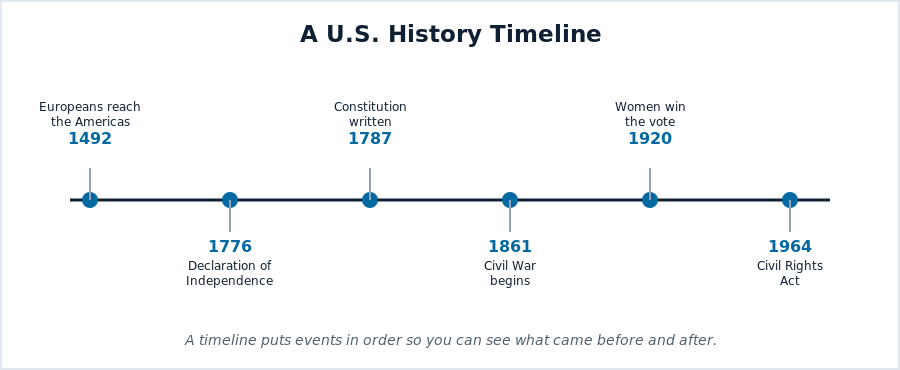
A timeline places events in the order they occurred, so you can see what came before and after. Order matters because an earlier event often causes a later one. On the test, watch for clue words — “before,” “after,” “then,” “during,” “by 1865” — and for dates that let you sequence events even when they are listed out of order.
Cause and Effect
A cause leads to an effect, and one event often has several causes and several effects. Signal words help you spot the link: “because,” “led to,” “as a result,” “therefore,” and “so.” Be careful of a common trap — just because one event came before another does not prove it caused it. Look for a real connection, not just an earlier date. A single big event, like a war, usually has multiple causes building up over time.
Comparison
Comparison questions ask how two things are alike or different — two leaders, two time periods, two documents. The trick is to compare them on the same feature: their goals, their methods, their results. Words like “similarly,” “in contrast,” “both,” and “unlike” signal comparison. Lining up two things side by side often reveals a pattern the test is asking about.
Watch: A Short Video Lesson
History for the Ages gives a clear overview to go with this lesson:
A Routine for These Questions
- For order, use dates and clue words (“before,” “after”) to sequence events.
- For cause and effect, look for “because,” “led to,” “as a result.”
- Remember that earlier does not automatically mean the cause.
- For comparison, line the two items up on the same feature.
Practice
- What is chronology?
- What is the difference between a cause and an effect?
- Name one signal word for cause and effect.
- Why doesn’t “it happened first” prove that an event caused a later one?
- What do comparison questions ask you to do?
- Can one event have more than one cause?
Answers
- The order in which events happened.
- A cause makes something happen; an effect is the result.
- Any of: because, led to, as a result, therefore, so.
- Coming earlier is not the same as causing — you need a real connection.
- Show how two things are alike and different.
- Yes — big events usually have several causes.
Where This Fits in Your Social Studies Prep
These reasoning skills support every history topic and build on drawing conclusions. Put them to work reading graphs, maps, and political cartoons. See every topic on the Social Studies Prep Hub.
Recommended Prep Books
These study guides and practice books help you keep building momentum as you prepare:

Related to This Article
More math articles
- 7th Grade Ohio’s State Tests Math Worksheets: FREE & Printable
- CPA ISC Change Management: Read a Control Failure Scenario (2027 Prep)
- Protest rights
- School desegregation
- Grade 3 Math: Word Problems: Addition and Subtraction
- Riemann Sum Calculator (Left, Right, Midpoint, Trapezoid)
- ACT Aspire Algebra 1 Free Worksheets: Free Printable ACT Aspire Algebra 1 Practice with Worked Keys
- The budget line shows purchasing possibilities
- Collective Behavior, Social Movements, and Social Change
- How to Prepare for the TASC Math Test?





















What people say about "Chronology, Cause and Effect, and Comparison"?
No one replied yet.