How to Help Your Child Prepare for the California Grade 7 CAASPP Math Test
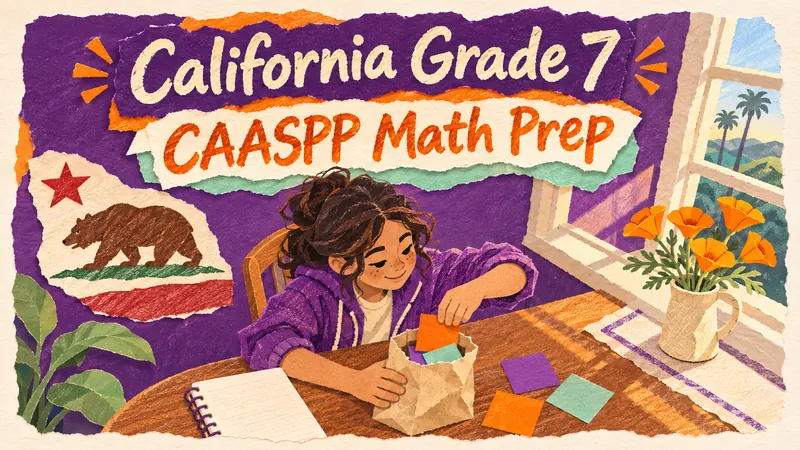
A $48 jacket is 25% off. Before reaching for a calculator, ask your seventh grader, “What is one fourth of $48? Is that how much we save or how much we pay?” Those two amounts are easy to mix up. Give your child a chance to explain the difference before you move on.
What to expect on the Grade 7 CAASPP math test
California’s Smarter Balanced math assessment is part of the California Assessment of Student Performance and Progress, or CAASPP. The computer-adaptive section selects later questions in part from a student’s earlier responses. A separate performance task gives the student related questions to work through and asks them to show their reasoning. Students may select answers, enter a response, or work with an on-screen tool.
The state test is untimed. California estimates about an hour for each part, or about two hours total, plus setup and breaks. A scientific calculator is available on screen for certain Grade 7 math questions. Ask the school when the sessions will happen and how your child will use available tools and approved supports. CAASPP administration manual · California accessibility and calculator guidance
California uses the results to check progress in grade-level math. Your child’s report is one piece of the picture. Look at it alongside classwork and ask the teacher about a skill your child can work on next.
Quick California Grade 7 CAASPP Math Check
Use scratch paper to keep track of steps. Choose one answer for each question. Each correct answer earns 10 points. After question 10, you’ll see the score and worked explanations. Use this short quiz to decide what to review. It samples only some of the skills on the state test.
Question 1 of 10
Quiz results
This score reflects the number of these ten questions your child answered correctly. An 80/100 means eight correct answers. Ask about one missed or uncertain answer, then try a fresh example together.
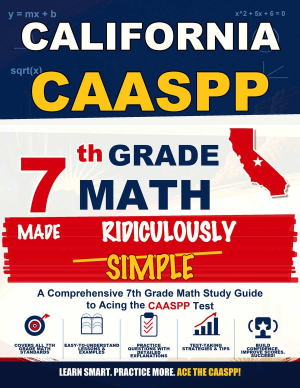
Where did your child get stuck? Try a worked example in Made Ridiculously Simple, then ask how they would start a similar problem.
Answers and explanations
1. A walker travels mile in hour at a steady pace. What is the speed in miles per hour?
Your answer:
Correct answer: B. 1 miles per hour
In an hour, the walker covers two half-hours at the same pace. Double mile to get 1 miles per hour.
2. A $48 jacket is 25% off. What is the price before tax?
Your answer:
Correct answer: D. $36
One fourth of $48 is $12. Subtract the $12 discount from $48 to get $36.
3. What is − + ?
Your answer:
Correct answer: A. −
On a number line, start at − and move right unit. Since is , you land on −.
4. What is (−2.5) × 4?
Your answer:
Correct answer: C. −10
Four groups of −2.5 give −10. A negative number multiplied by a positive number gives a negative product.
5. Which expression is equivalent to 3(2x − 4) + 5x?
Your answer:
Correct answer: B. 11x − 12
Multiply each term inside the parentheses by 3 to get 6x − 12. Add 5x to 6x to get 11x − 12.
6. Which inequality has the same solutions as 3x + 2 ≤ 20?
Your answer:
Correct answer: A. x ≤ 6
Subtract 2 from both sides to get 3x ≤ 18. Divide by positive 3, so the inequality direction stays the same.
7. On a scale drawing, 1 centimeter represents 2.5 meters. A wall measures 4 centimeters on the drawing. How long is the wall?
Your answer:
Correct answer: D. 10 meters
Four centimeters on the drawing represent 4 × 2.5 meters, or 10 meters.
8. A circle has a radius of 7 centimeters. What is its exact circumference?
Your answer:
Correct answer: C. 14π centimeters
The diameter is twice 7, or 14 centimeters. Multiply the diameter by π to get 14π centimeters.
9. A student wants to estimate which lunch option is most popular among all students at a school. Which method gives a random sample of that population?
Your answer:
Correct answer: D. Randomly draw 30 names from a list of all students at the school.
Each student has the same chance of being selected when names are drawn at random from a list of the whole school.
10. You flip a fair coin and roll a fair six-sided die. What is the probability of getting heads and rolling a number greater than 4?
Your answer:
Correct answer: A.
Two die faces, 5 and 6, work. That is , or . Multiply by the independent chance of getting heads to get .
This quiz samples selected skills. Also review proportional graphs, rational division, angle relationships, surface area, and comparing data sets.
Grade 7 math topics to review
Ratios and Proportional Relationships
Find unit rates even when the quantities are fractions. Decide whether a table or graph shows a proportional relationship. Find the constant rate and write an equation. If each item costs $4, write y = 4x, where x is the number of items and y is the total price in dollars. The points in a proportional relationship lie on a line through the origin. Work through percent increases, decreases, taxes, tips, and discounts. If your child finds the discount first, ask what still needs to be done to get the amount paid.
The Number System
Add, subtract, multiply, and divide positive and negative rational numbers. Use a number line to show what subtracting a negative means. Notice that a fraction can give a terminating decimal or a repeating one. For example, is 0.375, while repeats. Try two ways to justify an answer, such as explaining the sign and then checking with a drawing or a story.
Expressions and Equations
Use the distributive property and combine like terms. Write an equation or inequality from a story and say what the variable represents. Solve and graph the solution, then check it by substituting a value. Ask: “If three identical items plus $2 shipping cost at most $20, what is the most one item can cost?” The inequality 3x + 2 ≤ 20 gives x ≤ 6.
Geometry
Use scale drawings, draw shapes from stated conditions, and picture cross sections of three-dimensional figures. Use circle circumference and area with the appropriate units. Work with angles and find area, surface area, and volume of figures built from simpler shapes. Picture slicing a solid cylinder. A slice parallel to the circular ends makes a circle. A slice lengthwise through the center makes a rectangle. Ask your child to sketch both slices.
Statistics and Probability
Use random samples to learn about a population. Compare two data sets using center and spread, then explain what a difference in their centers means in context. Use data or a probability model to estimate the chance of an event. For compound events, list outcomes in a table or tree and identify which meet both conditions. Ask why getting heads three times in a row does not change the chance on the next fair coin flip.
| Amount | Percent of $48 | Value |
|---|---|---|
| Discount | 25% | $12 |
| Sale price | 75% | $36 |
You save $12 and pay $36 before tax.
| Coin | Die 1–4 | Die 5 or 6 |
|---|---|---|
| Heads | 4 outcomes | 2 that work |
| Tails | 4 outcomes | 2 that do not work |
Heads with a 5 or 6 gives = .
Try it together: How often will you draw red?
Cut five paper slips the same size, two red and three blue. Fold them the same way and put them in a bag. Before drawing, ask your child to predict the chance of red. Draw one slip, record the color, put it back, and mix the slips. Repeat until you’ve made 20 draws in all. Compare the fraction of red draws with your prediction. Ask what would change if you kept each slip out of the bag.
Show the answer
The model gives a chance of red on each draw with replacement. Over 20 draws, about eight reds is a reasonable expectation, but a small trial can turn out differently. If you draw red and keep it out, one red remains among four slips, so the next chance of red is .
Pick a Grade 7 lesson, quiz, or printable worksheet for a skill your child missed. Try Balance Algebra for a different way to think about keeping both sides of an equation equal. The Effortless Math games collection has other choices. Our Online Center’s timed practice tests use their own timers and score reports. Use the results to choose what to review.
Choose a study timeline that fits
Start with the materials you already have and the skills your child’s teacher recommends. For a short online session, work through one lesson and let your child try a few questions. Finish by talking through one answer.
Six months
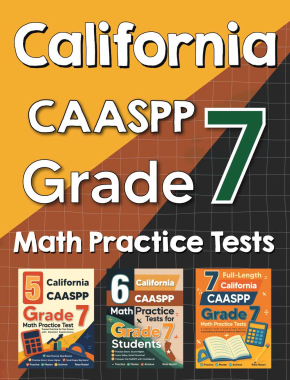
Start with Made Ridiculously Simple and the Grade 7 workbook. Plan three 15–20-minute sessions a week. Try a few online questions early. In months 1 and 2, practice ratios and rational numbers, one topic per session. In months 3 and 4, add equations and geometry. Use short sets from the five- and six-test books as checkpoints. In months 5 and 6, work on probability and sampling, then choose a mixed set from the seven-test book. Leave a separate short session to talk through difficult questions.
Six weeks
Take three sessions a week of about 20 minutes. In week 1, check classwork and try Online Center practice to choose two priorities. In weeks 2 and 3, pair a study-guide example with a short workbook set. In week 4, try a scale drawing and the paper-slip experiment. In weeks 5 and 6, choose questions from the six-test book. Review missed answers before doing another set. Keep the day before testing light.
30 days
Use Made Ridiculously Simple and the seven-test book. Try four 15–20-minute sessions a week. In the first week, use classwork and a short online set to identify two priorities. In weeks 2 and 3, teach one example and give your child a few related questions. In the last week, try a short mixed set early and return to one skill needing practice. Keep the last day calm.
One week
Use three 10–15-minute sessions. Review one worked example in the study guide and choose a few questions from a practice book or the Online Center. Ask your child to talk through one answer they changed and why. Leave the day before testing for familiar work or rest.
Before, during, and after testing
In the weeks before
Ask when assessment sessions will take place and what your child has been working on in class. Try reading the directions and entering answers in an Online Center practice set before testing week. Ask the school about tools and supports, including approved accommodations under an individualized education program (IEP) or Section 504 plan.
On test day
Use a familiar morning routine. Remind your child to read what the question asks for, check the units, and explain a diagram or calculation when the directions ask for reasoning. If anxiety rises, breathe out slowly, reread the question, and pick one small step. Ask the school how students request a break or get help with technology.
After the test and when results arrive
Ask what strategies helped and what felt unfamiliar. Give your child time to answer. Look at the score report with classwork and choose a practical next step with the teacher.
Books and practice resources
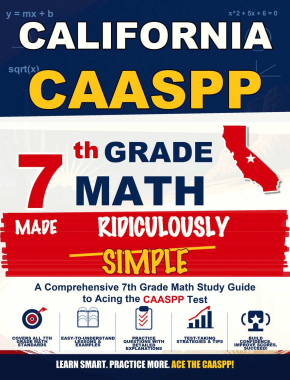
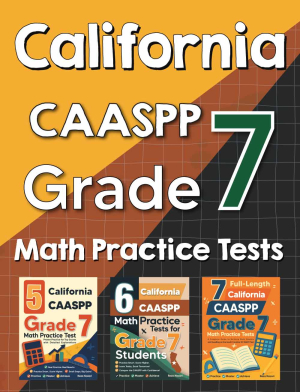
The California Grade 7 Math Preparation Bundle contains the five-, six-, and seven-test books. The study guide and workbook are sold separately. Use one worked lesson to teach a skill, the workbook to practice it, and a mixed set from a practice-test book to check it again later.
Work through a lesson
 Original price was: $29.99.$19.99Current price is: $19.99.
Ask your child to explain why one step is needed.
Practice the same skill
Original price was: $29.99.$19.99Current price is: $19.99.Try a short workbook set while the example is fresh.
Start mixing topics
Original price was: $27.99.$17.99Current price is: $17.99.Use the five-test book to practice shifting between skills.
Check an earlier skill
Original price was: $28.99.$18.99Current price is: $18.99.Choose a few questions and talk through a missed answer.
Try a fresh checkpoint
Original price was: $29.99.$19.99Current price is: $19.99.Revisit the guide or workbook after a mixed set.
California sources and Effortless Math practice
California Grade 7 mathematics standards · CAASPP administration manual · California accessibility and calculator guidance · Effortless Math Grade 7 Online Center
Common questions
Can my child use a scientific calculator?
An on-screen scientific calculator is available on some questions of the standard Grade 7 math test. Check with the school about approved supports and tools.
Does every practice session need to be timed?
Short untimed practice makes room to draw, explain, and correct a problem. An Effortless Math timed set can be useful occasionally to get used to working on screen. The state math test itself is untimed.
My child knows the math but loses track of steps. What can help?
Ask them to label each answer on paper, such as “sale price,” “discount,” or “per item.” That label tells both of you what the number means.
Leave a comment
What helped your seventh grader explain a discount, equation, or probability question? Leave a comment with a strategy that worked.

Related to This Article
More math articles
- Texas Paycheck Calculator: Take-Home Pay After Tax (2026)
- Top 10 Tips to Create an ASTB Math Study Plan
- The Best Grade 4 ELA Practice Tests for Minnesota Students
- Early Earth and the Origin of Life
- From Simple to Complex: Calculus of Surfaces
- Government Economic Policy and Market Failures
- 7th Grade SBAC Math Worksheets: FREE & Printable
- Why do I Struggle with Math so much?
- Free Grade 7 English Worksheets for Washington Students
- Low-Temperature Sterilization Methods




What people say about "How to Help Your Child Prepare for the California Grade 7 CAASPP Math Test - Effortless Math"?
No one replied yet.