Free Grade 4 English Worksheets for Arkansas Students
Fourth grade is the year reading really shifts. Passages get longer, the questions ask for evidence, and writing moves from short responses to organized paragraphs with reasons. If you’re an Arkansas parent or teacher trying to help, you don’t need a curriculum overhaul. You need steady single-skill practice on the things Arkansas fourth graders are actually working on.
This page is a working stash for Arkansas fourth graders. The worksheets line up with the Arkansas English Language Arts Standards, the same skills your child’s teacher is hitting between August and May. They also happen to be the same skills ATLAS leans on in the spring, but that’s not the point. The point is steady practice on the right things.
Everything here is a free PDF. Click the title, the file opens, you print it. No account, no email, no “sign up to unlock.” Hand the same worksheet to a tutor, photocopy it for two cousins, leave it folded in the glove compartment, whatever works.
What’s actually on this page
57 single-skill worksheets, grouped by what they’re actually doing. Each one is short on purpose. Fourth graders don’t need a 14-page packet. They need ten or fifteen minutes on one thing, a conversation about why an answer was wrong, and then dinner.
The Quick Review at the top of every PDF is the actual teaching part. Read it with your kid before they pick up the pencil. The answer key on the last page explains the *why*, not just the *what*, which is where most of the learning happens.
Reading: Literature
- Text Evidence and Inferences in Stories, [RL.4.1] back up answers, and good guesses, with the story itself
- Theme and Summary, [RL.4.2] the lesson the story is teaching, plus a short retell
- Describing Characters, Settings, and Events in Depth, [RL.4.3] go beyond surface traits, what shapes the story
- Words from Mythology, Allusions, Herculean, odyssey, mentor, words with a story behind them
- Poetry, Drama, and Prose: Structural Differences, stanzas, scenes, paragraphs, and what each one does
- First-Person vs. Third-Person Point of View, [RL.4.6] who is telling the story, and what that changes
- Story Text vs. Visual or Oral Versions, [RL.4.7] the book vs. The movie vs. The audio version
- Comparing Themes and Patterns Across Cultures, [RL.4.9] the same idea told two different ways
Reading: Nonfiction
- Text Evidence and Inferences in Nonfiction, [RI.4.1] show me where in the article it says that
- Main Idea, Key Details, and Summary, [RI.4.2] what the article is mostly about, in your own words
- Events, Procedures, and Concepts in Nonfiction, [RI.4.3] what happened, how it works, what it means
- Academic and Domain-Specific Vocabulary in Nonfiction, [RI.4.4] the science and social-studies words on the page
- Text Structures: Chronology, Compare, Cause/Effect, Problem/Solution, how the writer organized the article
- Firsthand vs. Secondhand Accounts, [RI.4.6] the person who was there vs. The writer who learned later
- Charts, Graphs, Diagrams, and Timelines, [RI.4.7] the picture is doing some of the work
- Reasons and Evidence the Author Uses, [RI.4.8] what the author claims, and what they offer to support it
- Integrating Information from Two Texts, [RI.4.9] what do BOTH articles say about this topic?
Foundational Reading Skills
- Decoding Multisyllable Words, [RF.4.3] break the long ones into pieces
- Reading Fluency: Accuracy, Rate, and Expression, [RF.4.4] read aloud so it sounds like real talking
- Self-Correcting While You Read, [RF.4.4b] fix it when the sentence stops making sense
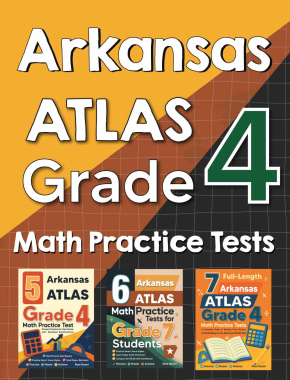
Working on Math Too? Try the Arkansas ATLAS Grade 4 Math Bundle
Many third graders are getting ready for the ATLAS in both subjects. If your child also needs math practice that matches the same standards, this companion bundle is the shortest path, workbook, study guide, and full practice tests in one download.
Writing
- Opinion Writing, [W.4.1] say what you think, and back it up
- Informative / Explanatory Writing, [W.4.2] teach someone something they didn’t know
- Narrative Writing, [W.4.3] tell a story in order, with dialogue and pacing
- Organizing Writing for Task and Purpose, [W.4.4] different writing for different jobs
- Planning, Revising, and Editing, [W.4.5] make a draft better, one pass at a time
- Short Research Project, [W.4.7] ask a question, find some answers, write it up
- Taking Notes and Listing Sources, [W.4.8] write down what you find, not everything you see
Listening and Speaking
- Collaborative Discussions, [SL.4.1] how to be a useful voice in a group conversation
- Paraphrasing What You Heard, [SL.4.2] say it back in your own words
- Identifying a Speaker’s Reasons and Evidence, [SL.4.3] what did they claim, and what did they offer for it?
- Reporting on a Topic, [SL.4.4] telling a class about something, clearly
Grammar
- Parts of Speech Review, [L.4.1pos] nouns, pronouns, verbs, adjectives, adverbs
- Relative Pronouns and Relative Adverbs, [L.4.1a] who, whose, which, that, where, when
- Progressive Verb Tenses, [L.4.1b] was running, is running, will be running
- Modal Auxiliaries, can, may, must, should, could, would, might
- Ordering Adjectives, [L.4.1d] a tiny old wooden box (not a wooden tiny old box)
- Prepositional Phrases, [L.4.1e] the small group of words that adds where/when/how
- Fragments and Run-On Sentences, [L.4.1f] the two most common sentence errors at this age
- Frequently Confused Words, [L.4.1g] to/too/two, their/there/they’re, your/you’re
Capitalization, Punctuation, and Spelling
- Capitalization Rules, [L.4.2a] names, places, titles, the start of a sentence
- Commas and Quotation Marks in Quoted Speech, [L.4.2b] punctuating what characters say
- Commas in Compound Sentences, [L.4.2c] where to put the comma before and, but, or, so
- Spelling Grade-Level Words, [L.4.2d] the common words a fourth grader should know
- Using Reference Materials to Check Spelling, [L.4.2e] look it up before you turn it in
Knowledge of Language
- Word Choice for Precision and Effect, [L.4.3a] pick the word that says exactly what you mean
- Punctuation for Effect, [L.4.3b] the dash, the ellipsis, the exclamation, used on purpose
- Formal vs. Informal English, [L.4.3c] school writing vs. How you talk to a friend
Vocabulary and Word Study
- Context Clues for Word Meaning, [L.4.4a] use surrounding words to find the meaning
- Greek and Latin Roots and Affixes, [L.4.4b] tele-, photo-, port, dict, struct, anti-
- Dictionaries, Glossaries, and Thesauruses, three reference tools that do different jobs
- Multiple-Meaning Words, [L.4.4d] bark, light, run, which meaning fits HERE?
- Similes and Metaphors, [L.4.5a] comparing with ‘like’ and ‘as,’ or just comparing
- Idioms, Adages, and Proverbs, [L.4.5b] piece of cake, the early bird gets the worm
- Synonyms, Antonyms, and Shades of Meaning, [L.4.5c] cool, chilly, cold, freezing, pick the right strength
- Academic and Domain-Specific Words, [L.4.6a] the grown-up words showing up in fourth-grade reading
- Real-Life Word Connections, [L.4.6b] connect new words to situations you already know
- Pronunciation Keys and Syllable Stress, [L.4.6c] read the squiggles in a dictionary entry
How to actually use these without burning your kid out
A small confession from years of watching well-meaning parents pile up the printouts: the trick isn’t more worksheets. It’s slower worksheets. Two suggestions that actually work:
Pick one. Sit with it. The temptation is to grab six and call it a study session. Resist that. One worksheet, with a real conversation about the wrong answers, will teach more than six speed-runs.
Talk about the misses, not the hits. When your kid gets one wrong, ask them to read the explanation in the answer key out loud. If they can re-explain why the right answer is right, that’s the moment the skill actually went in.
Wait a week before circling back. If something is shaky today, don’t drill it tonight. Try a different worksheet on the same skill in five or six days. The space between attempts is where retention lives.
A word about ATLAS
Arkansas families sometimes find pages like this because ATLAS, the Arkansas’s Grade 4 English assessment, is on the calendar in the spring, and they want to know what to do. The straight answer: the worksheets here aren’t a cram pack. They’re skill builders that happen to line up with what ATLAS measures, because ATLAS measures the same Arkansas English Language Arts Standards skills your kid is already learning.
If you only have time to pick two to start with, make them Main Idea, Key Details, and Summary and Context Clues for Word Meaning. Both show up disproportionately on the reading sections, and most kids who lose points on ATLAS reading lose them on one or the other.
Questions that come up a lot
Are these aligned to Arkansas’s standards? Yes. Each worksheet targets a specific Grade 4 skill from the Arkansas English Language Arts Standards.
Can I use these for homeschool? Yes, and plenty of Arkansas homeschool families do. They work well as the practice piece after a longer lesson, or as a five-day rotation through the four big skill areas.
My kid reads above grade level, what should I pick? Try Comparing Themes and Patterns Across Cultures and Greek and Latin Roots and Affixes. Both stretch confident readers in ways that are still on grade.
My kid is behind on reading, where do I start? Don’t start with the long passages. Start with Greek and Latin Roots and Affixes and Context Clues for Word Meaning. They unlock a surprising amount of the rest.
Is there an answer key? Every PDF has one on the last page, written so the student can understand the explanation themselves.
Before you print
If the first worksheet doesn’t land, don’t take it personally. Some skills need a different angle on a different day. Try a shorter one. Try one in a different skill area. Try the same one again next Tuesday after school. Practice doesn’t have to be perfect to be useful. It just has to keep happening. Come back whenever you need a new one.
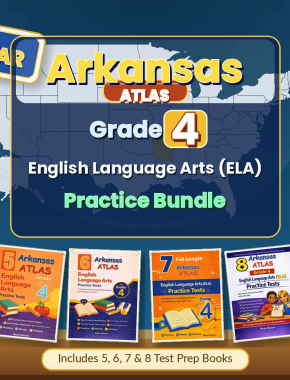
Best Bundle to Ace the Arkansas ATLAS Grade 4 ELA
Looking for the best resource to help your kid ace the Arkansas ATLAS? Try this bundle, four full practice-test books (5 + 6 + 7 + 8 tests) covering the same Grade 4 reading, writing, and language skills your child is already learning. Instant PDF download, answer keys included.

Related to This Article
More math articles
- NREMT EMT Score Report: What a Failed Score Tells You About 950 (2027 Prep)
- What Kind of Math Is on the ASVAB Test?
- Free Grade 6 English Worksheets for Georgia Students
- AP Cybersecurity Log Analysis: Follow the Evidence (2027 Prep)
- The Best Grade 7 Math Book for Connecticut Students
- From Tables and Graphs to Equations: How to Master Proportional Relationships
- The Best Grade 3 ELA Practice Tests for Colorado Students
- How to Prepare for the ATI TEAS 7 Math Test?
- 10 Most Common 6th Grade Common Core Math Questions
- Free Grade 7 English Worksheets for North Carolina Students







What people say about "Free Grade 4 English Worksheets for Arkansas"?
No one replied yet.