Using Distributive Property to Factor Numerical Expressions
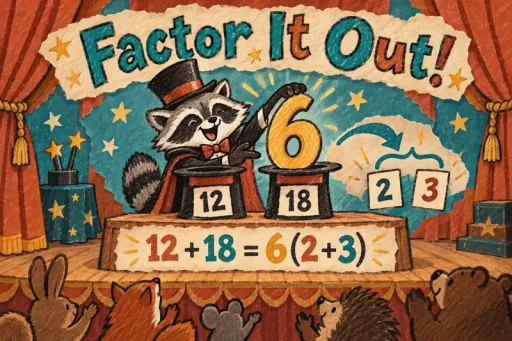
To factor a numerical sum, find a common factor, divide every term by it, and write that factor outside parentheses. For example, 12 + 18 = 6(2 + 3). Check by distributing 6 back to both terms. Using the greatest common factor leaves no common whole-number factor greater than 1 inside.
Factor by reversing distribution
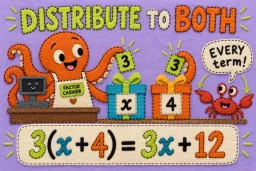
The distributive property says a(b + c) = ab + ac. Factoring reads the same equality backward: ab + ac = a(b + c). A common factor must divide every term. The GCF gives the largest positive whole-number factor you can take out, but any common factor gives an equivalent expression.
For 12 + 18, factoring out 3 gives 3(4 + 6), which is correct but can be factored further. Factoring out the GCF, 6, gives 6(2 + 3). Keep the addition or subtraction signs between the quotients; do not multiply the quotients together.
Using Distributive Property to Factor Numerical Expressions, Example 1

Use distributive property, factor the expression, (40+25).
Solution:
Step 1: Find the greatest common factor of 40 and 25. It is 5.
Step 2: Divide each number by 5: 40 ÷ 5 = 8 and 25 ÷ 5 = 5.
Step 3: Use the distributive property to write an equivalent expression.
(40+25=5×8+5×5=5(8+5))
Using Distributive Property to Factor Numerical Expressions, Example 2
Use distributive property, factor the expression, (56+21).
Solution:
Step 1: Find the greatest common factor of 56 and 21. It is 7.
Step 2: Divide each number by 7: 56 ÷ 7 = 8 and 21 ÷ 7 = 3.
Step 3: Use the distributive property to write an equivalent expression.
(56+21=7×8+7×3=7(8+3))
Using the Distributive Property to Factor Numerical Expressions
Factoring is the process of breaking down an expression into its component parts, the numbers or quantities you’d multiply together to get the original expression. The distributive property is your fundamental tool for factoring numerical expressions. By recognizing common factors and “factoring them out,” you transform addition into multiplication, revealing the structure within seemingly complex expressions.
Understanding the Distributive Property
The distributive property states: (a(b + c) = ab + ac). Reading right-to-left for factoring: (ab + ac = a(b + c)). The value (a) is the common factor that “distributes” across both terms. When factoring, you’re reversing this process, recognizing (a) as the common element and pulling it out front.
Finding the Greatest Common Factor (GCF)
To factor an expression using the distributive property, first identify the greatest common factor (GCF) of all terms. The GCF is the largest number that divides evenly into each term.
Example: In the expression (12 + 18), what is the GCF?
- Factors of 12: 1, 2, 3, 4, 6, 12
- Factors of 18: 1, 2, 3, 6, 9, 18
- Common factors: 1, 2, 3, 6
- Greatest common factor: 6
The Factoring Process: Step-by-Step
Step 1: Identify All Terms
List every term in your expression. In (15 + 25 + 10), the three terms are 15, 25, and 10.
Step 2: Find the GCF
Determine what number divides evenly into all terms. For 15, 25, and 10:
- 15 = 3 × 5
- 25 = 5 × 5
- 10 = 2 × 5
Step 3: Divide Each Term by the GCF
Divide every term by the GCF:
- 15 ÷ 5 = 3
- 25 ÷ 5 = 5
- 10 ÷ 5 = 2
Step 4: Write the Factored Form
The factored form is GCF × (sum of quotients): (15 + 25 + 10 = 5(3 + 5 + 2))
Step 5: Verify by Distributing
Check your work: (5(3 + 5 + 2) = 5(3) + 5(5) + 5(2) = 15 + 25 + 10) ✓
Worked Examples: Factoring Numerical Expressions
Example 1: Simple GCF Factoring
Problem: Factor (12 + 18)
Solution:
- Find GCF of 12 and 18: Both are divisible by 6 (and also by 1, 2, 3, but 6 is greatest)
- Divide each term: (12 ÷ 6 = 2) and (18 ÷ 6 = 3)
- Factored form: (6(2 + 3))
- Check: (6(2 + 3) = 12 + 18) ✓
Example 2: Larger Numbers with Multiple Terms
Problem: Factor (28 + 42 + 14)
Solution:
- Prime factorizations:
- 28 = 2² × 7
- 42 = 2 × 3 × 7
- 14 = 2 × 7
- Common factors in all three: 2 and 7, so GCF = 2 × 7 = 14
- Divide each: (28 ÷ 14 = 2), (42 ÷ 14 = 3), (14 ÷ 14 = 1)
- Factored form: (14(2 + 3 + 1))
- Check: (14(2 + 3 + 1) = 28 + 42 + 14) ✓
Example 3: Factoring with Subtraction
Problem: Factor (48 – 32)
Solution:
- GCF of 48 and 32:
- 48 = 2⁴ × 3
- 32 = 2⁵
- Divide each: (48 ÷ 16 = 3) and (32 ÷ 16 = 2)
- Factored form: (16(3 – 2))
- Check: (16(3 – 2) = 16(1) = 16 = 48 – 32) ✓
Example 4: Multiple-Term Expression
Problem: Factor (36 + 54 + 72 + 18)
Solution:
- Find GCF:
- 36 = 2² × 3²
- 54 = 2 × 3³
- 72 = 2³ × 3²
- 18 = 2 × 3²
- Divide each: (36 ÷ 18 = 2), (54 ÷ 18 = 3), (72 ÷ 18 = 4), (18 ÷ 18 = 1)
- Factored form: (18(2 + 3 + 4 + 1))
- Check: (18(2 + 3 + 4 + 1) = 18(10) = 180 = 36 + 54 + 72 + 18) ✓
Why Factoring Matters
Simplification
Factored form often reveals structure. Instead of thinking of (24 + 40) as two separate numbers, seeing it as (8(3 + 5)) shows the underlying relationship clearly.
Mental Math
Factoring simplifies calculations. (8(3 + 5) = 8(8) = 64) is often easier to compute than (24 + 40).
Algebra Foundation
Factoring numerical expressions is the foundation for factoring algebraic expressions like (6x + 9), which factors to (3(2x + 3)) using the exact same process.
Common Factoring Patterns
Pattern 1: Factor of 2 or 5 Expressions like (14 + 26 + 30) often have 2 as a factor. Check: (14 + 26 + 30 = 2(7 + 13 + 15)).
Pattern 2: Multiples of 10 Numbers ending in 0 suggest trying 10 as a factor. For (30 + 50 + 20 = 10(3 + 5 + 2)).
Pattern 3: Numbers in a sequence Expressions like (10 + 20 + 30) = (10(1 + 2 + 3)) show the power of recognizing repeated structure.
Practice Problems
- Factor (16 + 24)
- Factor (35 + 49 + 21)
- Factor (60 – 45)
- Factor (27 + 36 + 18 + 45)
- Factor (100 + 150 + 75)
Check your factored forms
- 16 + 24 = 8(2 + 3)
- 35 + 49 + 21 = 7(5 + 7 + 3)
- 60 − 45 = 15(4 − 3)
- 27 + 36 + 18 + 45 = 9(3 + 4 + 2 + 5)
- 100 + 150 + 75 = 25(4 + 6 + 3)
Distribute the outside factor to check every term. If the original term equals the GCF, its quotient is 1, not 0.
This skill appears in Common Core 6.NS.B.4, whose stated sum problems use two whole numbers from 1 to 100. The multi-term and subtraction examples here extend that basic idea.
Existing distributive property calculator

Related to This Article
More math articles
- Why Do I Need MATLAB Assignments Experts Help and Where One Get It
- Free GED Math Practice Tests, Worksheets & Review Tools
- CLEP U.S. History I 077: Religion, Science, and Education
- Natural-monopoly regulation trades efficiency for cost recovery
- The Ultimate 7th Grade SOL Math Course (+FREE Worksheets)
- What Kind of Math Is on the HiSET Test?
- The Art of Math: How to Solve Word Problems with Scale Drawings and Scale Factors
- The Best Grade 8 Math Book for North Carolina Students
- Top 10 Tips to Create the SSAT Math Study Plan
- The Best Grade 3 ELA Practice Tests for Texas Students




What people say about "Factor Numerical Expressions with Distribution"?
No one replied yet.