Top 10 6th Grade PARCC Math Practice Questions
TL;DR: If your sixth grader has the PARCC Math test ahead, these 10 practice questions cover the grade 6 topics it leans on hardest: ratios and unit rates, dividing fractions, decimals, expressions, and equations. Every solution is fully worked out, so when something gets missed you can walk through the steps together rather than just landing on the answer. A quick honest read of where your student stands before test day arrives.
Key takeaways:
- PARCC Grade 6 math (and the state tests built on its framework) is computer-based.
- All 10 practice questions come with step-by-step worked solutions.
- Aligned with the Common Core State Standards for Math grade 6.
- Includes Type I (procedural), Type II (reasoning), and Type III (modeling) items.
- 20-30 minutes of daily practice over several weeks beats last-minute cramming.
1- Which of the following is equivalent to \(5(12x-16)\)?
A. \(60x-16\)
B. \(17x-21\)
C. \(12x-80\)
D. \(60x-80\)
2- Which ratio is equivalent to \(91:21\)?
A. \(13:3\)
B. \(9:2\)
C. \(7:3\)
D. \(21:91\)
3- Solve for \(x\) in the equation \(-60=115-x\).
A. \(x=175\)
B. \(x=55\)
C. \(x=-55\)
D. \(x=-175\)
4- Solve the inequality \(-8 \le 5x-8 < 2\).
A. \(-1 \le x < 2\)
B. \(0 \le x < 2\)
C. \(0 < x \le 2\)
D. \(-2 \le x < 0\)
5- The ratio of boys to girls in a school is \(4:5\). If there are \(765\) students in the school, how many boys are in the school?
A. \(612\)
B. \(510\)
C. \(425\)
D. \(340\)
6- Martin earns \($20\) an hour. Which of the following inequalities represents the amount of time Martin needs to work per day to earn at least \($100\) per day?
A. \(20t≥100\)
B. \(20t≤100\)
C. \(20+t≥100\)
D. \(20+t≤100\)
7- \((55+5)÷12\) is equivalent to …
A. \(60÷3.4\)
B. \( \frac{55}{12}+5\)
C. \((2×2×3×5)÷(3×4)\)
D. \( (2×2×3×5)÷3+4\)
8- What is the value of the expression \(6(2x-3y)+(3-2x)^2\), when \(x=2 \) and \(y=-1\)?
A. \(-23\)
B. \(41\)
C. \(43\)
D. \(49\)
9- Round \(\frac{215}{7}\) to the nearest tenth.
A. \(31\)
B. \(30.8\)
C. \(30.7\)
D. \(30\)
10- A chemical solution contains \(6\%\) alcohol. If there are \(45 ml\) of alcohol, what is the volume of the solution?
A. \(270 ml\)
B. \(420 ml\)
C. \(750 ml\)
D. \(1,200 ml\)
Best 6th Grade PARCC Math Prep Resource for 2026
Answers:
1- D
\(5(12x-16)=(5×12x)-(5×16)=(5×12)x-(5×16)=60x-80\)
2- A
\(91: 21 = 13: 3\)
\(13×7=91\)
And \( 3×7=21\)
3- A
\(-60 = 115 – x\)
First, subtract 115 from both sides of the equation. Then:
\(-60 – 115=115 – 115- x→-175 = – x\)
Multiply both sides by \((-1)\):
\(→x = 175\)
4- B
\(-8≤5x-8<2 →\) (add 8 all sides)\(-8+8≤5x-8+8<2+8 →0≤5x<10→\) (divide all sides by 5) \(0≤x<2\)
5- D
The ratio of boys to girls is \(4:5\). Therefore, there are \(4\) boys out of \(9\) students. To find the answer, first, divide the total number of students by \(9\), then multiply the result by \(4\).
\(765 ÷ 9 = 85 ⇒ 85 × 4 = 340\)
6- A
For one hour he earns \($20\), then for \(t\) hours he earns \($20t\). If he wants to earn at least \($100\), therefore, the number of working hours multiplied by \(20\) must be equal to \(100 \) or more than \(100\).
\(20t≥100\)
7- C
\((55+5)÷(12)=(60)÷(12)\)
The prime factorization of \(60\) is: \(2×2×3×5 \)
The prime factorization of \(12\) is: \( 3×4 \)
Therefore: \((60)÷(12)=(2×2×3×5)÷(3×4)\)
8- C
Plug in the value of \(x\) and \(y\) and use the order of operations rule.
\(x=2\) and \(y=-1\)
\(6(2x-3y)+(3-2x)^2=6(2(2)-3(-1))+(3-2(2))^2=6(4+3)+(-1)^2 = 42+1=43\)
9- C
\(\frac{215}{7} ≅ 30.71 ≅ 30.7\)
10- C
\(6\%\) of the volume of the solution is alcohol. Let \(x\) be the volume of the solution.
Then: \(6\% \space of \space x = 45 \space ml ⇒ 0.06 x = 45 ⇒ x = 45 ÷ 0.06 = 750\)
Looking for the best resource to help you succeed on the Grade 6 PARCC Math test?
The Most Comprehensive Review for 6th-Grade Students
Recommended EffortlessMath Books
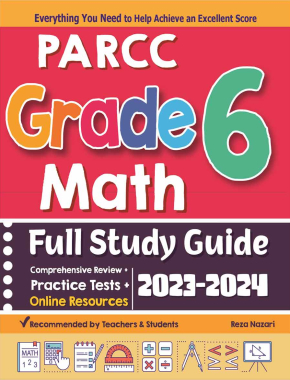
If you want a workbook that lines up with these practice questions, Mastering Grade 6 Math walks through every sixth-grade topic with worked examples and lots of try-it-yourself problems. For the algebra side of sixth grade – expressions, equations, and inequalities – Pre-Algebra for Beginners builds the same skills from the ground up.
Frequently Asked Questions
What does the PARCC Grade 6 math test cover?
PARCC Grade 6 math covers Ratios and Proportional Relationships, the Number System (dividing fractions, decimal operations, GCF/LCM), Expressions and Equations, Geometry (area, volume, surface area), and Statistics and Probability. At grade 6, the heaviest content strands are ratios and unit rates, fraction division, decimal operations, one-variable equations and inequalities, and statistical thinking (mean, median, mode, IQR). The 10 practice questions on this page sample across those strands so you can see where your skills are strong and where you need a few more reps.
How long is the PARCC math test for 6th-grade students?
PARCC Grade 6 math (and the state tests still built on its framework) is computer-based and typically runs about 2.5 hours across multiple sessions, with around 40-50 items. Plan to pace yourself – skip a problem and come back rather than burning five minutes on one tough question. The 10 practice items here are short enough to do in one sitting (about 20-25 minutes) and they mirror the kinds of items you’ll see on the real test.
Are these 6th-grade practice questions free?
Yes – every practice question on this page is free, with a worked solution. No login, no email, no paywall. Print the page or work through it on screen. If you find these helpful, share the link with a classmate or your teacher – it’s the best free way to sample the test format.
What’s the best way to study for the PARCC Grade 6 math test?
For PARCC-style tests specifically, the Type II and Type III items ask you to explain your reasoning – not just give an answer. Practice writing one or two sentences that justify each step. The general rule for middle school: 20-30 minutes a day, four or five days a week, beats a weekend cram. Mix topic practice (one skill at a time) with mixed practice (random topics in one sitting). The mixed sets are closer to how the real test feels.
What if I can’t solve some of these practice questions?
That’s normal – one of the points of practice is finding gaps. When you miss a question, read the worked solution slowly. Then redo the problem on a fresh sheet without looking. If a whole topic feels hard, drop back to the basics first – it’s faster to fill a gap than to push through frustration. The Related Lessons below cover the 6th-grade skills students miss most.
Are calculators allowed on the PARCC math test?
For most state 6th-grade math tests, a calculator is allowed on part of the test but not on the section that tests basic computation. Check your state’s policy on the official PARCC page. The 10 questions here can be solved with pencil and paper – we recommend practicing both with and without a calculator so you’re ready either way.
How many questions are on the real PARCC Grade 6 math test?
It varies by state and year, but most 6th-grade state tests have 40-60 math questions total, often split across two sessions. The 10 sample questions here are a representative slice – if you’re getting 8 or more right and showing solid work, you’re tracking well for the real test.
What item types appear on PARCC Grade 6 math?
Multiple choice is most common, but you’ll also see multi-select (“choose all that apply”), fill-in-the-blank, drag-and-drop, equation builders, and short open-response items where you show work. The practice questions on this page mostly use multiple choice, but the underlying math is the same across item types.
How can parents help a 6th-grade student prepare in PARCC-aligned states?
Two things matter most: steady practice (not last-minute cramming) and going through wrong answers together. Ask your child to explain each step out loud – hearing themselves explain often catches the slip. Don’t drill speed at the expense of accuracy; accuracy with reasonable pace is what the test rewards.
Where do I get more 6th-grade math practice?
EffortlessMath has full-length practice tests, topic-by-topic worksheets, and step-by-step lessons for every 6th-grade math skill. The Related Lessons below cover the topics students miss most on PARCC. For a complete workbook, the Mastering Grade 6 Math book walks through every standard with worked examples and answer keys.
Related EffortlessMath Lessons
If a topic on this page feels rusty, these short lessons go deeper:
- How to add and subtract fractions with unlike denominators
- How to multiply and divide decimals
- How to find the percent of a number
- How to solve ratio word problems
- How to solve multi-step word problems

Related to This Article
More math articles
- Cartels face an incentive to cheat
- New Jersey NJSLA Grade 6 Math Free Worksheets: Free Printable Worksheets Covering Every Skill
- Concurring opinions
- Free Grade 3 English Worksheets for Montana Students
- The Best Grade 5 Math Book for Indiana Students
- How to Develop a Mindset for Math in 7 Steps?
- The Best Grade 4 Math Book for New York Students
- Number Properties Puzzle – Challenge 8
- Full-Length GED Math Practice Test
- The Best Grade 8 Math Book for Alaska Students


What people say about "Top 10 6th Grade PARCC Math Practice Questions"?
No one replied yet.