MoGEA Math Flashcards
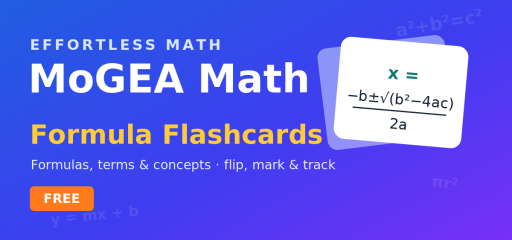
MoGEA Math Flashcards: a free, printable set covering the topics you will see on the test, with answer keys included, so you can practice each topic one skill at a time and check your own work before test day.
Free MoGEA Math review
Lock in every key MoGEA Math formula, term, and concept with a free, interactive flashcard deck covering numbers, fractions and percents, ratios and proportions, exponents and roots, algebra, coordinate geometry, geometry, data and probability.
Each card shows the rule or definition, a short explanation, and many include a quick diagram. Flip a card, filter by topic or card type, shuffle, and mark what you know so the cards you miss come back for review.
83flashcards
9topics covered
26cards with a diagram
Freeonline, progress saved
What These MoGEA Math Flashcards Cover
This free deck collects the formulas, key terms, and concepts students use across the whole MoGEA Math course, organized into 9 topics. Use the dropdown to study one topic at a time, or shuffle the full deck for mixed review before a test.
| Topic | Cards | What students review |
|---|---|---|
| Numbers | 12 cards | Integers, factors, primes, GCF and LCM, order of operations. |
| Fractions & Percents | 8 cards | Fraction operations, percent of a number, percent of change, conversions. |
| Ratios & Proportions | 5 cards | Ratios, proportions, unit conversion, simple interest, average speed. |
| Exponents & Roots | 9 cards | Exponent rules, square roots, radicals, scientific notation. |
| Algebra | 14 cards | Equations, like terms, FOIL, factoring, the quadratic formula, inequalities. |
| Coordinate Geometry | 6 cards | Slope, line equations, distance and midpoint, parallel and perpendicular. |
| Geometry | 17 cards | Area, perimeter, volume, the Pythagorean theorem, angle rules. |
| Data & Probability | 8 cards | Mean, median, mode, range, probability, and counting. |
| Test Facts | 4 cards | Test format, question types, and calculator policy. |
Jump to a Topic
NumbersFractions & PercentsRatios & ProportionsExponents & RootsAlgebraCoordinate GeometryGeometryData & ProbabilityTest Facts
Numbers
12 cards. Integers, real numbers, absolute value, factors and primes, GCF and LCM, order of operations, the distributive property, and factorials.
Fractions & Percents
8 cards. Converting mixed numbers and improper fractions, adding, subtracting, multiplying and dividing fractions, percent of a number, percent of change, and fraction, decimal, and percent conversions.
Ratios & Proportions
5 cards. Ratios, proportions, unit conversions, simple interest, and average speed.
Exponents & Roots
9 cards. The exponent rules, including product, quotient, power, zero, negative, and fractional exponents, plus square roots, simplifying radicals, and scientific notation.
Algebra
14 cards. Variables and expressions, solving one and two step equations, combining like terms, FOIL and special products, factoring, the quadratic formula, systems, and inequalities.
Coordinate Geometry
6 cards. Slope, slope-intercept and point-slope form, the distance and midpoint formulas, and parallel and perpendicular lines.
Geometry
17 cards. Area, perimeter, and volume formulas for common shapes, the Pythagorean theorem and triples, angle rules, and polygon interior angles.
Data & Probability
8 cards. Mean, median, mode, and range, the probability of an event, the probability of A and B, the counting principle, and finding a missing value from a mean.
Test Facts
4 cards. Quick facts about the MoGEA Math test, the math question types, and the calculator policy.
How to Use These MoGEA Math Flashcards
1
Pick one topic
Use the topic dropdown instead of facing all 83 cards at once. Start with the topics you find hardest.
2
Flip, then mark
Read the front, say the rule or definition out loud, then flip. Mark Know it only when you can explain it, not just recognize it.
3
Practice right away
After a set, solve a few problems that use those rules. Flashcards build recall; worked practice turns them into test-day tools.
Best Order for Studying
If the deck feels like a lot, study the foundational topics first, such as numbers, fractions and percents, and exponents, then move on to algebra, geometry, and data, and review the test facts last. This moves from the skills every other topic builds on to the ones that appear in specific problem types.
Most Important Formulas and Facts to Know First
- Order of operations: the sequence that keeps every calculation consistent.
- Exponent rules: product, quotient, power, zero, and negative exponents.
- Fraction operations: and converting between fractions, decimals, and percents.
- Percent of a number and percent of change: the backbone of word problems.
- Slope and slope-intercept form: for reading and writing linear graphs.
- Area, perimeter, and volume: the core geometry formulas.
- The Pythagorean theorem: for right triangles and distance.
- Factoring and the quadratic formula: for solving quadratics.
- Mean, median, mode, and range: the four measures that summarize data.
- Probability of an event: favorable outcomes over total outcomes.
Common Mistakes These Cards Help Fix
- Ignoring order of operations and simply working left to right.
- Adding or subtracting fractions without a common denominator.
- Confusing area with perimeter, or surface area with volume.
- Flipping an inequality sign at the wrong time, instead of only when multiplying or dividing by a negative.
- Mixing up mean, median, and mode.
- Treating a negative exponent as a negative number instead of a reciprocal.
- Applying the Pythagorean theorem to triangles that are not right triangles.
Frequently Asked Questions
What is the MoGEA test?
The MoGEA, or Missouri General Education Assessment, is a test used for admission into educator preparation programs in Missouri. It has subtests in reading comprehension and interpretation, writing, mathematics, and science and social studies. Each program may set its own requirements, so check with your college and the official MoGEA site.
What is on the MoGEA math test?
The MoGEA mathematics subtest covers foundational math, including number sense and operations, algebra, geometry and measurement, and data and probability. Expect questions like finding 20% of 45, which is 9, solving a simple linear equation, or reading a graph. The deck’s Test Facts cards also summarize the format.
Is there a MoGEA math practice test?
Yes, MoGEA math practice tests are available, including official practice materials on the MoGEA website. Take a practice test early, mark the topics you miss, and use these flashcards to fill the gaps. For example, if slope or distance questions cause trouble, filter to coordinate geometry and review the six cards there every day.
How do you make math flashcards fun?
Make math flashcards fun by turning them into a game. Time yourself to beat your best score, shuffle the deck for surprise review, or quiz a study partner and trade points. With the MoGEA deck, try a quick challenge: answer every card in one topic correctly, then unlock the next topic. Small wins keep motivation high.
What is the easiest way to make flashcards?
The easiest way to make flashcards is to start with a ready-made deck and add only what you are missing. The free MoGEA math deck already has 83 cards on topics like fractions, exponents and geometry. Write your own cards just for rules you keep forgetting, such as the formula for simple interest, I = Prt.
Explore more free review tools in our math flashcards hub.

Related to This Article
More math articles
- Product Projections: How to Swiftly Estimate Decimal Multiplications
- Presidential approval and political capital
- Michigan M-STEP Grade 6 Math: Free Worksheets and Practice Topics
- Speaker of the House
- How to Prepare for the SIFT Math Test?
- How many questions are on the SAT Test?
- How to Graph Logarithmic Functions?
- Number Properties Puzzle – Challenge 16
- Top 10 Tips to ACE the ISEE Math Test
- Reaganomics: Taxes, Union Decline and Deregulation










What people say about "MoGEA Math Flashcards"?
No one replied yet.