7th Grade MAP Math FREE Sample Practice Questions

TL;DR: NWEA’s MAP Growth math test is adaptive, which means your 7th grader sees harder or easier questions based on how they’re answering in the moment. The most efficient way to prepare is to practice the question types MAP leans on: rational-number operations, proportional reasoning, two-step equations, simple geometry, and basic statistics. Rehearse the pacing too. By the next test window, the format and content will both feel familiar.
Key takeaways:
- MAP Growth is computer-adaptive: each answer determines the next question’s difficulty, so guesses cost more than blanks.
- Seventh-grade MAP centers on rational-number arithmetic, proportional relationships, expressions and equations, geometry, and statistics.
- There is no time limit, but rushing hurts on an adaptive test, careful reading raises your score more than speed does.
- Calculator access depends on the school’s MAP settings; check with your teacher before test day.
- Practice with full-length, mixed-topic sets, not just one topic at a time, to mimic the real MAP experience.
Do not worry if your student does not know how to solve the questions! Because all questions are answered in detail to avoid future mistakes.
Start preparing your student for the 2026 MAP Math test with our free sample practice questions. Also, make sure to follow some of the related links at the bottom of this post to get a better idea of what kind of mathematics questions students need to practice.
10 Sample 7th Grade MAP Math Practice Questions
1- A chemical solution contains \(4\%\) alcohol. If there is 24 ml of alcohol, what is the volume of the solution?
A. 240 ml
B. 480 ml
C. 600 ml
D. 1200 ml
2- The price of a laptop is decreased by \(10\%\) to $360. What is its original price?
A. 320
B. 380
C. 400
D. 450
3- What is the median of these numbers? \(4, 9, 13, 8, 15, 18, 5\)
A. 8
B. 9
C. 13
D. 15
4- Three times the price of a laptop is equal to five times the price of a computer. If the price of the laptop is $200 more than a computer, what is the price of the computer?
A. 300
B. 500
C. 800
D. 1500
5- What is the perimeter of a square that has an area of 595.36 feet?
6- Jason is 9 miles ahead of Joe running at 5.5 miles per hour and Joe is running at the speed of 7 miles per hour. How long does it take Joe to catch Jason?
A. 3 hours
B. 4 hours
C. 6 hours
D. 8 hours
7- 55 students took an exam and 11 of them failed. What percent of the students passed the exam?
A. \(20 \%\)
B. \(40 \%\)
C. \(60 \%\)
D. \(80 \%\)
8- Jason needs an \(75\%\) average in his writing class to pass. On his first 4 exams, he earned scores of \(68\%, 72\%, 85\%,\) and \(90\%\). What is the minimum score Jason can earn on his fifth and final test to pass?
9- A bank is offering \(3.5\%\) simple interest on a savings account. If you deposit $12,000, how much interest will you earn in two years?
A. $420
B. $840
C. $4200
D. $8400
10- 5 less than twice a positive integer is 83. What is the integer?
A. 39
B. 41
C. 42
D. 44
Best 7th Grade MAP Math Workbook Resource for 2026
Answers:
1- C
\(4\%\) of the volume of the solution is alcohol. Let \(x\) be the volume of the solution.
Then: \(4\% \space \)Of \(\space x = 24 \space \)Ml \(⇒ 0.04 x = 24 ⇒ x = 24 ÷ 0.04 = 600\)
2- C
Let \(x\) be the original price.
If the price of a laptop is decreased by \(10\%\) to $360, then:
\(90 \% \)Of \(x=360 ⇒ 0.90x=360 ⇒ x=360÷0.90=400\)
3- B
Write the numbers in order:
\(4, 5, 8, 9, 13, 15, 18\)
Since we have 7 numbers (7 is odd), then the median is the number in the middle, which is 9.
4- A
Let L be the price of laptop and C be the price of computer.
\(3\)(L) \(=5\)(C) \(\space\) and \(\space\) L \(= $200 +\) C
Therefore, \(3($200 +\) C\()=5\)C \(⇒ $600 + 3\)C \(= 5\)C \(⇒\) C\(=$300\)
5- 97.6
Use the area of square formula.
\(S = a^2 ⇒ 595.36 = a^2 ⇒ a = 24.4\)
Use the perimeter of square formula.
\(P = 4a ⇒ P=4(24.4) ⇒ P = 97.6\)
6- C
The distance between Jason and Joe is 9 miles. Jason running at 5.5 miles per hour and Joe is running at the speed of 7 miles per hour. Therefore, every hour the distance is 1.5 miles less.
\(9 ÷ 1.5 = 6\)
7- D
The failing rate is 11 out of \(55 = \frac{11}{55}\).
Change the fraction to percent:
\(\frac{11}{55} ×100\%=20\%\)
20 percent of students failed. Therefore, 80 percent of students passed the exam.
8- 60
Jason needs an \(75\%\) average to pass for five exams. Therefore, the sum of 5 exams must be at lease \(5 × 75 = 375\)
The sum of 4 exams is:
\(68 + 72 + 85 + 90 = 315\)
The minimum score Jason can earn on his fifth and final test to pass is:
\(375 – 315 = 60\)
9- B
Use simple interest formula:
I=prt
(I = interest, p = principal, r = rate, t = time)
I\(=(12000)(0.035)(2)=840\)
10- D
Let \(x\) be the integer. Then:
\(2x – 5 = 83\)
Add 5 both sides: \(2x = 88\)
Divide both sides by \(2: x = 44\)
Looking for the best resource to help you succeed on the MAP Grade 7 Math test?
The Best Books to Ace 7th Grade MAP Math Test
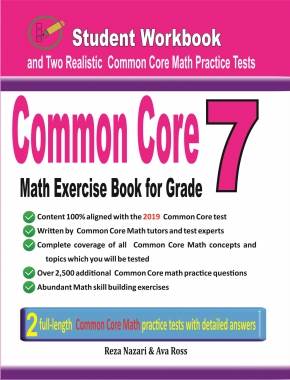
Common Core Math Exercise Book for Grade 7 Student Workbook and Two Realistic Common Core Math Tests
Frequently Asked Questions
What is the MAP Growth test?
MAP Growth (Measures of Academic Progress) is an adaptive computer test from NWEA used by many schools to track student progress in reading, language, math, and science. Students typically take it two or three times a year, and the math score is reported on the RIT scale.
How is MAP different from a typical end-of-year state test?
MAP is adaptive, the test picks the next question based on whether you got the last one right. It also runs untimed in most schools and isn’t tied to a single grade-level standard. State tests like STAAR or FSA are usually fixed-form, timed, and tied directly to one grade’s standards.
What math topics show up most on 7th grade MAP?
Operations with rational numbers (including negatives), ratios and proportional relationships, percent problems, two-step equations and inequalities, geometry (area, volume, scale drawings), and basic statistics (measures of center, probability of simple events).
How long is the MAP test?
The MAP math test typically takes 45 to 60 minutes, but schools can extend that since the test is untimed. The number of questions varies because the test ends once the algorithm has enough data to pin down the student’s RIT score.
What’s a good 7th grade MAP math RIT score?
NWEA’s fall norms put the average 7th-grade math RIT around 225, with 230+ being above average and 220 below. A typical year of growth is 4 to 6 RIT points. Compare your child’s score against NWEA’s published norms, which are the cleanest benchmark.
Are calculators allowed on the MAP test?
It depends on the school’s configuration. NWEA lets districts choose calculator settings per grade. Many 7th grade implementations allow an embedded basic calculator on certain items but not others. Ask your teacher what your school enables.
How should my 7th grader prepare for MAP math?
Two habits beat any single strategy: (1) take full-length practice sets that mix topics, since MAP cycles through all strands; and (2) review explanations for every missed question, naming the specific concept that tripped them up. Targeted review beats rote drilling.
Should my child guess on MAP?
Generally yes. There’s no penalty for wrong answers, so a blank is no better than a guess. But because the test is adaptive, a string of guesses can drop the difficulty of upcoming questions. The best policy is: answer everything, but slow down to give each question your best shot.
How often do students take MAP?
Most schools administer MAP two or three times a year, fall, winter, and spring, to measure growth across the year. A few schools test only fall and spring. Each session takes about an hour.
What does the MAP score report show?
You see an overall RIT score, percentile rank against NWEA norms, projected growth, and a breakdown by subscore (e.g., for 7th grade math: Operations and Algebraic Thinking, The Real and Complex Number Systems, Geometry, and Statistics and Probability). The subscores show which area needs the most attention.
Related Lessons You May Like
- How to add and subtract integers
- How to solve proportional ratios
- How to solve percent of change
- How to solve one-step equations
- How to solve multi-step word problems
If you want a workbook that lines up with these questions one chapter at a time, Mastering Grade 7 Math covers every Grade 7 standard with patient explanations and lots of practice. For extra reps on translating word problems into equations, Mastering Grade 7 Math Word Problems is a strong companion.

Related to This Article
More math articles
- Top 10 6th Grade NYSE Math Practice Questions
- How to Remove Discontinuity from a Function
- 3rd Grade PARCC Math FREE Sample Practice Questions
- NYSTCE Grades 1-6 Math (222) Worksheets: FREE & Printable
- CLEP College Algebra Worksheets: FREE & Printable
- CBEST Math FREE Sample Practice Questions
- Idaho ISAT Grade 7 Math Worksheets: 95 Free PDFs with Tutor-Style Answer Keys
- How to Solve Word Problems by Adding Three or More Fractions
- 8th Grade Wisconsin Forward Math Worksheets: FREE & Printable
- The Best Grade 8 Math Book for Indiana Students





What people say about "7th Grade MAP Math Free Sample Practice Questions"?
No one replied yet.