Grade 3 Math: Equivalent Fractions
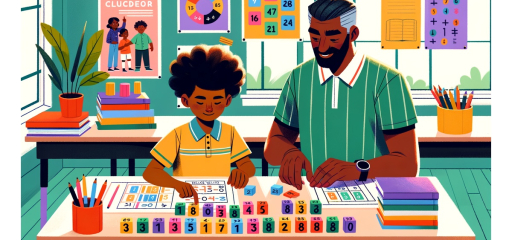
Once upon a time in the bustling town of Mathington, there lived two friends, Lily the Lioness and Tim the Tiger. Lily and Tim loved exploring the world around them, especially when it came to understanding fractions. One sunny morning, as they strolled through the colorful Mathington Market, they stumbled upon a fascinating new concept – equivalent fractions. Let’s join them on their exciting journey to unravel the mystery of equivalent fractions!
Understanding the Concept
Equivalent fractions are like secret codes in the world of math. They look different but hold the same value. Imagine you have a delicious pizza. If you cut it into 4 equal slices and eat 2 slices, you’ve eaten \(\frac{2}{4}\) of the pizza. But what if you cut the same pizza into 8 equal slices? Eating 2 slices would then be \(\frac{2}{8}\) of the pizza. Both fractions represent the same amount of pizza eaten, even though they look different.
Lily and Tim decided to create a chart to visualize equivalent fractions better. They listed fractions like \(\frac{1}{2}\), \(\frac{2}{4}\), and \(\frac{3}{6}\) on one side and their corresponding shaded diagrams to represent the fractions on the other side. The chart was a colorful masterpiece showcasing how different fractions could mean the same value.
Key Concepts Explained
To find equivalent fractions, you need to remember the magical rule – multiply or \divide the top and bottom of the fraction by the same number. Let’s \dive deeper with Lily and Tim’s example.
The Absolute Best Book to Ace Grade 3 Math
Lily had a fraction \(\frac{2}{3}\) written on her notebook. She wanted to find an equivalent fraction with a larger denominator. So, she decided to multiply the top and bottom by 2. By doing this, she got a new fraction \(\frac{4}{6}\). Both fractions, \(\frac{2}{3}\) and \(\frac{4}{6}\), are equivalent because they represent the same value.
Tim, being curious, wanted to try \dividing instead of multiplying. He took the fraction \(\frac{4}{8}\) and \divided the top and bottom by 2. This gave him the equivalent fraction \(\frac{2}{4}\). Even though Tim used \division, the fractions were still equivalent.
The Mathington Library had a magical book that could generate endless equivalent fractions. Lily and Tim spent hours exploring different fractions and finding their equivalents. They realized that equivalent fractions were like twins – different in appearance but identical in value.
Common Mistakes to Avoid
One common mistake is changing both the numerator and denominator by different numbers. For example, if you have \(\frac{2}{3}\) and you multiply the numerator by 2 but the denominator by 3, you won’t get an equivalent fraction. Remember, always multiply or \divide the numerator and denominator by the same number to find equivalent fractions.
Another mistake is forgetting to simplify the fractions. Equivalent fractions should be in their simplest form. If you have \(\frac{4}{8}\) as an equivalent fraction of \(\frac{2}{4}\), don’t forget to simplify it further to \(\frac{1}{2}\).
Summary and Key Takeaways
In the exciting world of equivalent fractions, numbers may look different but can hold the same value. By multiplying or \dividing the numerator and denominator by the same number, you can unlock a world of equivalent fractions. Remember to simplify your fractions to their simplest form for a clearer understanding. Lily and Tim’s adventure in discovering equivalent fractions had opened a new realm of possibilities in their mathematical journey.
The Most Comprehensive Grade 3 Math Workbook
Lily and Tim realized that understanding equivalent fractions was like solving a thrilling puzzle where pieces might look different but fit together perfectly. The world of math was full of surprises, and they couldn’t wait to explore more adventures in Mathington!
💡 Teaching Tip: Multiply or divide top and bottom by the same number!
Additional Practice Resources

Related to This Article
More math articles
- Parallel, Perpendicular, and Intersecting Lines
- A Deep Dive into the Chapters of the Book: Pre-Algebra for Beginners
- Stay Calm: 7 Working Techniques To Overcome Exam Nerves
- Decoding the Depths: A Dive into the Composite Floor Function
- 6th Grade PARCC Math FREE Sample Practice Questions
- Praxis Core Math Worksheets: FREE & Printable
- Absolute Value Definition
- Full-Length ALEKS Math Practice Test
- Repeating Patterns
- How to Graph an Equation in the Standard Form?









What people say about "Grade 3 Math: Equivalent Fractions - Effortless Math: We Help Students Learn to LOVE Mathematics"?
No one replied yet.