Double Digits, Double Fun: How to Solve Word Problems with Two-digit Divisors
TL;DR: Word problems with two-digit divisors ask you to divide by a number somewhere between 11 and 99. Long division still does the job, but at each step you'll need to estimate the next digit of the quotient — and that estimation gets faster with practice. Don't forget remainders: if the story leaves something left over, your final answer might need to account for it differently than a clean quotient. Estimate, divide, check, and report carefully.
Key takeaways:
- Two-digit divisor problems use long division with divisors from 10 to 99.
- Estimate each digit of the quotient using rounded values.
- Multiply the partial quotient by the divisor, subtract, then bring down.
- Check by multiplying: quotient times divisor plus remainder should equal the dividend.
- Real-world problems: distributing supplies, forming teams, packaging items.

Dividing Two-digit and Three-digit Numbers by Two-digit Numbers in Word Problems
Example 1:
A school ordered \(240\) pencils and wants to distribute them equally among \(20\) classrooms. How many pencils will each classroom receive?
Solution Process:
Divide \(240\) by \(20\).
Answer:
Each classroom will receive \(12\) pencils.
The Absolute Best Book for 5th Grade Students
Example 2:
There are \(154\) students in a school who want to play soccer. If each team requires \(22\) players, how many full teams can the school form?
Solution Process:
Divide \(154\) by \(22\).
Answer:
The school can form \(7\) full teams with \(0\) students left over.
Dividing two-digit and three-digit numbers by two-digit numbers in word problems requires careful reading and understanding of the problem’s context. By identifying the numbers involved and performing the division, you can find the solution and apply this knowledge to various real-world scenarios. Whether it’s distributing resources, forming groups, or calculating averages, division plays a pivotal role. Practice regularly with different word problems to become adept at using division in practical situations!
Practice Questions:
1. A bakery baked \(360\) muffins and wants to pack them in boxes of \(24\). How many full boxes will they have?
2. A library has \(528\) books and wants to distribute them equally among \(33\) tables. How many books will each table get?
3. There are \(275\) students going on a field trip. If each bus can carry \(25\) students, how many buses are needed?
4. A factory produces \(462\) toys and wants to pack them in boxes of \(21\). How many boxes will they prepare?
5. A marathon event has \(540\) water bottles to be distributed equally among \(45\) hydration stations. How many bottles will each station get?
A Perfect Book for Grade 5 Math Word Problems!

Answers:
1. \(15\) full boxes
2. \(16\) books per table with a remainder of \(0\)
3. \(11\) buses
4. \(22\) boxes
5. \(12\) bottles per station
The Best Math Books for Elementary Students
A Reliable 4-Step Method for Two-Digit Word Problems
Word problems built around two-digit numbers (10–99) trip up many students because the words pile up faster than the math. The fix is the same every time: slow the reading down, capture what you know, decide on the operation, and check the answer makes sense. Here’s the method that works for almost every two-digit word problem in elementary and middle-school math.
- Read the problem twice. The first read is for the story. The second read is for the numbers and the question being asked.
- Underline the question. What exactly is the problem asking you to find? “How many in all?” “How many more?” “How many are left?”
- Pick the operation. “In all” / “altogether” → addition. “How many more” / “difference” → subtraction. “Each” / “groups of” → multiplication or division.
- Solve and double-check. Estimate first (“about 80 + 20 ≈ 100”), then compute carefully. If your exact answer is far from your estimate, recheck the setup.
Worked Examples
Example 1: Addition
“Mia read 47 pages on Monday and 38 pages on Tuesday. How many pages did she read in all?” The phrase “in all” tells you to add. \(47 + 38 = 85\) pages. Estimate check: \(50 + 40 = 90\). Close to 85 — answer is reasonable.
Example 2: Subtraction
“A bookstore had 92 books on the shelf. After a busy weekend, only 56 were left. How many books were sold?” “How many were sold” = the difference. \(92 – 56 = 36\) books. Estimate: \(90 – 60 = 30\). Reasonable.
Example 3: Multiplication
“A school orders 24 boxes of pencils. Each box has 12 pencils. How many pencils total?” “Each” + total → multiply. \(24 \times 12 = 288\) pencils. Estimate: \(25 \times 12 = 300\). Within range.
Common Mistakes to Avoid
- Picking the wrong operation. Don’t grab the first number you see and add it to the second. Read for what’s being asked.
- Forgetting to regroup. When subtracting and the top digit is smaller, you have to borrow — practice this until it’s automatic.
- Skipping the estimate. A quick estimate catches huge errors before you turn in the answer.
- Mixing up the order. “How many more does Sara have than Tom?” means Sara’s number minus Tom’s, not the other way around.
Related Topics
Frequently Asked Questions
How do I know whether to add or subtract?
Look at the question. “Total,” “altogether,” “in all,” “combined” → add. “Difference,” “how many more,” “how many fewer,” “left over” → subtract. When in doubt, draw a picture.
What if the problem has more than one step?
Solve one step at a time. Underline what each step needs to find, then move on. Multi-step problems are just stacks of one-step problems with a logical order.
Why do my estimates matter?
Estimates catch big mistakes before they cost you points. If your computed answer is wildly different from your estimate, something went wrong in the setup or the arithmetic.
Are these problems on standardized tests?
Yes — two-digit word problems show up on almost every elementary and early-middle-school standardized math test, including state assessments and ITBS-style tests.
Practice Problems
- A bakery sold 67 muffins on Friday and 84 on Saturday. How many in all? (Answer: 151)
- There were 95 students at a field trip. After 38 went home early, how many remained? (Answer: 57)
- Mark biked 24 miles each day for 13 days. Total miles? (Answer: 312)
- A garden has 72 tulips and 39 daffodils. How many more tulips? (Answer: 33)
Recommended EffortlessMath Books
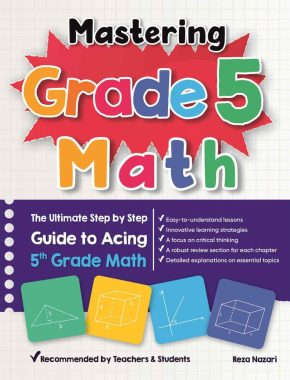
For a workbook that builds long division skills with worked examples, the Mastering Grade 5 Math walks through two-digit divisor problems step by step. For pure word-problem practice, the Mastering Grade 5 Math Word Problems packs in hundreds of division scenarios with full solutions.
Related EffortlessMath Lessons
If a topic on this page feels rusty, these short lessons go deeper:

Related to This Article
More math articles
- How to Find Rational and Irrational Numbers?
- Chapter 7: Congress-Structure and Membership
- 5th Grade MCAP Math Worksheets: FREE & Printable
- 5th Grade OAA Math Worksheets: FREE & Printable
- What Are the Applications of Inverse Trigonometric Functions?
- 5 Best Laptops For Teachers
- Math anxiety is a common reality, yet the signs can be misinterpreted
- CLEP U.S. History I 012: Dissent, Religious Liberty, and Colonial Authority
- Top Free Websites for FTCE General Knowledge Math Preparation
- The Best Grade 3 ELA Practice Tests for Kentucky Students










What people say about "Double Digits, Double Fun: How to Solve Word Problems with Two-digit Divisors - Effortless Math"?
No one replied yet.