10 Most Common 7th Grade IAR Math Questions

10 Most Common 7th Grade IAR Math Questions: this Effortless Math guide explains the topic in plain language, shows how it works through solved examples, and gives you free practice to try immediately, so the idea sticks instead of staying abstract.
Does getting the best score in the 7th-grade Illinois Assessment of Readiness (IAR) test seem out of reach for your 7th-grade students?
Familiarity with the 10 Most Common 7th Grade IAR Math Questions will be the key to your 7th-grade students’ success in the IAR Math Test. Using these questions will help your 7th-grade student know which areas need more practice. A fully descriptive answer will also help your 7th-grade students to analyze each question individually and prepare themselves for the IAR Math exam.
Make sure to follow some of the related links at the bottom of this post to get a better idea of what kind of mathematics questions students need to practice.
The Absolute Best Book to Ace 7th Grade IAR Math Test
10 Sample 7th Grade IAR Math Practice Questions
What is the median of these numbers? (2, 28, 28, 19, 67, 44, 35)
(19)
(28)
(44)
(35)
Show answer and explanation
B
Write the numbers in order:
(2, 19, 28, 28, 35, 44, 67)
Since we have (7) numbers ((7) is odd), then the median is the number in the middle, which is (28).
Last week (24,000) fans attended a football match. This week three times as many bought tickets, but one-sixth of them canceled their tickets. How many are attending this week?
(48,000)
(54,000)
(60,000)
(72,000)
Show answer and explanation
C
Three times (24,000) is (72,000). One-sixth of them canceled their tickets.
One sixth of (72,000) equals (12,000) ((frac{1}{6}) × 72,000 = 12,000).
(60,000) ((72,000 to 12,000 = 60,000)) fans are attending this week
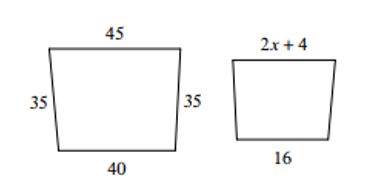
The following trapezoids are similar. What is the value of (x)?
(7)
(8)
(18)
(45)
Show answer and explanation
A
It needed to have a ratio to find the value of (x).
(frac{45}{40}=frac{2x+4}{16}⇒ 40(2x+4)=45×16 ⇒ x=7)
If (x=- 8), which equation is true?
( x(2x-4)=120)
(8 (4-x)=96)
( 2 (4x+6)=79)
( 6x-2=-46)
Show answer and explanation
B
(8 (4-(-8))=96)
In a bag of small balls (frac{1}{3}) are black, (frac{1}{6}) are white, (frac{1}{4}) are red and the remaining (12) blue. How many balls are white?
(8)
(12)
(16)
(24)
Show answer and explanation
A
(frac{1}{3}x + frac{1}{6}x + frac{1}{4}x + 12= x)
((frac{1}{3} + frac{1}{6} + frac{1}{4}) x+ 12= x)
((frac{9}{12})x+ 12 = x)
(x = 48)
In a bag of small balls (frac{1}{6}) are white then: (frac{48}{6} = 8)
A boat sails (40) miles south and then (30) miles east. How far is the boat from its start point?
(45)
(50)
(60)
(70)
Show answer and explanation
B
Use the information provided in the question to draw the shape.
Use Pythagorean Theorem: (a^2 + b^2 = c^2)
(40^2 + 30^2 = c^2 ⇒ 1,600 + 900 = c^2 ⇒ 2,500 = c^2 ⇒ c = 50)
Sophia purchased a sofa for ($530.40). The sofa is regularly priced at ($624). What was the percent discount Sophia received on the sofa?
(12%)
(15%)
(20%)
(25%)
Show answer and explanation
B
The question is this: (530.40) is what percent of (624)?
Use the percent formula:
(part = frac{percent}{100}× whole)
(530.40= frac{percent}{100}× 624 ⇒ 530.40 = frac{percent ×624}{100}⇒53,040 = percent ×624)
(⇒percent = frac{53,040}{624}= 85)
(530.40) is (85 %) of (624). Therefore, the discount is: (100%, 85% = 15%)
The score of Emma was half that of Ava and score of Mia was twice that of Ava. If the score of Mia was (60), what is the score of Emma?
(12)
(15)
(20)
(30)
Show answer and explanation
B
If the score of Mia was (60), therefore the score of Ava is (30). Since the score of Emma was half as that of Ava, therefore, the score of Emma is (15).
A bag contains (18) balls: two green, five black, eight blue, a brown, a red, and one white. If (17) balls are removed from the bag at random, what is the probability that a brown ball has been removed?
(frac{1}{9})
(frac{1}{6})
(frac{16}{17})
(frac{17}{18})
Show answer and explanation
D
If (17) balls are removed from the bag at random, there will be one ball in the bag.
The probability of choosing a brown ball is (1) out of (18). Therefore, the probability of not choosing a brown ball is (17) out of (18) and the probability of having not a brown ball after removing (17) balls is the same.
A rope weighs (600) grams per meter of length. What is the weight in kilograms of (12.2) meters of this rope? ((1) kilograms (= 1,000) grams)
Best 7th Grade IAR Math Prep Resource
(0.0732)
(0.732)
(7.32)
(7,320)
Show answer and explanation
C
The weight of (12.2) meters of this rope is: (12.2 × 600 space g = 7,320 space g)
(1space kg = 1,000 space g) therefore,
( 7,320 space g ÷ 1,000 = 7.32 space kg)
Common Core Math Exercise Book for Grade 7 Student Workbook and Two Realistic Common Core Math Tests

Related to This Article
More math articles
- 4th Grade PARCC Math Practice Test Questions
- North Dakota NDSA Grade 6 Math Free Worksheets: Free Printable Grade 6 Math PDFs, No Signup
- How to Find the Perimeter of Right-Angled Triangle?
- New Hampshire SAS Grade 7 Math Worksheets: 95 Free Printable PDFs with Answer Keys
- Overview of the Praxis Core Mathematics Test
- 5th Grade NHSAS Math Worksheets: FREE & Printable
- Chapter 7: Congress-Structure and Membership
- Comparing and Ordering Numbers for 5th Grade: Tips and Practice
- Migration, Direction, Selection, and Policy
- Billionaire Basics: How to Master Addition and Subtraction of Massive Whole Numbers











What people say about "10 Most Common 7th Grade IAR Math Questions"?
No one replied yet.