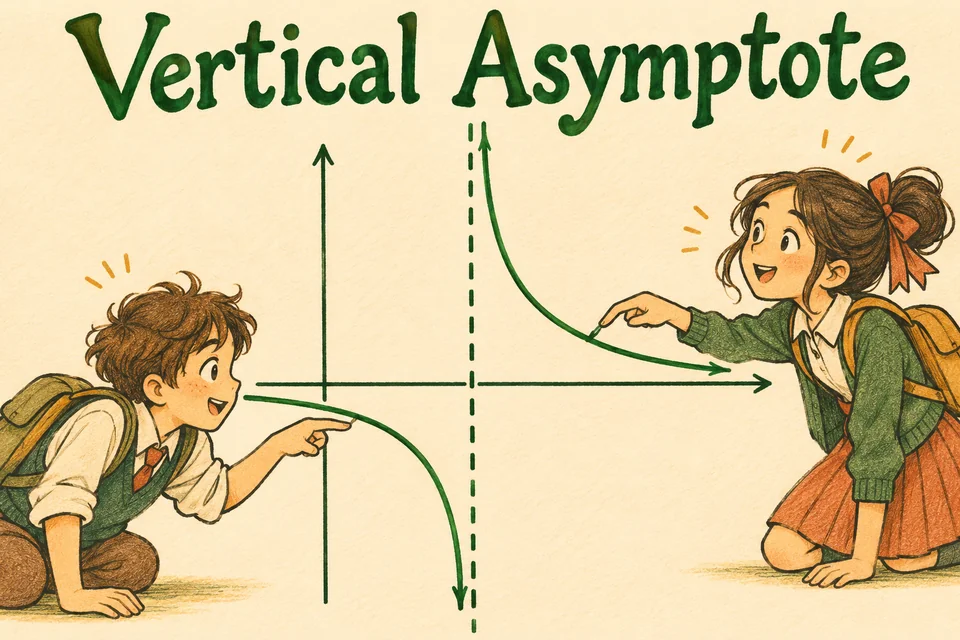
Vertical Asymptote definition
A vertical line x = a is a vertical asymptote if a function tends to positive or negative infinity as x approaches a from at least one side.
Vertical Asymptote in a picture
How it works
For a rational function, factor and cancel common factors while keeping the original domain restrictions. A real zero of the reduced denominator gives a vertical asymptote. If all factors causing that zero cancel and the limit is finite, the missing point is a hole instead.
Worked examples
Find the vertical asymptote of 1/(x − 3).
x = 3.
What happens at x = 2 for (x² − 4)/(x − 2)?
The factor cancels and the limit is 4. There is a hole, not a vertical asymptote.
Find the vertical asymptote of (x − 1)/(x − 1)².
One denominator factor remains after cancellation, so x = 1 is a vertical asymptote.
Common mistake
A denominator zero by itself does not guarantee an asymptote. Check what remains after cancellation.
Quick check
Is a vertical asymptote written x = a or y = a?
Show answer
x = a.
Must both one-sided limits be infinite?
Show answer
No. At least one is enough.
What happens at x = 0 for ln x?
Show answer
The right-hand limit is −∞, so x = 0 is a vertical asymptote.
Sources
Flashcard
Vertical Asymptote
Reveal the definition
A vertical line x = a is a vertical asymptote if a function tends to positive or negative infinity as x approaches a from at least one side.
Effortless Math. “Vertical Asymptote.” Math Dictionary.