Horizontal Asymptote definition
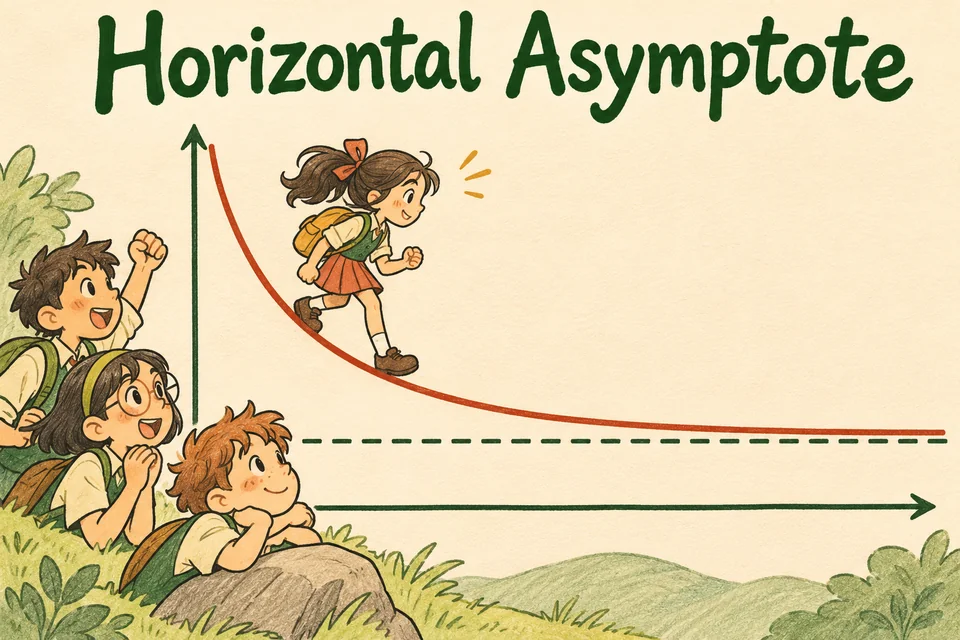
A horizontal line y = L is a horizontal asymptote if the function approaches L as x tends to positive infinity, negative infinity, or both.
Horizontal Asymptote in a picture
How it works
For a rational function, compare the highest degrees. A smaller numerator degree gives y = 0. Equal degrees give the ratio of leading coefficients. A larger numerator degree gives no horizontal asymptote. The definition concerns end behavior, so the graph may intersect the line at finite inputs.
Worked examples
Find the horizontal asymptote of 3/(x + 2).
y = 0 because the denominator has higher degree.
Find it for (2x² + 1)/(5x² − 7).
Equal degrees give y = 2/5.
Does x²/(x + 1) have a horizontal asymptote?
No. Its numerator degree is higher.
Common mistake
Compare leading coefficients only when the degrees match. The asymptote describes behavior far from the origin.
Quick check
Which form describes a horizontal asymptote?
Show answer
y = L.
Can a graph cross one?
Show answer
Yes.
May a function have different left and right horizontal asymptotes?
Show answer
Yes.
Sources
Flashcard
Horizontal Asymptote
Reveal the definition
A horizontal line y = L is a horizontal asymptote if the function approaches L as x tends to positive infinity, negative infinity, or both.
Effortless Math. “Horizontal Asymptote.” Math Dictionary.