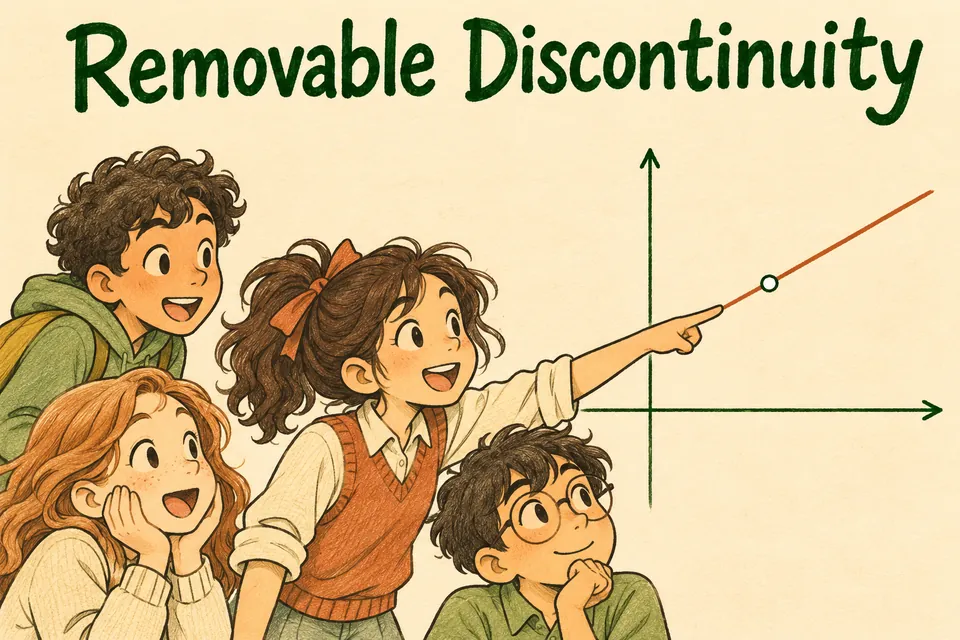
Removable Discontinuity definition
A removable discontinuity occurs where a function has a finite two-sided limit but is undefined or has a different value at that input.
Removable Discontinuity in a picture
How it works
Redefining the function value to equal the limit makes it continuous there. A graph may show an open circle, sometimes with a filled point at a different height. For a rational function, a missing input whose denominator factors all cancel gives this kind of discontinuity.
Worked examples
Find the hole in (x² − 1)/(x − 1).
For x ≠ 1 the expression equals x + 1, so the hole is (1, 2).
A function has limit 5 at x = 2, but f(2) = 7. How can you remove the discontinuity?
Set f(2) = 5.
Can a discontinuity with unequal left and right limits be fixed at one point?
No. Changing one function value does not make the limits agree.
Common mistake
Keep the original excluded input even after simplifying. The simplified rule supplies the limiting value.
Quick check
What limit is needed for a removable discontinuity?
Show answer
A finite two-sided limit.
What can you set f(a) to when the limit exists and is L?
Show answer
L.
Is an infinite discontinuity removable by changing one value?
Show answer
No.
Sources
Flashcard
Removable Discontinuity
Reveal the definition
A removable discontinuity occurs where a function has a finite two-sided limit but is undefined or has a different value at that input.
Effortless Math. “Removable Discontinuity.” Math Dictionary.