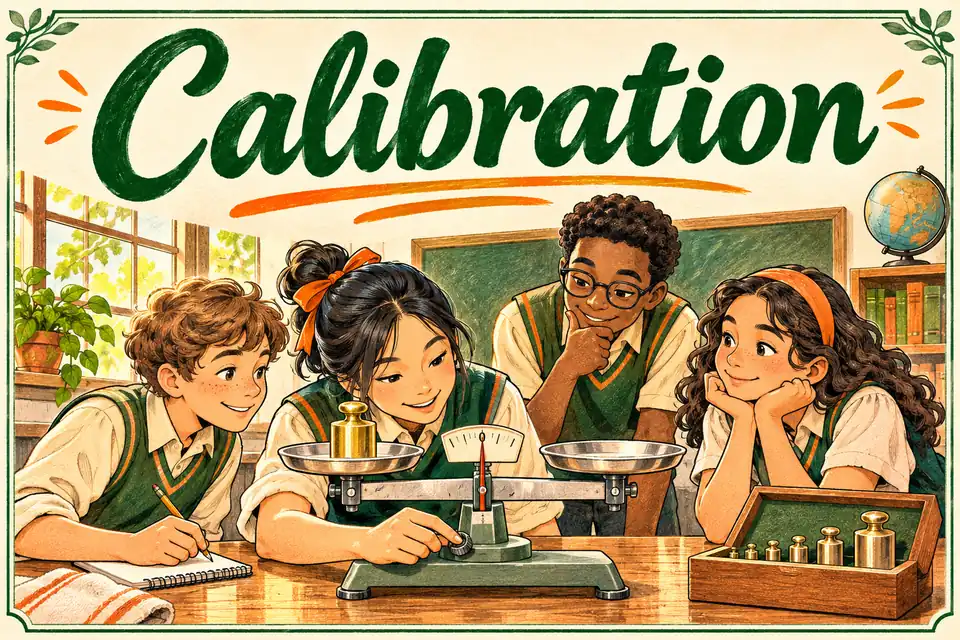
Calibration definition
Calibration establishes how a measuring instrument’s indications correspond to reference values under specified conditions.
Calibration in a picture
How it works
Compare the instrument’s readings with standards whose values and uncertainties are known. The relationship can support a correction or a calibration curve for future measurements. Calibration can reveal an offset even if the instrument has never been adjusted.
Worked examples
A thermometer reads 20.5° for a reference at 20.0°. What is the indication error here?
+0.5°.
A balance reads high by 1 g at every checked point. What correction fits those readings?
Subtract 1 g within the range supported by the checks.
Does one successful check prove the same accuracy across the whole range?
No. Other points may behave differently.
Common mistake
Document the conditions and reference values. Adjusting an instrument is a separate operation from establishing its measurement relationship.
Quick check
What does an instrument’s indication mean?
Show answer
The value it shows.
What does calibration compare it with?
Show answer
A reference standard.
Can calibration identify a consistent offset?
Show answer
Yes.
Sources
Flashcard
Calibration
Reveal the definition
Calibration establishes how a measuring instrument’s indications correspond to reference values under specified conditions.
Effortless Math. “Calibration.” Math Dictionary.