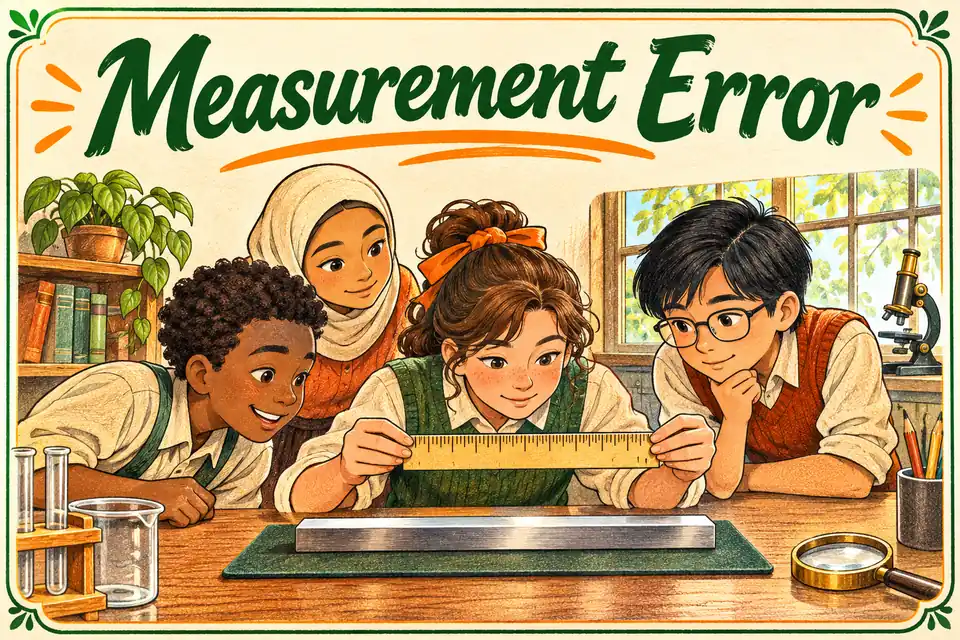
Measurement Error definition
Measurement error is a measured value minus a reference value for the same quantity.
Measurement Error in a picture
How it works
The sign gives the direction of the difference. A positive error means the reading is high relative to the reference, and a negative error means it is low. In practice, the true value is often unknown, so a suitable reference is needed to estimate an error.
Worked examples
A scale reads 103 g for a 100 g reference. Find the error.
103 − 100 = +3 g.
A clock reads 58 s for a 60 s reference. Find the error.
58 − 60 = −2 s.
What error does a reading equal to its reference give?
Zero relative to that reference.
Common mistake
Subtract the reference from the reading to preserve the direction. Take an absolute value only when the magnitude is requested.
Quick check
What does a positive error mean?
Show answer
The reading is above the reference.
What are the error units for values in centimeters?
Show answer
Centimeters.
Can you find an exact error without a known reference?
Show answer
You need a reference to calculate it.
Sources
Flashcard
Measurement Error
Reveal the definition
Measurement error is a measured value minus a reference value for the same quantity.
Effortless Math. “Measurement Error.” Math Dictionary.