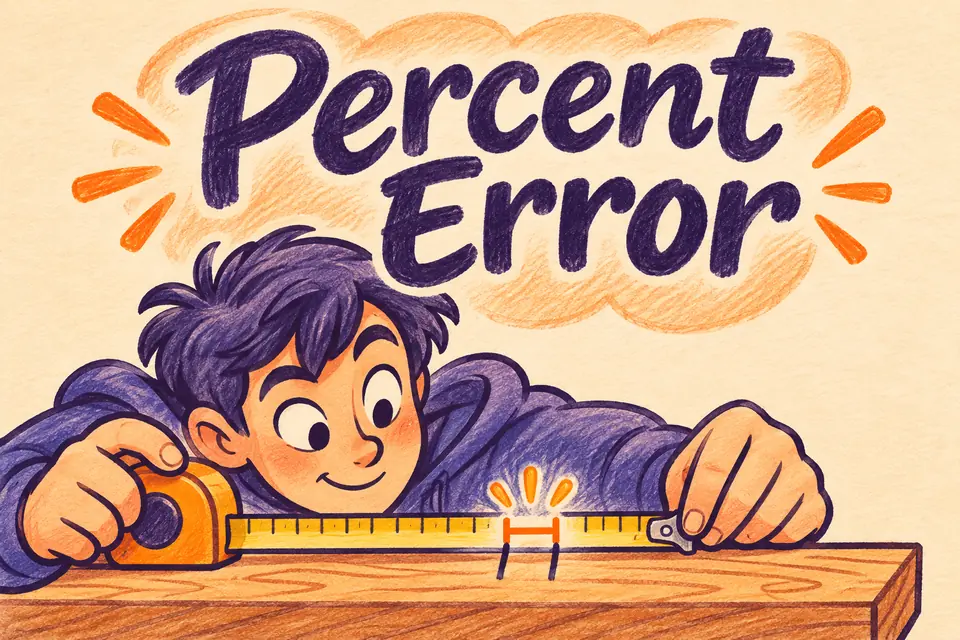
Percent Error definition
Percent error expresses the size of a measurement’s difference from an accepted value as a percentage of that accepted value.
Percent Error in a picture
How it works
Subtract the accepted value from the measured value. Take the absolute value, divide by the magnitude of the accepted value, and multiply by 100 to write the result as a percent. In this common classroom convention, the result is zero or positive. A signed version can indicate whether a measurement ran high or low. With an accepted value of zero, this formula is undefined.
Worked examples
A scale reads 102 g for a 100 g mass. Find the percent error.
The absolute difference is 2 g. Divide by 100 g and multiply by 100 to get 2%.
An estimate is 18 L and the accepted amount is 24 L. Find the percent error.
The difference is 6 L. Divide 6 by 24 to get 0.25, or 25%.
The measured and accepted lengths are both 40 cm. Find the percent error.
The difference is zero, so the percent error is 0%.
Common mistake
Use the accepted value as the denominator. Match the units before subtracting or dividing.
Quick check
A sample reads 76 g. The accepted value is 80 g. What is the percent error?
Show answer
5%, because 4 ÷ 80 = 0.05.
Is the usual absolute percent error negative if the measurement is low?
Show answer
No. The absolute value makes the difference nonnegative.
Can you use this formula if the accepted value is zero?
Show answer
No. It would require dividing by zero.
Sources
Flashcard
Percent Error
Reveal the definition
Percent error expresses the size of a measurement’s difference from an accepted value as a percentage of that accepted value.
Effortless Math. “Percent Error.” Math Dictionary.