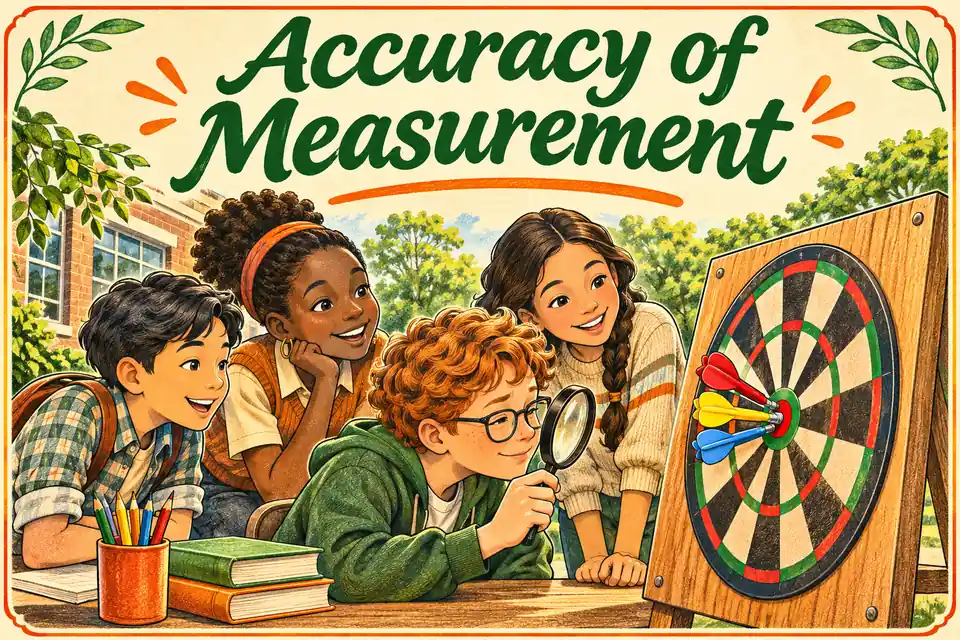
Accuracy of Measurement definition
Accuracy of measurement describes how close a measured value is to the true or appropriate reference value.
Accuracy of Measurement in a picture
How it works
Accuracy is a qualitative idea in metrology. Use a known reference and a numerical error to describe how close a particular result is. If repeated measurements cluster tightly but far from the reference, they have high precision and poor accuracy.
Worked examples
Two readings are 49.9 mm and 50.8 mm, with reference 50.0 mm. Which is more accurate?
49.9 mm, because its absolute error is 0.1 mm versus 0.8 mm.
A scale repeatedly reads 205 g for a 200 g reference. What do the repeated readings show?
They agree closely with one another, while the 5 g offset shows poor agreement with the reference.
Does a finer display automatically improve accuracy?
No. A finely displayed number can still have a systematic offset.
Common mistake
Use the distance from the reference to compare accuracy. Use repeat readings to compare precision.
Quick check
Which point on a target represents the reference?
Show answer
The bullseye.
Is more decimal detail sufficient to establish accuracy?
Show answer
No.
Can calibration help reveal an offset?
Show answer
Yes.
Sources
Flashcard
Accuracy of Measurement
Reveal the definition
Accuracy of measurement describes how close a measured value is to the true or appropriate reference value.
Effortless Math. “Accuracy of Measurement.” Math Dictionary.