Articles

You can find helpful articles about mathematics and test prep here.

Interested in Becoming an Effortless Math Guest Blogger? Click here

Search in Articles articles.

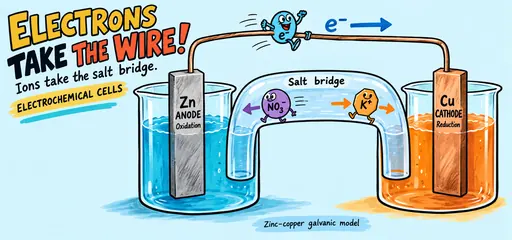
Hand-drawn zinc-copper galvanic cell comic: electrons travel through the wire from zinc anode to copper cathode, while nitrate and potassium ions travel through the salt bridge.

Electrochemical Cells: Electron Flow and Cell Voltage

Trace electrons and salt-bridge ions in electrochemical cells. Calculate standard cell voltage with a zinc-copper example and six review questions.
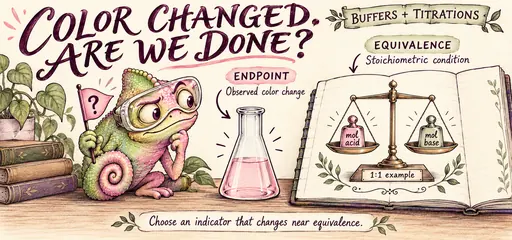
Hand-drawn chameleon comic distinguishes an observed indicator color-change endpoint from titration equivalence, with equal acid and base moles in a 1:1 example.

Buffers and Titrations: Endpoint vs. Equivalence

Learn how buffers resist pH change, calculate acid concentration from a titration, and distinguish endpoint from equivalence. Includes six review questions.
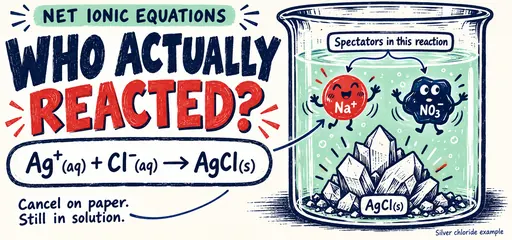
Hand-drawn comic of silver chloride precipitate beneath sodium and nitrate spectator ions that remain dissolved, with the balanced silver chloride net ionic equation.

Net Ionic Equations: Precipitates and Spectator Ions

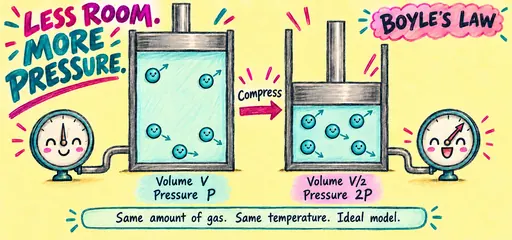
Hand-drawn Boyle’s law comic with five particles in each piston chamber: halving volume doubles pressure for the same ideal gas amount at constant temperature.

Gas Laws: Pressure, Volume and Kelvin Temperature

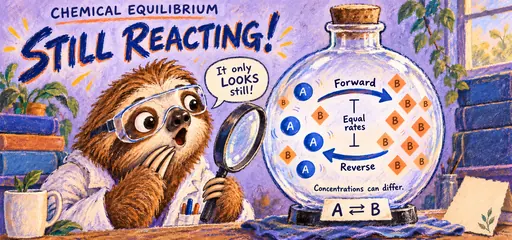
Oil-pastel comic of a curious sloth scientist examining an A-to-B equilibrium model: forward and reverse reactions continue at equal rates while concentrations can differ.

Chemical Equilibrium: Expressions, Q vs. K and Shifts

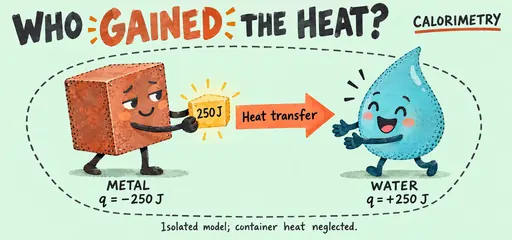
Handmade comic of metal transferring 250 joules to water: metal heat is negative and water heat positive in an isolated model with container heat neglected.

Calorimetry and Heat: Calculate q and Choose Its Sign

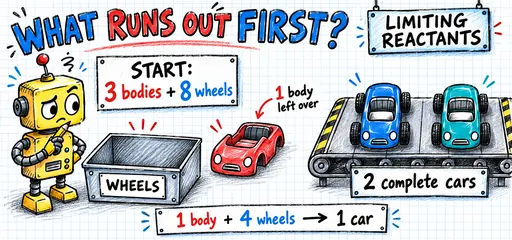
Hand-drawn toy factory analogy for limiting reactants: three car bodies and eight wheels make two four-wheel cars, leaving one unused body and no wheels.

Stoichiometry and Limiting Reactants: Calculate Yield

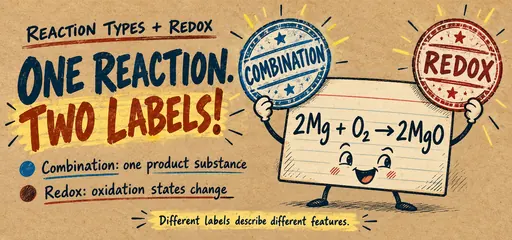
Hand-drawn reaction card with the balanced magnesium-oxygen equation holds combination and redox badges, showing that classifications describe different features.

Reaction Types and Redox: Oxidation, Reduction and Agents

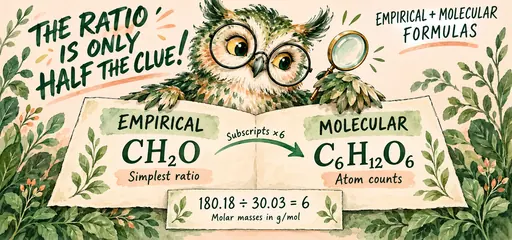
Hand-painted owl compares empirical CH2O with molecular C6H12O6; the molar-mass ratio 180.18 divided by 30.03 gives a subscript multiplier of six.

Empirical and Molecular Formulas: Calculate Atom Ratios

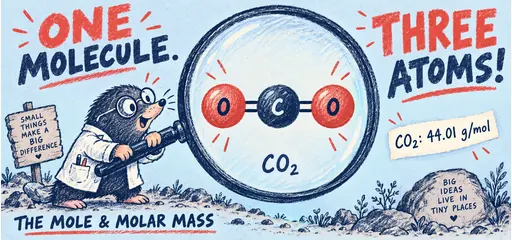
Hand-drawn mole chemist magnifies one carbon dioxide molecule containing one carbon and two oxygen atoms; CO2 has molar mass 44.01 g/mol.

The Mole and Molar Mass: Convert Grams to Molecules

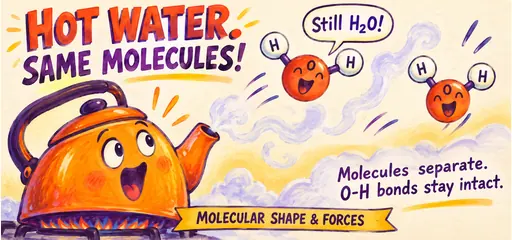
Hand-painted comic kettle releases two intact bent H2O molecules: boiling separates water molecules while their oxygen-hydrogen covalent bonds stay intact.

Molecular Shape and Polarity: CO2 and Water

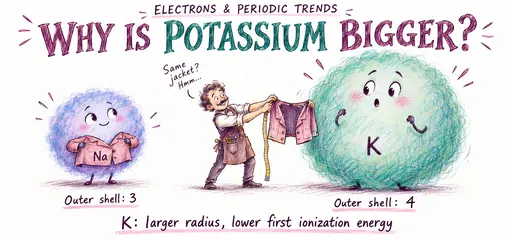
Hand-sketched tailor compares sodium and potassium atom-cloud cartoons: potassium has outer shell four, a larger radius and lower first ionization energy than sodium with outer shell three.

Electrons and Periodic Trends: Atomic Size and Energy