Articles

You can find helpful articles about mathematics and test prep here.

Interested in Becoming an Effortless Math Guest Blogger? Click here

Search in Articles articles.

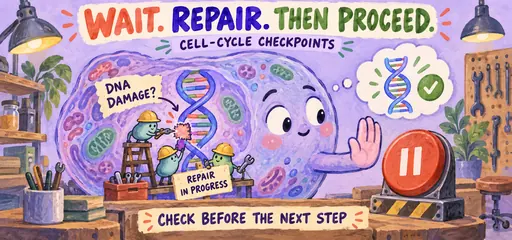
A cell pauses while tiny repair-protein mechanics mend damaged DNA, illustrating checkpoint arrest before the next cell-cycle step.

Cell Cycle Checkpoints: G1, G2 and Spindle Control

Skin can replace many damaged cells through division, whereas most mature neurons remain outside the division cycle. These cell types share essentially the same inherited genome but express different proteins and respond differently to growth signals. Cell specialization includes regulation of wheth
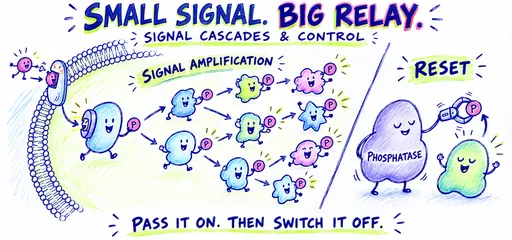
Ballpoint comic shows a receptor triggering a branching phosphorylation relay and a phosphatase removing a phosphate from a target to help reset signaling.

Signal Transduction Cascades: Amplification and Control

A frightened animal can mobilize fuel rapidly after an endocrine signal. A small number of activated receptors can change the activity of many downstream molecules. That multiplication is signal amplification.
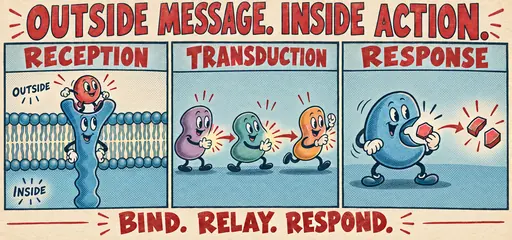
Three hand-inked panels show an outside ligand binding a surface receptor, an intracellular relay, and a changed enzyme activity response.

Cell Signaling: Reception, Transduction and Response

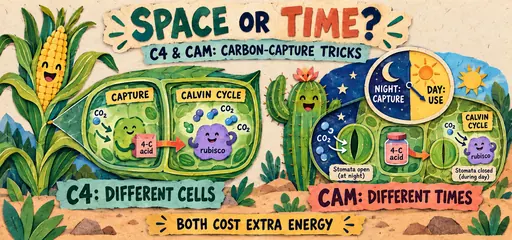
Handmade comic contrasts C4 carbon capture in different cells with CAM capture at night and use by day, showing open nighttime and closed daytime stomata.

Photorespiration, C4 and CAM Photosynthesis Explained

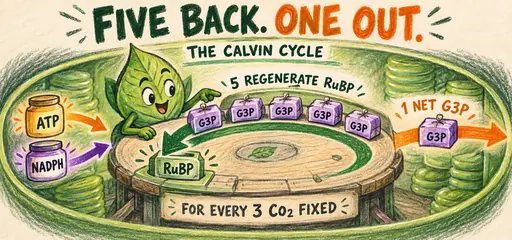
A leaf biochemist shows five G3P packages returning to regenerate RuBP and one net G3P exported per three carbon dioxide fixed, with ATP and NADPH inputs.

The Calvin Cycle Explained: Phases, ATP and G3P

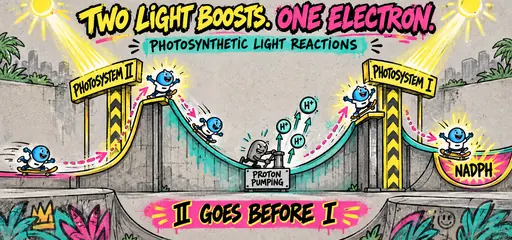
A comic electron follows two light-powered boosts, photosystem II then photosystem I, with proton pumping between them and an NADPH endpoint.

Photosynthetic Light Reactions: ATP, NADPH and Oxygen

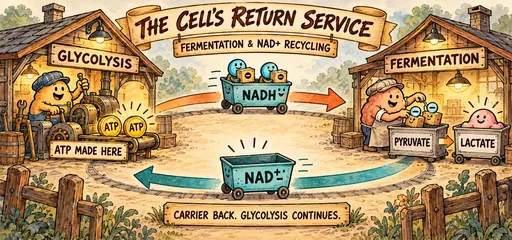
Hand-drawn fermentation comic: NADH delivers electrons to pyruvate, making lactate, while regenerated NAD+ returns to glycolysis, where ATP is made.

Fermentation and NAD+ Recycling: How Glycolysis Continues

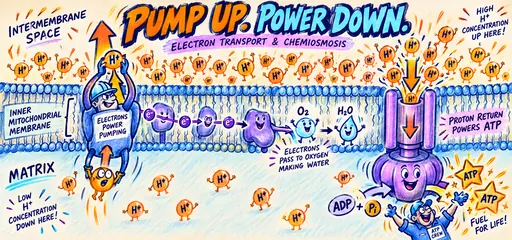
Crayon comic of mitochondrial electron transport pumping H+ into the intermembrane space and proton return through ATP synthase producing ATP in the matrix.

Electron Transport and Chemiosmosis: How ATP Forms

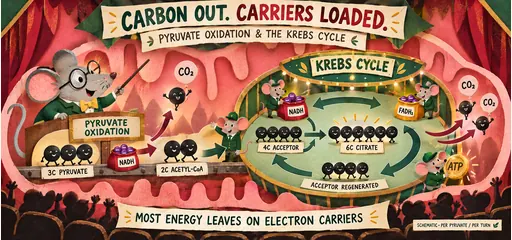
Handmade paper-theater comic showing pyruvate oxidation, acetyl-CoA entering the Krebs cycle, carbon dioxide release, acceptor regeneration and loaded electron carriers.

Pyruvate Oxidation and Krebs Cycle: Carbon and ATP Counts

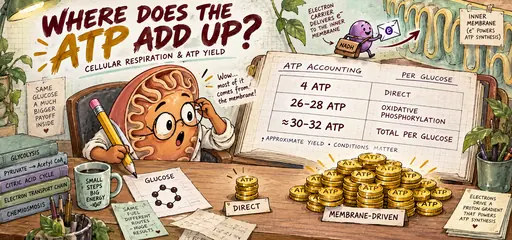
Watercolor mitochondrion accountant comparing 4 direct ATP with approximately 26–28 from oxidative phosphorylation, totaling about 30–32 ATP per glucose depending on conditions.

Cellular Respiration: Stages and 30–32 ATP Yield

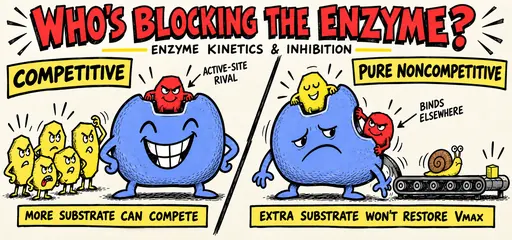
Hand-inked comic comparing competitive inhibition at the active site with pure noncompetitive inhibition at a separate site; extra substrate cannot restore the latter’s Vmax.

Enzyme Kinetics: Km, Vmax and Inhibition

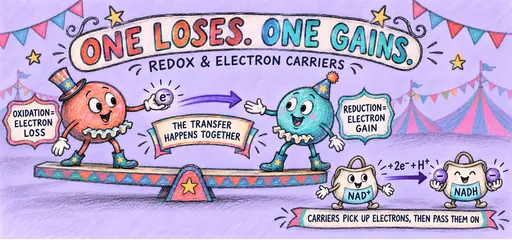
Pastel circus comic showing paired electron loss by oxidation and gain by reduction, with NAD+ accepting two electrons and a proton to form NADH.

Redox and Electron Carriers: NADH, FADH2 and NADPH