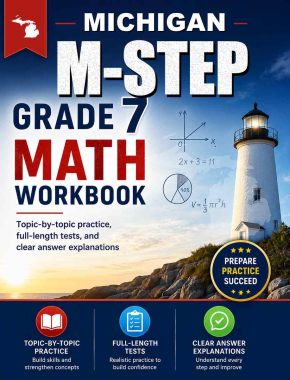
Michigan M-STEP 7th Grade Math Workbook
Michigan M-STEP 7th Grade Math Workbook is a digital Grade 7 Math workbook designed around Michigan Student Test of Educational Progress, targeted chapter practice, and full-length readiness checks.
Students also viewed
More Michigan books for this grade band and nearby math goals.
 Michigan M-STEP 8th Grade Math Workbook
Original price was: $29.99.$19.99Current price is: $19.99.
Michigan M-STEP 8th Grade Math Workbook
Original price was: $29.99.$19.99Current price is: $19.99.
 Michigan M-STEP 5th Grade Math Workbook
Original price was: $29.99.$19.99Current price is: $19.99.
Michigan M-STEP 5th Grade Math Workbook
Original price was: $29.99.$19.99Current price is: $19.99.
 Michigan M-STEP 4th Grade Math Workbook
Original price was: $29.99.$19.99Current price is: $19.99.
Michigan M-STEP 4th Grade Math Workbook
Original price was: $29.99.$19.99Current price is: $19.99.
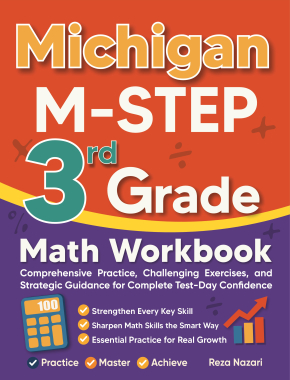 Michigan M-STEP 3rd Grade Math Workbook
Original price was: $24.99.$17.99Current price is: $17.99.
Michigan M-STEP 3rd Grade Math Workbook
Original price was: $24.99.$17.99Current price is: $17.99.
Michigan M-STEP 7th Grade Math Workbook: Printable Grade 7 Math Review for Michigan M-STEP Grade 7 Math Preparation
Students preparing for Michigan M-STEP Grade 7 Math benefit from a resource that is focused, printable, and flexible enough to work in real teaching environments. Michigan M-STEP 7th Grade Math Workbook was built for exactly that purpose, helping adults turn Grade 7 Math review into a plan instead of a last-minute scramble.
This workbook is anchored to current Michigan Grade 7 Math standards and the M-STEP assessment framework and the expectations tied to Michigan Student Test of Educational Progress. Students first work skill by skill, then use the two full-length tests to show whether their learning holds up in longer, more demanding review sessions.
Why This eBook Can Support Stronger Test Readiness
One reason this workbook stands out is that it is shaped around the kind of thinking students need for Michigan M-STEP Grade 7 Math. The review is not limited to narrow drill; it supports grade-level fluency, multi-step reasoning, and practical application across the main Grade 7 strands. That matters because stronger results usually come from better understanding, better habits, and enough volume to make improvement visible.
Adults often know that a learner is weak in one or two areas, but they still need a practical way to move from diagnosis to improvement. This workbook supports that transition by combining structured chapter work with two longer tests, so the review reflects a state-specific review system that balances chapter practice with full-length readiness checks rather than one-size-fits-all worksheet repetition.
What This Grade 7 Math Download Includes
The book structure is intentional: around 80 printable worksheets, 11 chapter groupings, and 2 complete practice tests. That combination gives students time to repair weak areas before they are asked to sustain performance across mixed-skill problems.
- Answer keys for chapter practice and full-length tests
- A format that helps adults assign selected pages or run the full workbook from start to finish
- Coverage that supports current Michigan Grade 7 Math standards and the M-STEP assessment framework
- About 80 focused Grade 7 Math worksheets organized across 11 chapters
- A student-friendly layout that keeps practice organized without watering down the math
- 2 full-length Michigan M-STEP Grade 7 Math practice tests that extend review into mixed-skill readiness
- Worked explanations that support correction, reteaching, and independent review
- A digital workbook that can be reused for targeted review across multiple sessions
The Kind of Math Work Students Will See Inside
Students use the workbook to revisit proportional reasoning in word problems, percent, tax, discount, and unit-rate applications, rational number operations, expressions, equations, and inequalities, and algebraic reasoning and pattern analysis, but the value is not only the topic list. The real advantage is that the practice shifts from concentrated review into broader, mixed-skill work, which is where many learners discover whether they truly understand the content.
For teachers and intervention specialists, the main value is not only that the workbook has enough pages. It is that the pages are organized in a way that helps instruction. Adults can spot gaps, assign targeted follow-up, and use the practice tests to see whether a student is ready to move forward or still needs another cycle of review.
Who Benefits From This Printable Math Workbook
This workbook serves more than one kind of buyer. It works for parents in Michigan who want a stronger at-home study plan, tutors supporting one-to-one intervention, learning centers running structured test-prep sessions, and homeschool families building a weekly Grade 7 Math routine, and it fits settings such as benchmark prep, warm-ups and bell work, summer reinforcement, and intervention blocks. That flexibility matters because the same student may receive support from a teacher, a tutor, and a parent over the course of one review cycle.
If you need a resource that can move between classroom instruction and home support without losing usefulness, this workbook is well suited for that role. Teachers can use it for small-group reteaching, tutors can use it to anchor weekly sessions, and parents can assign manageable pages without having to design a new study plan from scratch.
How to Use This Workbook for Better Results
One effective way to use the book is to begin with the chapters that match a student’s biggest needs, correct mistakes deliberately, and then move into a full-length test as a checkpoint. That sequence helps adults see whether the student is only improving inside one narrow topic or becoming more secure across broader Grade 7 work.
The printable format also helps when instruction time is fragmented. Adults can assign a small set of pages on one day, a correction cycle on another day, and a practice-test segment later on. That kind of modular use makes the workbook especially practical for busy classrooms and families who need a flexible review plan.
How This Workbook Aligns With What Buyers Search For
The strongest product pages do not stuff keywords; they align with real buyer intent. This one speaks to shoppers looking for M-STEP grade 7 math review, Michigan M-STEP 7th grade math workbook, 7th grade math intervention workbook, Michigan math test prep, and Michigan M-STEP 7th Grade Math Workbook because those are the exact use cases the workbook supports: chapter-by-chapter practice, printable instruction, full-length test review, and correction-friendly math support for Grade 7 learners.
Buyers comparing digital math resources often want clear signals before they commit: state alignment, realistic page volume, answer support, printable delivery, and multiple ways to use the book. Michigan M-STEP 7th Grade Math Workbook checks those boxes while also offering a stronger instructional path toward less guesswork and better mathematical decision-making, more durable retention from one review cycle to the next, stronger confidence before test day, and better pacing on mixed-skill sets.
Why This Download Can Save Planning Time and Strengthen Review
A workbook can only help students if it is realistic to use. Michigan M-STEP 7th Grade Math Workbook keeps the learning path visible, makes correction more manageable, and gives adults enough material to revisit weak skills instead of hoping a single practice round will be enough. That practicality is one reason it works so well in both instructional and test-prep settings.
For families who want a workbook that can grow with a student’s needs, this one offers unusual flexibility. It can function as ongoing standards review, a tutoring anchor, a benchmark-prep supplement, or a final exam-season resource. That makes the purchase easier to justify because it keeps working across multiple stages of the school year.
Frequently Asked Questions
Is this workbook only useful right before the M-STEP assessment?
No. It works well for year-round review, benchmark preparation, summer practice, tutoring, intervention, and homework support because the content is organized by chapter before it moves into full-length testing.
Does the workbook work for independent practice?
Yes. Many students can complete selected pages independently, then use the answer key and explanations for guided correction. It is also easy for an adult to assign only the pages that fit a current need rather than requiring the full book at once.
Why is a workbook format useful for Michigan M-STEP Grade 7 Math preparation?
A workbook provides continuity. Students can move from targeted practice into broader tests without switching formats, and adults can monitor progress in a way that is harder to do with unrelated worksheets pulled from different sources.
Michigan M-STEP 7th Grade Math Workbook is a strong choice when you need a printable Grade 7 Math workbook that can support actual improvement before M-STEP. The chapter structure, answer support, and full-length practice tests work together to build the kind of readiness that is difficult to create with disconnected practice alone.
You must be logged in to post a review.
There are no reviews yet.