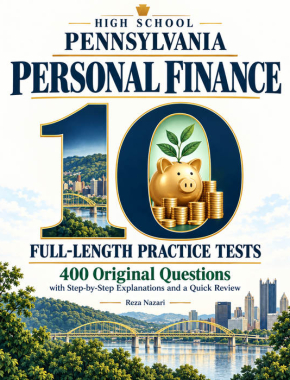
10 Full-Length Pennsylvania Personal Finance Practice Tests
10 Full-Length Pennsylvania Personal Finance Practice Tests gives high school learners 10 complete forms and 400 original questions in one instant downloadable PDF. The Pennsylvania edition pairs topic-tagged answer keys with step-by-step explanations, a Quick Review, Reference Sheet, five-week study plan, and score tracker. Use the first form to see what needs attention, then return to new questions after focused review. The file is ready for screen reading or selected-page printing under the purchase terms.
Read the Figures Behind the Choice
A paycheck figure shapes what can be spent. A loan term can shape the budget for much longer. Pennsylvania students practice reading both in context through ten complete tests, then use worked answers to see which calculation supports the decision at hand and why it fits.
10 Full-Length Pennsylvania Personal Finance Practice Tests contains 400 original four-choice questions in ten complete 40-question forms. Each suggests a 60-minute sitting. The printed plan covers personal finance fundamentals, income, spending, saving and investing, risk and insurance, and credit. The mixed forms ask students to recognize the relevant topic and choose the right information before applying a method.
This is an instant downloadable PDF: start with a complete Pennsylvania form, then use the worked answers to understand each decision before moving to the next one.
A clear view of what is included
10 complete tests
40 original questions per form.
400 original questions
Four answer choices with a worked explanation for each question.
140-page PDF
One downloadable file with the tests and study support together.
60 minutes
Suggested time for each full practice sitting.
What You Get Inside
Full-length practice
Ten fresh forms provide repeated mixed-topic work.
Answers that teach
Topic-tagged keys and step-by-step explanations show the reasoning.
Quick Review
A concise return to important ideas between test sittings.
Planning tools
A Reference Sheet, five-week study plan, and score tracker support focused review.
Companion pages
Clickable and scannable test QR codes lead to the online companion pages.
What students will practice
Income items ask what a pay statement leaves available after deductions. Credit items ask students to read borrowing terms and the cost that develops across payments. Spending and saving questions bring those amounts into a plan, while risk questions ask what protection does and what expense remains. The subjects connect naturally, but each answer must follow from the specific conditions in its prompt. A learner cannot solve a question about take-home pay by remembering only a tax definition; the document and the decision have to be read together.
Some questions stand alone. Others use a pay stub, account statement, budget, or other shared source for several items. Students practice finding the right line each time, even when another figure on the page looks more prominent. The opening pages give them a workable routine: define the task, gather relevant facts, do the calculation or comparison, and check whether the result fits. A basic calculator is permitted, and pacing advice helps manage the hour.
A practical study rhythm
Answer keys tag each question by topic. Step-by-step explanations show how the answer was reached and why a tempting alternative fails. A missed net-pay item may reveal a deduction that was skipped. A credit error can come from confusing a monthly payment with the full obligation. Students can mark guesses before scoring and review those too, so a lucky correct letter does not hide a weak method.
The five-week study plan gives the ten forms a rhythm of practice, diagnosis, and another attempt. A score tracker records topic patterns as well as overall results. Quick Review and Reference Sheet pages help learners revisit the idea behind an error without starting from the beginning of the book. A QR code at the start of each form leads to its companion online page, while the printed tests support notes and written calculations.
For a missed calculation, the most useful follow-up is a sentence about what the result means. The worked solution supplies the arithmetic; the student should connect it to the paycheck, loan, budget, or policy in the prompt. A later form asks for that connection again with different terms.
Why Choose the Instant PDF?
Start when you are ready
Download the book after purchase and keep the ten tests in one file.
Choose your working format
Read on a tablet or computer, or print the pages you need for permitted personal or instructional use.
Is This the Right Book for You?
A good fit if
You want mixed-topic high school finance practice, worked answers, and a way to track results across Pennsylvania forms.
May not be the best fit if
You need a lesson-by-lesson introductory course before attempting full practice tests.
Your digital copy
This purchase delivers the complete 140-page PDF. It includes the practice tests, answer support, Quick Review, Reference Sheet, study plan, and score tracker. The PDF works for screen reading and for printing selected pages. The linked QR codes can be clicked in the digital file.
Frequently Asked Questions
Is this a digital product?
Yes. The purchase is an instant downloadable PDF, not a mailed print book.
Can I print the practice tests?
Yes. You can print selected pages for use within the terms of your purchase.
Can teachers or tutors use it?
Yes, for guided review, tutoring, homeschool study, and classroom discussion within the purchase terms.
Where should a student begin?
Try one complete form. Read the explanations for missed or guessed answers, then use a later form to check what changed.
Ready for the first form?
Pennsylvania students gain repeated practice turning a number on a document into a conclusion they can explain and defend.
Download the PDF and begin with the first full form.
Students also viewed
A companion personal finance course for students who want lessons alongside these practice tests.

You must be logged in to post a review.




There are no reviews yet.