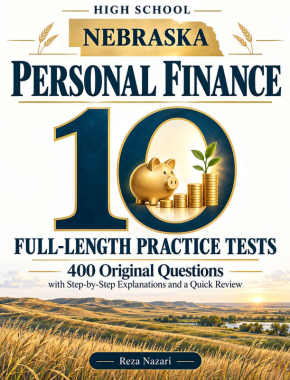
10 Full-Length Nebraska Personal Finance Practice Tests
10 Full-Length Nebraska Personal Finance Practice Tests gives high school learners 10 complete forms and 400 original questions in one instant downloadable PDF. The Nebraska edition pairs topic-tagged answer keys with step-by-step explanations, a Quick Review, Reference Sheet, five-week study plan, and score tracker. Use the first form to see what needs attention, then return to new questions after focused review. The file is ready for screen reading or selected-page printing under the purchase terms.
Read the Record Before You Decide
A balance, payment, or rate is useful only when a student knows what it describes. Nebraska’s ten practice tests make that reading skill central. They ask learners to work from documents and financial situations, choose an answer that fits the facts, and see the reasoning after every question.
10 Full-Length Nebraska Personal Finance Practice Tests contains 400 original multiple-choice questions in ten 40-question forms. Students can use the suggested 60 minutes to practice pacing, or work untimed when a topic is new. Earning, spending, saving, investing, credit, and risk recur across the forms. The range gives a course or independent study plan more than one way to reveal a weakness.
This is an instant downloadable PDF: start with a complete Nebraska form, then use the worked answers to understand each decision before moving to the next one.
A clear view of what is included
10 complete tests
40 original questions per form.
400 original questions
Four answer choices with a worked explanation for each question.
133-page PDF
One downloadable file with the tests and study support together.
60 minutes
Suggested time for each full practice sitting.
What You Get Inside
Full-length practice
Ten fresh forms provide repeated mixed-topic work.
Answers that teach
Topic-tagged keys and step-by-step explanations show the reasoning.
Quick Review
A concise return to important ideas between test sittings.
Planning tools
A Reference Sheet, five-week study plan, and score tracker support focused review.
Companion pages
Clickable and scannable test QR codes lead to the online companion pages.
What students will practice
Account statements and budgets are a useful part of this practice. A student may have to distinguish a listed balance from money available for a decision, or read a fee in the context of an account’s rules. Borrowing and investing questions require a different time horizon. The same habit serves each area: read the condition attached to the figure before deciding what to calculate. The questions change, but that discipline should travel from one form to the next.
The book’s introductory method is straightforward. Read what is being asked, locate the relevant evidence, set up any arithmetic, and check the answer against the situation. Some items share a pay stub, bank record, price information, or budget. A single document can support several questions, each calling for a different line. A basic calculator is allowed, and pacing advice helps students reserve enough time for those denser sets. The student who can point to the controlling line has a stronger answer than one who only remembers an account rule.
A practical study rhythm
Every question has a worked explanation. The answer key tags its topic, so a missed account item can be separated from a misunderstanding of credit or insurance. Students can review an uncertain correct answer as carefully as a wrong one. With ten different tests, they can study one mistake and then meet the same kind of reasoning again without seeing the same prompt or figures.
The five-week study plan gives those attempts a sensible rhythm. A score tracker records topic patterns as well as the overall result. The Quick Review and Reference Sheet offer focused support between forms. Each test begins with a QR code to its companion online page, while the printed form lets students mark the exact line or word that changed their answer.
After a sitting, students can return to a statement question and point to the line that supports their choice. If they cannot find it, the worked answer shows where their reading went astray. Repeating that check on a later form builds a useful habit for account records outside a test, where the line behind the balance matters just as much.
Why Choose the Instant PDF?
Start when you are ready
Download the book after purchase and keep the ten tests in one file.
Choose your working format
Read on a tablet or computer, or print the pages you need for permitted personal or instructional use.
Is This the Right Book for You?
A good fit if
You want mixed-topic high school finance practice, worked answers, and a way to track results across Nebraska forms.
May not be the best fit if
You need a lesson-by-lesson introductory course before attempting full practice tests.
Your digital copy
This purchase delivers the complete 133-page PDF. It includes the practice tests, answer support, Quick Review, Reference Sheet, study plan, and score tracker. The PDF works for screen reading and for printing selected pages. The linked QR codes can be clicked in the digital file.
Frequently Asked Questions
Is this a digital product?
Yes. The purchase is an instant downloadable PDF, not a mailed print book.
Can I print the practice tests?
Yes. You can print selected pages for use within the terms of your purchase.
Can teachers or tutors use it?
Yes, for guided review, tutoring, homeschool study, and classroom discussion within the purchase terms.
Where should a student begin?
Try one complete form. Read the explanations for missed or guessed answers, then use a later form to check what changed.
Ready for the first form?
Nebraska students get repeated practice doing something financial decisions demand: finding the right information before trusting the answer that comes easiest.
Download the PDF and begin with the first full form.
Students also viewed
A companion personal finance course for students who want lessons alongside these practice tests.

You must be logged in to post a review.




There are no reviews yet.