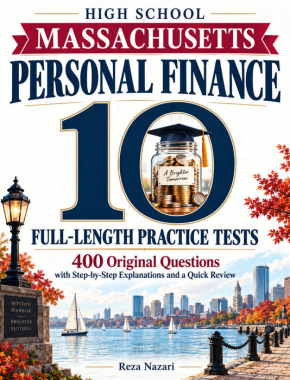
10 Full-Length Massachusetts Personal Finance Practice Tests
10 Full-Length Massachusetts Personal Finance Practice Tests gives high school learners 10 complete forms and 400 original questions in one instant downloadable PDF. The Massachusetts edition pairs topic-tagged answer keys with step-by-step explanations, a Quick Review, Reference Sheet, five-week study plan, and score tracker. Use the first form to see what needs attention, then return to new questions after focused review. The file is ready for screen reading or selected-page printing under the purchase terms.
Know When Interest Helps or Hurts
Interest can work for someone building savings or against someone carrying debt. Massachusetts students practice recognizing which side of that relationship they are on, what time period applies, and how an account or payment rule changes the result. Ten full-length tests make those distinctions familiar across saving, credit, income, and risk.
10 Full-Length Massachusetts Personal Finance Practice Tests contains ten complete 40-question forms, 400 original four-choice questions altogether. Each test suggests 60 minutes. The book covers income and taxes, loans and card debt, banking, renting or buying a home, consumer choices, saving, investing, retirement, and higher-education planning. Students must recognize which question a figure answers before applying it.
This is an instant downloadable PDF: start with a complete Massachusetts form, then use the worked answers to understand each decision before moving to the next one.
A clear view of what is included
10 complete tests
40 original questions per form.
400 original questions
Four answer choices with a worked explanation for each question.
137-page PDF
One downloadable file with the tests and study support together.
60 minutes
Suggested time for each full practice sitting.
What You Get Inside
Full-length practice
Ten fresh forms provide repeated mixed-topic work.
Answers that teach
Topic-tagged keys and step-by-step explanations show the reasoning.
Quick Review
A concise return to important ideas between test sittings.
Planning tools
A Reference Sheet, five-week study plan, and score tracker support focused review.
Companion pages
Clickable and scannable test QR codes lead to the online companion pages.
What students will practice
The direction of interest changes the meaning of the calculation. Massachusetts learners practice asking whose balance is growing, who owes the charge, and which period the rate describes. The answer choices help expose a familiar error: using a valid rate in the wrong role. Seeing that distinction across saving and credit questions builds a more reliable method.
The broader mix places that distinction beside spending, income, and risk. A product with an appealing rate still has conditions, and a low required payment may leave an obligation in place. Students learn to read those terms for their practical effect on a household, not as facts to recognize without applying. Minimum payments add a practical dimension: paying something toward a balance does not mean the cost stops growing. A saver and a borrower may see the same rate language but face very different consequences.
A practical study rhythm
The Massachusetts forms include direct questions and sets built around a shared statement or offer. The opening method asks students to define the task, find the relevant details, choose the setup, and verify the result. A familiar source can lead to a different calculation on the next item, making a fresh reading essential. A basic calculator is allowed during the suggested sitting, while pacing guidance helps learners decide when to mark a hard question and return to it after the shorter ones.
The five-week plan spaces ten Massachusetts forms with review between them. A score tracker shows progress by topic; Quick Review and Reference Sheet pages give a compact way back to the relevant idea. QR codes on each test’s first page open companion online pages. Students who work in print can note who earns or pays interest and for how long, then check that reasoning against the worked answer.
Topic-tagged answer keys separate saving errors from credit ones. Worked explanations show which rate, period, or rule belongs in the calculation and why a tempting result is incomplete. Students can mark a guess or a low-confidence correct answer before scoring, then use the explanation to confirm the method. New conditions on a later form test whether they understand the direction interest is moving and who bears its cost.
Why Choose the Instant PDF?
Start when you are ready
Download the book after purchase and keep the ten tests in one file.
Choose your working format
Read on a tablet or computer, or print the pages you need for permitted personal or instructional use.
Is This the Right Book for You?
A good fit if
You want mixed-topic high school finance practice, worked answers, and a way to track results across Massachusetts forms.
May not be the best fit if
You need a lesson-by-lesson introductory course before attempting full practice tests.
Your digital copy
This purchase delivers the complete 137-page PDF. It includes the practice tests, answer support, Quick Review, Reference Sheet, study plan, and score tracker. The PDF works for screen reading and for printing selected pages. The linked QR codes can be clicked in the digital file.
Frequently Asked Questions
Is this a digital product?
Yes. The purchase is an instant downloadable PDF, not a mailed print book.
Can I print the practice tests?
Yes. You can print selected pages for use within the terms of your purchase.
Can teachers or tutors use it?
Yes, for guided review, tutoring, homeschool study, and classroom discussion within the purchase terms.
Where should a student begin?
Try one complete form. Read the explanations for missed or guessed answers, then use a later form to check what changed.
Ready for the first form?
When a later form changes the account, balance, or time period, Massachusetts learners must decide anew what interest is doing. The worked solutions show the setup, giving students a way to repair the reasoning before the next comparison.
Download the PDF and begin with the first full form.
Students also viewed
A companion personal finance course for students who want lessons alongside these practice tests.

You must be logged in to post a review.




There are no reviews yet.